

Dr. Irene Pepperberg, a renowned cognitive scientist and avian behavior expert, has detailed her successful and evolving strategy for maintaining a strong connection with her African grey parrot, Griffin, during her travels. This approach, centered around the use of video calls, has proven to be an effective, albeit imperfect, method for mitigating the emotional impact of separation on both the researcher and her intelligent avian companion. Initially conceived as a way to bridge the physical gap, these virtual interactions have become an integral part of Pepperberg’s commitment to Griffin’s well-being, particularly as she navigates a reduced but still significant travel schedule.
Pepperberg, who famously worked with the African grey parrot Alex, has continued her groundbreaking research with other parrots, including Griffin and Athena. Her work has consistently highlighted the remarkable cognitive abilities and emotional depth of these birds, underscoring the importance of consistent social interaction and strong bonds. As she approaches her 75th birthday, Pepperberg has consciously scaled back her extensive travel commitments, reducing her monthly trips from an average of three to one. However, even this adjusted schedule necessitates periods of absence from her lab, where Griffin resides and with whom she shares a deep, scientifically cultivated relationship.
The logistical challenges of maintaining these connections are considerable, often dictated by global time differences. Pepperberg describes the relative ease of conducting calls when within the United States, where time zone differentials are typically manageable, allowing for calls before Griffin’s 8 PM bedtime. However, international travel presents significant hurdles. Journeys to locations like Dubai, with an eight-hour time difference, or Japan, a thirteen-hour difference complicated by the international dateline, necessitate precise scheduling. In these instances, Pepperberg has resorted to unconventional solutions, such as utilizing internet "hotspots" from colleagues’ cars, demonstrating a determined commitment to the continuity of her interaction with Griffin.
The Science Behind the Screen: Understanding Parrot Perception
The precise nature of what Griffin perceives during these video calls remains a subject of ongoing scientific inquiry, a testament to Pepperberg’s meticulous research methodology. Parrots possess a visual spectrum that extends into the ultraviolet range, a capability that differs from human vision and the typical optimization of smartphone cameras. While human faces are believed to possess minimal ultraviolet components, unlike the vibrant plumage of parrot feathers, it is plausible that Griffin receives a reasonably accurate visual representation of Pepperberg on screen.
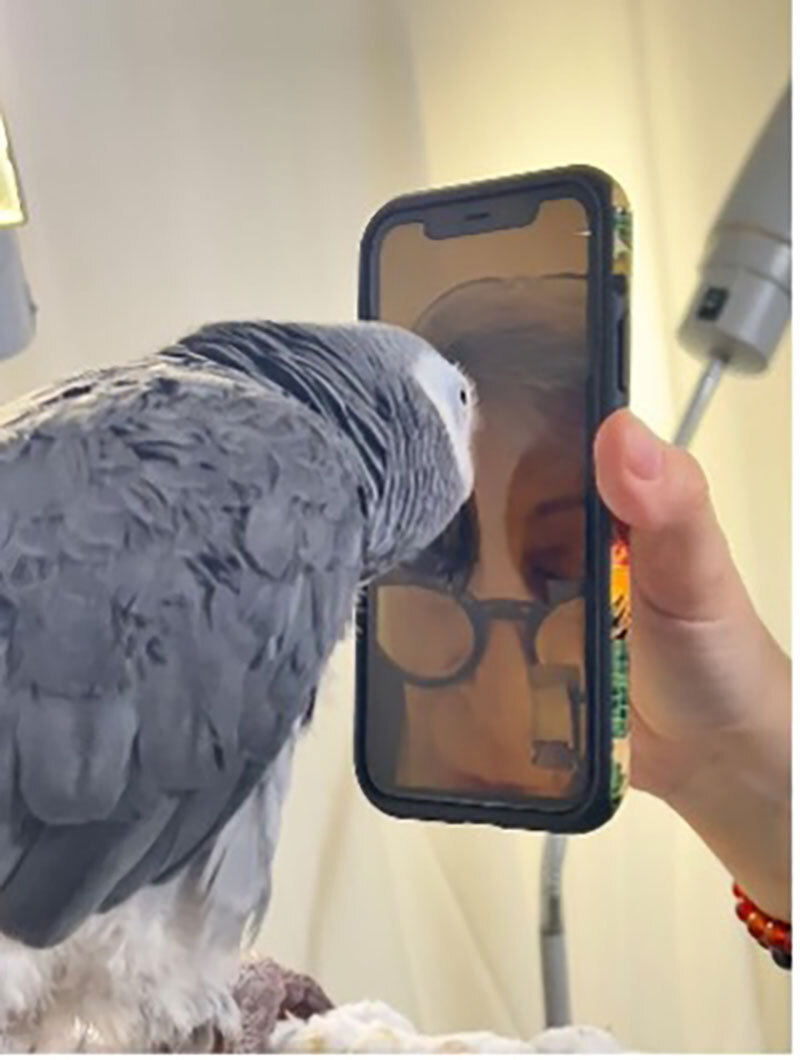
Furthermore, the auditory recognition of Pepperberg’s voice through the device is also an area of investigation. It is possible that Griffin’s positive association with the video calls stems from the fact that Pepperberg is the primary individual who initiates these interactions. This consistent pairing of the visual and auditory stimuli from the phone with Pepperberg’s presence could be the key factor in his positive response. Regardless of the exact perceptual mechanisms at play, the behavioral outcomes are consistently positive. Griffin’s actions, such as bending down to touch the screen to offer what Pepperberg interprets as "kisses," indicate a clear positive engagement with the technology.
Crucially, Griffin has demonstrated an understanding of the limitations of the video call. He has reportedly learned not to request "tickles" from the phone, a behavior that suggests he comprehends that Pepperberg is not physically present and therefore unable to provide such tactile interaction. This cognitive leap, recognizing the difference between a mediated presence and a physical one, is a significant indicator of his understanding of the situation. Pepperberg emphasizes that while the experience is not aversive and appears to be positive for Griffin, it is not a complete substitute for her physical presence.
Quantifying the Impact: The "Cold Wing" Phenomenon and its Mitigation
The effectiveness of video calls in maintaining the human-avian bond is not merely anecdotal; it has tangible implications for Griffin’s behavior upon Pepperberg’s return. In her previous writings, Pepperberg has alluded to the "cold wing" treatment, a phenomenon where the parrot may initially appear aloof or unresponsive to the researcher’s return after a period of absence. This behavior, while understandable from an avian perspective, can be disheartening for the human caregiver.
Pepperberg’s observations suggest that the regular video calls significantly mitigate this effect. Upon her return from trips where she has maintained virtual contact, Griffin is less likely to exhibit the "cold wing" response. If it does occur, its duration is considerably shorter. This suggests that the consistent, albeit mediated, interaction helps to reinforce the bond and reduce the perceived abandonment, thereby facilitating a smoother reintegration upon her physical return.
This observation aligns with broader research on animal behavior and attachment. Consistent positive reinforcement and the maintenance of social contact, even in a modified form, can help to reduce stress and anxiety associated with separation. For highly social animals like African grey parrots, who exhibit complex emotional lives and strong social dependencies, such interventions are critical for their psychological well-being.
The Broader Implications: Technology and Animal Welfare
The success of Dr. Pepperberg’s video call strategy with Griffin has significant implications for how we can leverage technology to enhance animal welfare, particularly for companion animals and those in research settings. As global travel becomes increasingly common, and as human-animal interactions continue to be a vital aspect of our lives, innovative solutions are needed to bridge the physical distances that inevitably arise.
Supporting Data and Context:
- Avian Intelligence: African grey parrots are widely recognized for their exceptional cognitive abilities, including complex problem-solving, understanding of concepts like "same" and "different," and a vocabulary of hundreds of words. This intelligence necessitates sophisticated forms of social interaction to prevent boredom and distress. (Pepperberg, I. M. (2000). The Alex studies: Cognitive and communicative abilities of grey parrots. Harvard University Press.)
- Attachment Theory in Animals: Research in animal behavior demonstrates that companion animals form strong attachment bonds with their human caregivers. Separation from these caregivers can lead to distress, anxiety, and behavioral issues. (Archer, J. (1997). The behavioural biology of dogs. CABI.)
- Technological Advancements: The widespread availability of smartphones and reliable internet connectivity has opened new avenues for remote interaction. Video conferencing platforms have become commonplace, facilitating communication across vast distances.
Chronology of Pepperberg’s Approach:
- Initial Conception: Dr. Pepperberg first contemplated using video calls as a means to stay connected with her parrots during travels.
- Implementation and Observation: She began implementing these calls, observing Griffin’s reactions and the impact on their bond.
- Refinement and Adaptation: Pepperberg adjusted her travel schedule and adapted her calling strategies to accommodate varying time differences and logistical challenges.
- Ongoing Research: The precise perceptual and cognitive mechanisms behind Griffin’s responses remain an area of active interest and potential future research.
Analysis of Implications:
The effectiveness of Dr. Pepperberg’s approach suggests that video calls can serve as a valuable tool for:
- Reducing Separation Anxiety: For pets who experience distress when left alone, regular video check-ins could provide a sense of reassurance and continuity.
- Maintaining Training and Cognitive Stimulation: In a controlled environment, video calls could potentially be used to continue basic training or cognitive enrichment exercises, preventing a decline in mental acuity during absences.
- Enhancing Human-Animal Bond in Remote Settings: For individuals who travel frequently for work or personal reasons, this method offers a way to sustain and strengthen their connection with their animal companions.
- Ethical Considerations in Research: In animal research, where animals may be housed in facilities separate from their primary caretakers, video communication could contribute to improved animal welfare by mitigating the stress of separation.
Potential Challenges and Future Directions:
While promising, the widespread adoption of this strategy faces potential challenges:
- Cost and Accessibility: High-speed internet and suitable devices may not be universally accessible or affordable.
- Animal Temperament: Not all animals may respond positively to video calls; some might find the technology confusing or aversive. Individual animal personality and prior experience will likely play a significant role.
- Ethical Oversight: For research animals, any use of video conferencing would need to be carefully considered within the context of ethical review boards and institutional animal care and use committees.
Dr. Pepperberg’s ongoing work with Griffin underscores the profound capacity for intelligent animals to adapt and engage with new forms of communication. Her dedication to not only understanding but actively nurturing the human-animal bond, even across vast distances, offers a compelling model for future interactions between humans and the animal kingdom, leveraging technology to foster deeper connections and enhance well-being. The "cold wing" phenomenon, once a potential consequence of separation, is now demonstrably softened by the simple act of bridging the digital divide, allowing Griffin to maintain a vital link to his devoted caregiver.
