
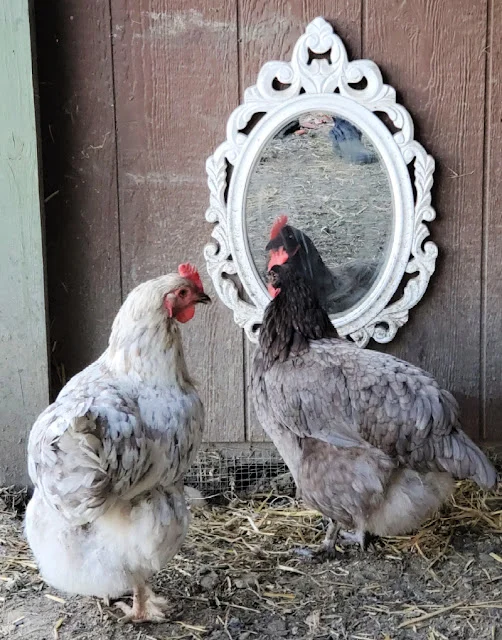
The question of whether non-human animals possess self-awareness—the capacity to recognize oneself as an individual distinct from the environment and others—has long been a cornerstone of ethological research. For decades, the "mirror test," or the mark test, served as the gold standard for assessing this cognitive trait. While primates, elephants, dolphins, and magpies have historically demonstrated success in these trials, recent scientific investigations have shifted the focus toward common poultry, specifically the domestic rooster (Gallus gallus domesticus). Emerging evidence suggests that these birds exhibit a sophisticated level of visual cognition, indicating that they possess the ability to distinguish their own reflections from those of conspecifics, challenging long-held assumptions regarding avian intelligence.

The Evolution of the Mirror Test
The mirror test was originally developed by psychologist Gordon Gallup Jr. in 1970. The methodology involves placing a mark on an animal’s body in a location that is only visible to the subject through a reflection. If the subject investigates or touches the mark on its own body while observing the mirror, it is inferred that the animal understands the reflection is a representation of itself.
For decades, this test was criticized for being biased toward animals with high manual dexterity or specific visual-spatial abilities. Because many animals—such as dogs, who rely primarily on olfaction, or birds, who may interpret a reflection as a territorial rival—failed the test, researchers began to refine their methodology to better suit the behavioral ecology of the species being studied. In the case of the domestic rooster, researchers moved away from the "mark test" and toward a paradigm based on alarm-calling behavior.

Behavioral Analysis: The Alarm-Call Paradigm
Roosters are known for their vigilant behavior. When a predator, such as a hawk, is spotted, a rooster will issue an alarm call to alert the rest of the flock. This is a high-cost, high-benefit social behavior designed to protect group members. Crucially, studies have shown that roosters are strategic; they do not sound the alarm when they are alone, as doing so would provide no benefit to their peers and would potentially reveal their own location to the predator.
In a 2023 study published in the journal PLOS ONE, researchers conducted experiments to determine if roosters would alert their flock when seeing a hawk silhouette, even if their only "flock-mate" was a reflection in a mirror. The findings were significant: when a rooster saw a predator while in the presence of another live bird, he sounded the alarm. However, when the same rooster saw a predator while in the presence of a mirror, he remained silent. This suggests that the bird recognized the reflection as himself and realized that there was no other individual present to warn.

Chronology of Cognitive Research in Poultry
The investigation into chicken cognition has accelerated over the past decade. Previously, chickens were often categorized as having limited cognitive abilities, a bias largely driven by their status as agricultural livestock. However, the timeline of recent findings paints a different picture:
- 2013-2015: Initial observations in behavioral ecology highlighted that chickens possess "Machiavellian" intelligence, including the ability to deceive others and engage in complex social hierarchies.
- 2017: Peer-reviewed studies confirmed that chickens can distinguish between familiar and unfamiliar flock members using visual cues, confirming that their primary mode of social identification is sight rather than sound or smell.
- 2023: The landmark study on mirror-based alarm calls provided the most compelling evidence to date that chickens possess a form of self-referential recognition. By demonstrating that roosters do not waste energy on useless alarm calls, researchers established that the birds possess the cognitive load necessary to differentiate "self" from "other."
Supporting Data and Scientific Implications
The implications of these findings extend beyond simple curiosity. If chickens possess self-awareness, it necessitates a reevaluation of how these animals are housed, managed, and treated in industrial and domestic settings.

Data from the 2023 study indicated that the silence of the roosters in front of the mirror was consistent across repeated trials. When researchers introduced a second, hidden rooster behind the mirror, the test subjects remained silent, confirming that the birds were not simply confused by the environment but were making a conscious decision based on the lack of a genuine, living peer.
Furthermore, ethologists note that chickens have a high degree of social sensitivity. They utilize at least 24 distinct vocalizations to communicate specific threats or food sources. The fact that this communication network is mediated by complex visual processing—such as identifying reflections—suggests that the avian brain is far more streamlined for social intelligence than previously credited.

The Role of Enrichment in Avian Welfare
For backyard chicken keepers, the question of self-recognition adds a layer of complexity to the concept of "enrichment." For years, owners have utilized mirrors, xylophones, and perches to mitigate boredom in coops. While some anecdotal reports from social media suggest that certain birds may act aggressively toward reflections, most experts attribute this to a misunderstanding of the bird’s social maturity or the bird’s initial inability to process the mirror’s presence.
When introduced correctly, mirrors function as a "boredom buster." The scientific consensus indicates that providing such stimuli does not necessarily cause distress but rather engages the bird’s innate curiosity. If the bird recognizes the reflection as itself, the interaction moves from an aggressive territorial encounter to a passive observation, which can serve as a mental exercise for the bird in a confined environment.

Expert Perspectives and Theoretical Debates
The scientific community remains divided on the extent to which these findings imply "consciousness." While some researchers argue that the mirror test proves a rudimentary form of self-concept, others caution against anthropomorphism.
"We are seeing a convergence of data that suggests birds possess a level of meta-cognition," notes one independent ethologist. "However, it is important to distinguish between the ‘social self’—the ability to identify oneself in a social hierarchy—and the ‘philosophical self.’ The rooster knows he is not the other bird, but we cannot yet confirm if he understands the abstract concept of ‘I’ in the human sense."

Despite the academic debate, the practical takeaway for poultry science is clear: the domestic chicken is an intelligent, observant, and socially aware animal. Their ability to process visual information and adjust their behavior based on the perceived presence of others is a hallmark of higher-order cognition.
Broader Impact on Agricultural Practices
The recognition of self-awareness in poultry has direct consequences for animal welfare standards. As the agricultural industry shifts toward more humane practices, the acknowledgment that birds are individuals capable of distinguishing themselves from their peers supports the push for larger, more stimulating environments.

When animals are treated as sentient beings capable of cognitive recognition, the justification for restrictive cages or barren environments becomes increasingly difficult to sustain. The ability to recognize a reflection is not merely a parlor trick; it is a signal that the animal’s environment is being processed at a cognitive level. As research continues to advance, it is highly probable that the standards for poultry husbandry will evolve to better accommodate the psychological needs of these complex birds.
In conclusion, while the debate regarding the exact nature of avian self-awareness will likely continue, the evidence provided by mirror-based alarm-call experiments offers a compelling argument for the sophistication of the chicken’s mind. By understanding that these birds are capable of distinguishing themselves from others, we gain a deeper appreciation for their behavior and a stronger imperative to ensure their well-being in all settings.
