
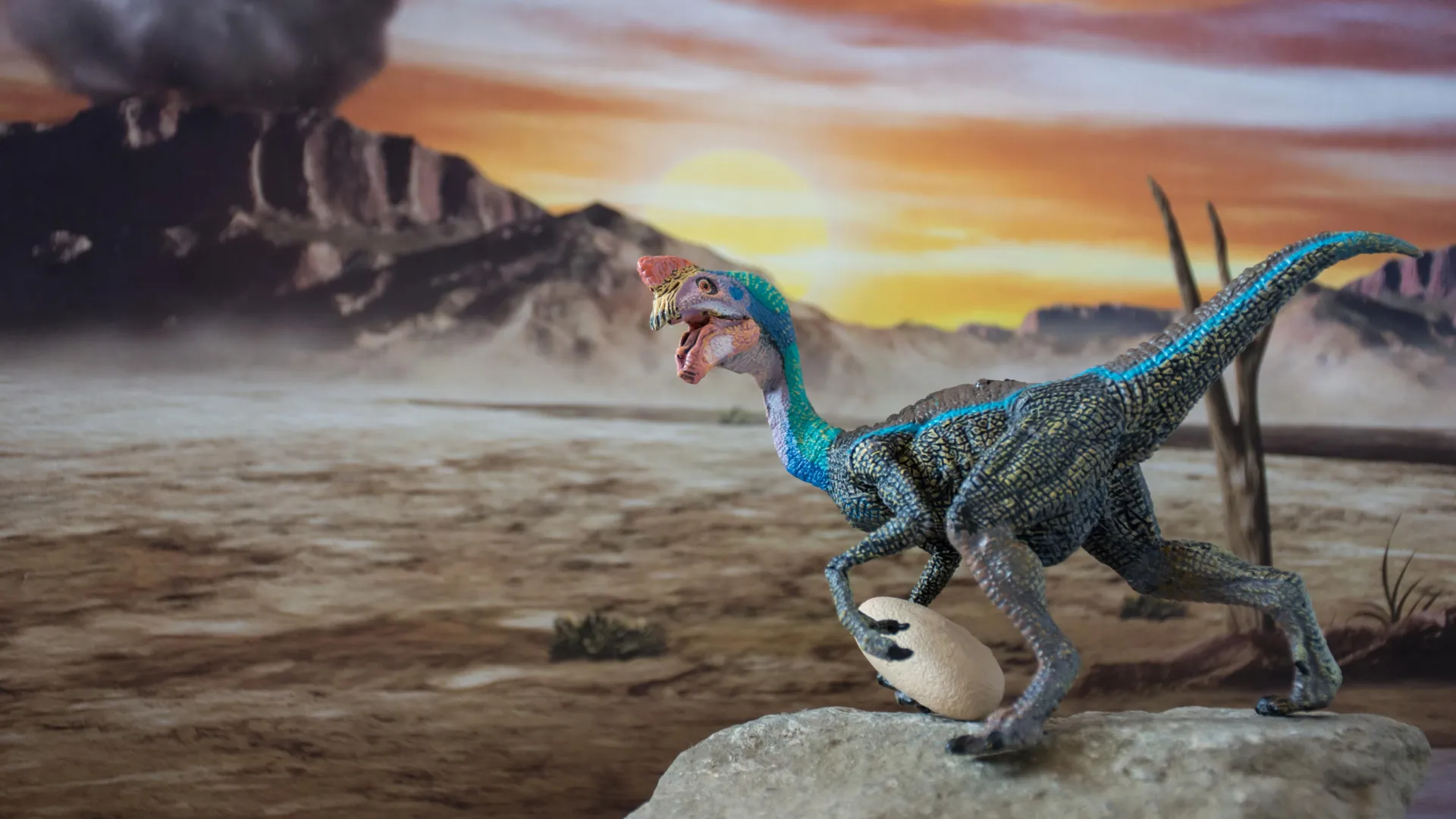
The evolutionary bridge between non-avian dinosaurs and modern birds has long presented paleontologists with profound mysteries, particularly regarding reproductive behaviors. Among the most enigmatic groups are the oviraptors—feathered, bipedal, and flightless theropods that roamed the earth during the Cretaceous period. For decades, scientists have debated the exact brooding mechanics of these creatures: Did they rely exclusively on external environmental sources like contemporary crocodilians, or did they warm their eggs directly through bodily contact akin to modern avian species?
A groundbreaking study published in the journal Frontiers in Ecology and Evolution offers definitive new insights into this ancient dilemma. By integrating advanced computer-aided heat transfer simulations with empirical physical experiments, an international research team has reconstructed the nesting and incubation dynamics of Heyuannia huangi, a representative oviraptor species. The findings demonstrate that oviraptors employed a hybrid strategy of co-incubation, utilizing both their bodily presence and ambient environmental heat, revealing a fascinating evolutionary stepping stone between reptiles and modern birds.
Reconstructing the Cretaceous Nursery: Methodology and Materiality
To evaluate how heat dispersed through a prehistoric clutch, the research team—led by senior author Dr. Tzu-Ruei Yang, associate curator of vertebrate paleontology at Taiwan’s National Museum of Natural Science, and high school researcher Chun-Yu Su—undertook a meticulous reconstruction of an oviraptor nest. The physical model was patterned after Heyuannia huangi, which inhabited what is now modern-day China approximately 70 to 66 million years ago during the Late Cretaceous epoch.
Heyuannia huangi was a medium-sized theropod, measuring roughly 1.5 meters in length and weighing approximately 20 kilograms. Fossil evidence indicates that these dinosaurs constructed distinctive semi-open nests, arranging their elongated, uniquely shaped eggs in complex, multi-layered ring patterns rather than burying them entirely beneath sediment or soil.
Replicating this prehistoric architecture required a high degree of ingenuity. The researchers constructed a life-sized physical model of the adult dinosaur using a supportive wooden frame combined with polystyrene foam to mimic skeletal proportions. Cotton, bubble paper, and specialized fabrics were layered over the structure to simulate soft tissues and feather coverage. Because oviraptor eggs differ morphologically from those of any extant animal, the team cast artificial eggs out of specialized resin to approximate the thermal conductivity and physical dimensions of the fossilized specimens. Two complete clutches were then arranged in dual-ring formations that faithfully mirrored the spatial geometry preserved in the fossil record.
Thermal Dynamics and the Mechanics of Asynchronous Hatching
The experimental phase of the study exposed the life-sized model and resin clutches to varying simulated environmental conditions. By monitoring thermal fluctuations across the inner and outer egg rings, the researchers mapped how heat distributed through the nest both in the presence and absence of the brooding adult.
The results highlighted a stark contrast between thermal stability in warm versus cold environments. Under colder ambient conditions, the presence of the brooding adult resulted in substantial temperature variances across the nest. Specifically, the outer ring of eggs experienced temperature deviations of up to 6 degrees Celsius compared to the inner ring. In biological terms, such pronounced thermal discrepancies would inevitably trigger asynchronous hatching—a phenomenon where eggs within the same clutch hatch at staggered intervals over several days or weeks.
Conversely, when the researchers simulated warmer ambient climates, the temperature variance across the clutch dropped dramatically to approximately 0.6 degrees Celsius. This data strongly implies that in warmer prehistoric latitudes, solar radiation played an indispensable role in moderating nest temperatures, smoothing out thermal gradients, and regulating embryonic development rates.
According to Dr. Yang, the physical architecture of the nests made direct, continuous contact with every single egg an impossibility. Because oviraptor clutches were open to the air and arranged in expansive horizontal rings, direct solar heat and soil warmth were likely critical complementary factors, positioning the adults more as environmental regulators than sealed heat sources.
Comparing Oviraptor Incubation Efficiency with Modern Avian Species
A primary objective of the study was to quantitatively compare the thermal efficiency of oviraptor brooding against modern avian incubation. Contemporary birds rely heavily on a mechanism known as thermoregulatory contact incubation (TCI). For TCI to function effectively, an adult bird must make direct, unbroken physical contact with all eggs simultaneously, acting as the primary and uniform heat source for the entire clutch while maintaining strict thermal consistency.
The experimental data revealed that oviraptors were structurally incapable of executing true TCI. The ring-shaped geometry of their nests and the sheer size of the clutch relative to the adult’s body precluded simultaneous, uniform contact with every egg. Consequently, the researchers concluded that oviraptors functioned as co-incubators, sharing the thermal burden with the surrounding environment.
The quantitative efficiency of this co-incubation strategy was found to be significantly lower than that of modern birds. First author Chun-Yu Su noted that while the oviraptor method was less thermally efficient, it was exceptionally well-suited to their transitional nesting style. During the Cretaceous period, dinosaur reproductive strategies were actively shifting away from fully buried, reptilian-style clutches toward the open, exposed nests characteristic of modern avian lineages.
Rather than framing this difference as an evolutionary deficiency, Dr. Yang emphasized that biological traits must be evaluated within their ecological context. Modern birds are not inherently superior at hatching eggs; rather, both modern birds and ancient oviraptors developed specialized brooding strategies tailored to the specific environmental pressures and physiological constraints of their respective eras.
Broader Implications for Paleontological Research and Evolutionary Science
While the study provides unprecedented clarity regarding oviraptor reproductive behavior, the research team acknowledges certain inherent limitations. The physical experiments were conducted under modern atmospheric conditions and relied on reconstructed models, both of which introduce minor variables when extrapolating to the ecosystems of the Late Cretaceous. Furthermore, the data suggests that oviraptors likely endured significantly longer incubation periods than their modern avian descendants.
Despite these methodological caveats, the integration of physical modeling with computational heat-transfer simulations establishes a robust new framework for studying dinosaur reproduction and parental care. By moving beyond purely descriptive paleontology into experimental physics, researchers can now reconstruct soft-tissue behaviors that leave no direct fossil trace.
Beyond its academic contributions, the study holds notable symbolic value within the global scientific community. The research was spearheaded by scientists and students based in Taiwan, a region entirely devoid of dinosaur fossil deposits. Dr. Yang highlighted this achievement as a powerful encouragement for students worldwide, proving that geographic absence of local fossils is no barrier to conducting world-class vertebrate paleontology through the power of interdisciplinary collaboration, engineering, and digital simulation. As science continues to blur the lines between extinct reptiles and living birds, studies of this caliber ensure that the silent nurseries of the Cretaceous will continue to yield their deepest secrets.
