
For generations, the foundational dogma of paleontology rested on a seemingly immutable chemical certainty: fossilization is an aggressive, destructive process. Traditional scientific consensus dictated that over the span of millions of years, fragile organic molecules—such as proteins, DNA, and soft tissues—inevitably degrade, decay, and vanish entirely. Under this long-standing view, any biological material recovered from dinosaur bones or teeth was routinely dismissed by mainstream researchers as modern contamination, introduced either by microscopic organisms, groundwaters, or human handling long after the animal perished. Consequently, soft-tissue analysis was largely restricted to relatively recent specimens, such as Ice Age mammoths preserved in permafrost or Pleistocene megafauna.
That paradigm has now been decisively challenged. A breakthrough study spearheaded by an international, multidisciplinary team of researchers from the University of Liverpool has provided rigorous, chemically robust evidence that original organic molecules can indeed survive within Mesozoic-era fossils. By deploying state-of-the-art analytical techniques on an exceptionally well-preserved duck-billed dinosaur specimen, the research team successfully detected authentic remnants of collagen locked deep within prehistoric bone. Published in the peer-reviewed journal Analytical Chemistry, this landmark discovery injects definitive empirical data into a contentious scientific debate that has simmered for approximately thirty years, fundamentally altering how the scientific community views the limits of molecular preservation.
The Specimen: An Exceptional Edmontosaurus Sacrum
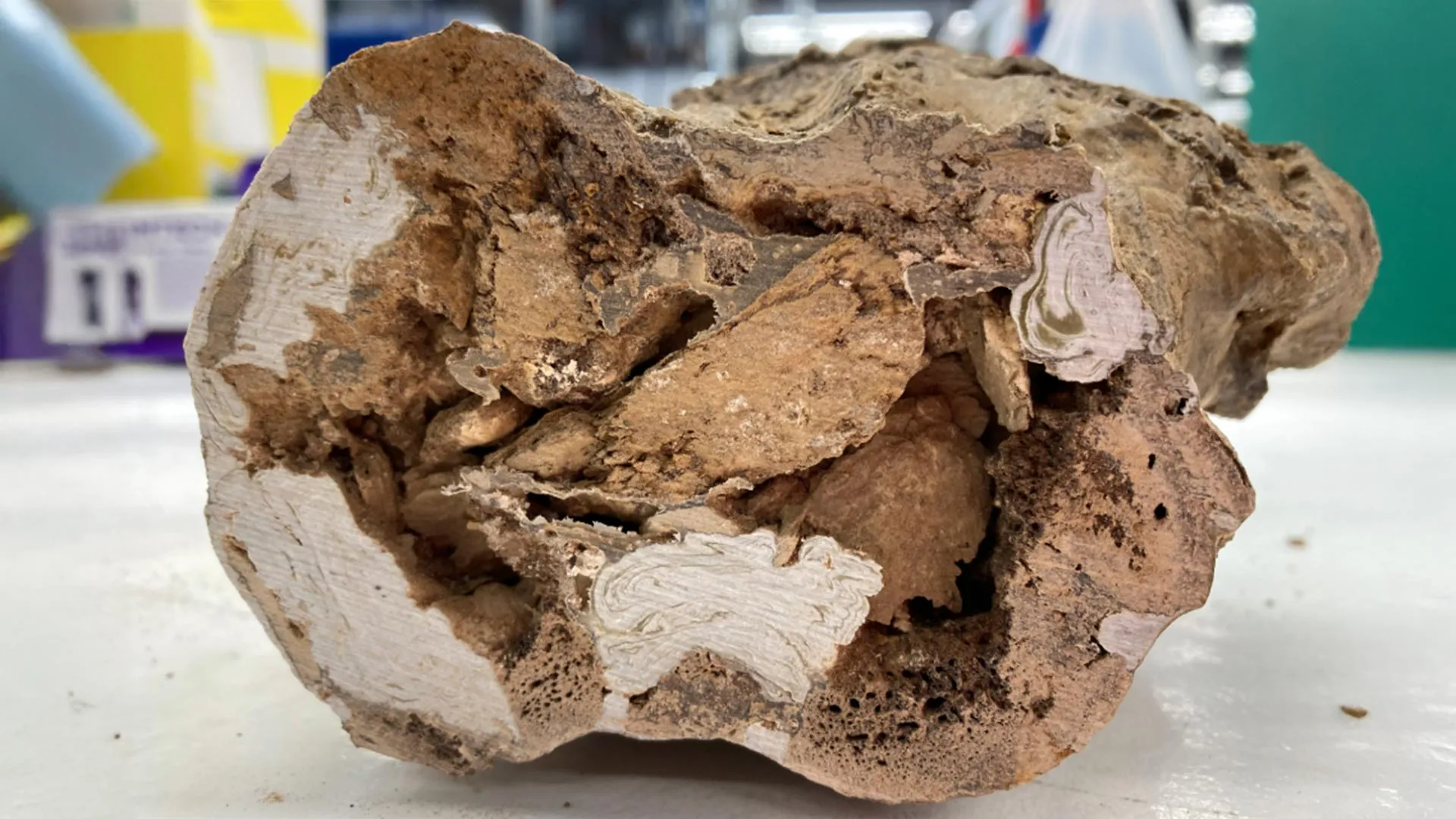
At the center of this pivotal research is a remarkably preserved 22-kilogram sacrum—a complex structure of fused vertebrae linked to the pelvis, forming the lower portion of the spine—belonging to an Edmontosaurus, a prominent genus of large, herbivorous duck-billed dinosaurs that roamed North America during the Late Cretaceous period. The fossilized remains were originally excavated from the richly fossiliferous Upper Cretaceous rock layers of the Hell Creek Formation in South Dakota, a geological repository renowned for yielding some of the world’s most complete dinosaur specimens from the final chapters of the Mesozoic era, just before the catastrophic asteroid impact that triggered the Cretaceous-Paleogene extinction event roughly 66 million years ago.
Following its extraction, the 75-million-year-old specimen was incorporated into the University of Liverpool’s permanent collections. Its unusually pristine state of preservation immediately set it apart from typical bone fragments. While most fossils undergo complete permineralization—where groundwater minerals entirely replace the original biological matrix—this particular sacrum retained structural nuances that caught the attention of researchers. Recognizing a rare opportunity, the Liverpool team decided to subject the ancient bone to an array of high-precision molecular testing methods that were largely unavailable to earlier generations of paleontologists.
Advanced Analytical Methods and Collaborative Breakthroughs
To rigorously test the hypothesis that endogenous organic molecules could survive deep within the mineralized matrix of a Cretaceous fossil, the University of Liverpool teamed up with elite research institutions, including the University of California, Los Angeles (UCLA) and internal departments such as the university’s Materials Innovation Factory and the Centre for Proteome Research.
The investigative workflow relied on a combination of advanced protein sequencing, mass spectrometry, and tandem mass spectrometry. Mass spectrometry operates by ionizing chemical compounds to generate charged molecules or molecule fragments, subsequently measuring their mass-to-charge ratios. This allowed the research collective to isolate and scan the bone matrix for specific molecular signatures characteristic of collagen, the foundational structural protein that accounts for the vast majority of organic content in vertebrate bone.
Crucially, researchers at UCLA utilized tandem mass spectrometry to detect and accurately quantify hydroxyproline for the first time in such an ancient sample. Hydroxyproline is a non-proteinogenic amino acid that plays a critical role in stabilizing the triple-helix structure of collagen. Because hydroxyproline is overwhelmingly specific to collagen within vertebrate bone tissue, its definitive detection served as an unmistakable chemical smoking gun.
Complementing these findings, the Centre for Proteome Research at Liverpool successfully identified specific fragments of collagen alpha-1, the primary structural protein form found natively in bone tissue. Meanwhile, specialists within the university’s Materials Innovation Factory performed supplementary materials-science analyses to cross-verify the structural integrity and chemical composition of the extracted residues. By employing multiple, independent analytical pathways, the research team effectively insulated their conclusions against the standard criticisms of experimental artifact or analytical error.
Confronting the Contamination Debate
For three decades, the primary hurdle facing researchers claiming to find soft tissue or proteins in dinosaur fossils has been the contamination critique. Skeptics have systematically argued that any organic material isolated from ancient bones must necessarily be modern in origin. Potential culprits cited in these critiques include bacterial biofilms, fungal hyphae, humic acids from surrounding soils, or careless handling by field paleontologists and laboratory technicians.
The new findings from the University of Liverpool directly confront and dismantle this longstanding objection. By isolating specific structural protein fragments—such as collagen alpha-1—and confirming the presence of altered yet authentic amino acid profiles deep within the impervious mineral matrix of the bone, the study demonstrates that the detected biomolecules are intrinsically bound to the fossil itself rather than superficial interlopers.
Professor Steve Taylor, chair of the Mass Spectrometry Research Group at the University of Liverpool’s Department of Electrical Engineering & Electronics, emphasized the absolute certainty of the team’s conclusions. "This research shows beyond doubt that organic biomolecules, such as proteins like collagen, appear to be present in some fossils," Professor Taylor stated. "Our results have far-reaching implications. Firstly, it refutes the hypothesis that any organics found in fossils must result from contamination."
Unlocking a Century of Archived Microscopy
Beyond resolving the immediate contamination dispute, the Liverpool-led study offers a pragmatic roadmap for future paleontological research. For nearly one hundred years, geologists and paleontologists have captured cross-polarized light microscopy images of fossilized bone thin sections to study crystal structures and mineralization patterns. Historically, these images were analyzed purely for structural and geological data.
However, the new research suggests that these century-old photographic archives and existing museum collections may be a goldmine for future molecular studies. According to Professor Taylor, cross-polarized light microscopy images often reveal distinct, intact patches of preserved bone collagen. Recognizing these optical signatures could allow researchers to pre-screen fossil candidates efficiently, identifying promising specimens without needing to perform destructive testing on every bone in a museum archive. This could instantly unlock a massive, ready-made trove of fossil candidates ripe for high-resolution protein analysis.
If successfully scaled, this methodological shift could enable scientists to investigate complex biological relationships and evolutionary lineages among extinct dinosaur species that traditional morphological anatomy—relying solely on skeletal shapes and bone dimensions—simply cannot resolve. Proteins evolve over time through predictable genetic mutations, meaning that recovering even fragmented amino acid sequences from diverse dinosaur taxa could eventually allow researchers to construct molecular phylogenies, placing dinosaurs on a biochemical family tree alongside their modern avian descendants.
The Ongoing Mystery of Prehistoric Preservation
Despite the profound implications of the discovery, the study also highlights a significant biological and chemical enigma: how delicate proteins manage to endure across geological timescales spanning tens of millions of years.
In standard biological environments, proteins begin to break down almost immediately after death through enzymatic hydrolysis, microbial decay, and thermal degradation. Under normal conditions, the half-life of a protein peptide bond is far too short to permit survival over a 75-million-year window, even under optimal, stable subterranean burial conditions. The discovery of surviving collagen fragments forces theoretical biochemists and geochemists to re-evaluate the kinetics of fossil preservation.
Researchers hypothesize that unique geochemical microenvironments within certain fossil bones—potentially involving complex interactions between iron oxides, mineral surfaces, and organic polymers—may create a natural cross-linking or "tanning" effect that shields protein molecules from water and microbial attack. Unlocking the exact mechanisms behind this ultra-long-term preservation remains one of the most intriguing open questions in modern science, bridging the gap between paleontology, structural biology, and advanced materials science.
A New Frontier in Extinct Animal Research
The successful verification of original collagen within a Cretaceous Edmontosaurus fossil marks a watershed moment for the scientific community. By bridging the chasm between macro-paleontology and molecular biology, this research establishes that the boundary separating the fossil record from the molecular world is far more porous than previously imagined.
As analytical technologies continue to advance in sensitivity and precision, the methodologies pioneered by the University of Liverpool and their collaborators will likely be applied to a broader array of prehistoric specimens. This progress promises to open unprecedented windows into the deep past, granting scientists access to biological and biochemical data that generations of researchers assumed had been permanently erased by the relentless march of deep time.
