
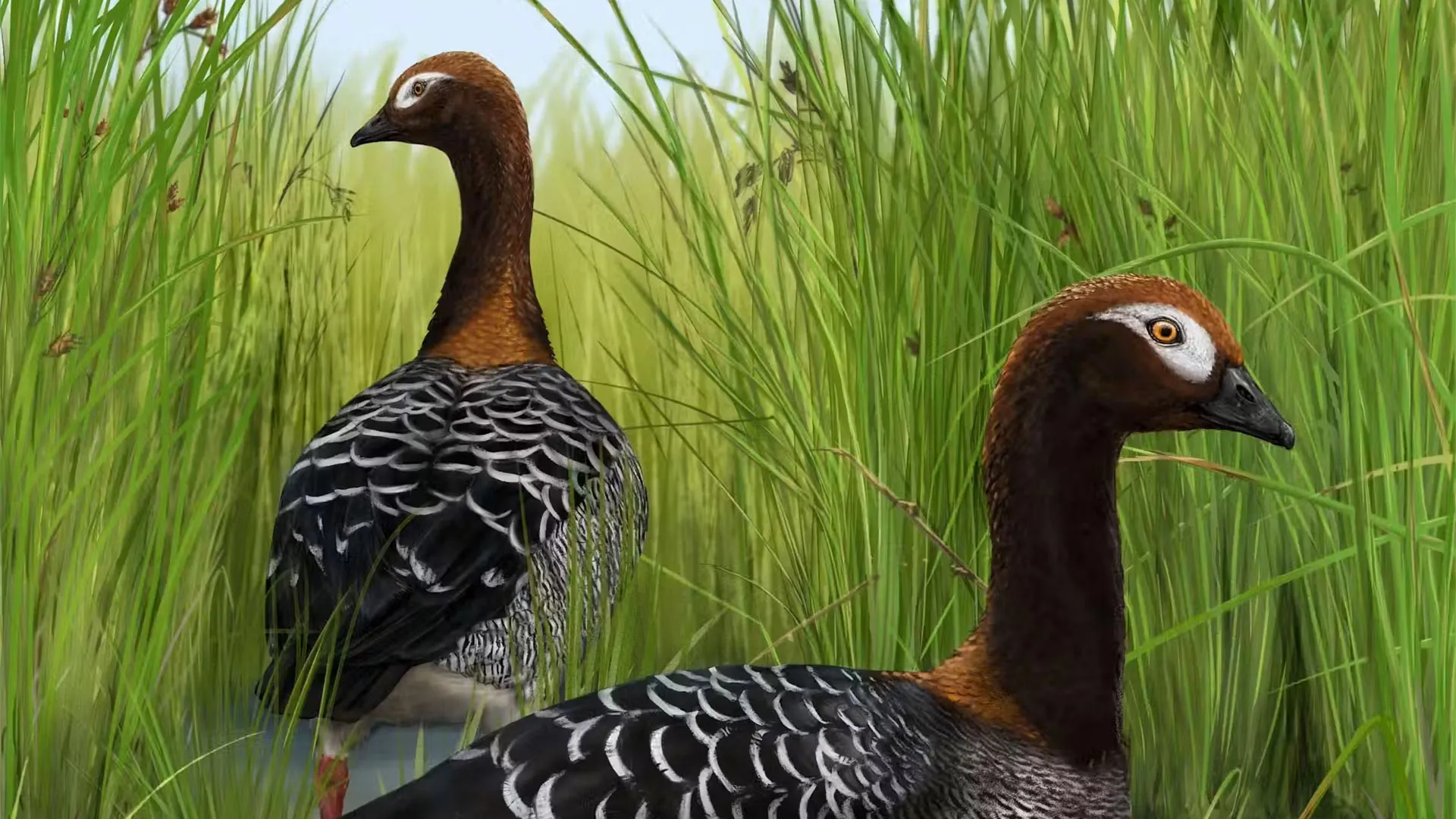
Paleontologists and evolutionary biologists have unveiled a groundbreaking discovery from the ancient lakebeds of Central Otago, fundamentally altering our understanding of how New Zealand’s extraordinary and isolated bird life evolved over millions of years. A newly identified species of prehistoric goose, unearthed from the world-renowned St Bathans fossil deposits, provides compelling new evidence that the ancestral origins of Aotearoa’s fauna are far more dynamic, wave-driven, and complex than traditional paradigms suggested.
The international research team behind the study—comprising experts from the University of Otago (Ōtākou Whakaihu Waka), the Museum of New Zealand Te Papa Tongarewa, and the University of Cambridge in the United Kingdom—published their findings in the academic journal Historical Biology. By meticulously re-examining fragmented fossil bones long tucked away in museum archives and comparing them with an extensive global library of modern and extinct avian skeletons, the researchers successfully isolated an entirely new, undescribed waterfowl species.
This scientific milestone not only enriches the growing fossil record of Miocene-era Zealandia but also resolves a long-standing academic debate regarding the arrival timeline and evolutionary trajectory of New Zealand’s unique megafauna.
The St Bathans Deposits: A Window into Miocene Zealandia
To understand the magnitude of this discovery, one must look back nearly two decades to the initial excavations of the St Bathans Fossil Fauna in Central Otago. These deposits represent the remnants of an expansive ancient lake—Lake Manuherikia—that existed during the early Miocene epoch, roughly 16 to 19 million years ago. During this period, much of Zealandia, the submerged continent that includes modern-day New Zealand, was tectonically active, shifting, and heavily forested, providing a vastly different ecosystem than the landscapes seen today.
The St Bathans site is internationally famous among paleontologists for preserving a delicate and fragile snapshot of early New Zealand life. Because the conditions of the ancient lake were exceptionally favorable for fossilization, scientists have recovered thousands of bones representing terrestrial and freshwater organisms, including land mammals, crocodiles, bats, fish, and an astonishing diversity of birds.
Waterfowl fossils are frequently recovered from these ancient muds, yet complete or identifiable goose remains have historically remained scarce. This scarcity prompted the collaborative research team to launch a comprehensive, systematic review of every fossil bone previously categorized simply as goose or duck-like within the St Bathans collection.
Unmasking Meterchen luti: The Mother Goose of the Mud
Led by Associate Professor Nic Rawlence, Director of the Otago Palaeogenetics Laboratory, and lead author Alan Tennyson of the Museum of New Zealand Te Papa Tongarewa, the team embarked on a painstaking comparative anatomical analysis. They cross-referenced the St Bathans fossil fragments against expansive skeletal databases spanning extinct and extant avian families worldwide.
The rigorous screening process bore fruit when researchers realized that a subset of the bones belonged to an entirely unique, previously unknown taxon. The newly described bird has been formally named Meterchen luti.
The etymology of the species name pays a clever homage to both its physical origins and cultural folklore. Meterchen translates from ancient Greek as "little mother goose," a direct nod to the classic nursery rhyme character Old Mother Goose, while the specific epithet luti is derived from the Latin word for "of the mud," capturing the literal mucky grave from which the fossilized bones were recovered.
Standing roughly the size of a modern small goose, Meterchen luti provides a vital missing piece in the puzzle of early Australasian waterfowl distribution. However, what makes the discovery truly fascinating to evolutionary biologists is what the bird is not related to.
For years, a prevailing hypothesis suggested that waterfowl found in the St Bathans deposits represented the direct, uninterrupted ancestors of New Zealand’s later, iconic giant flightless geese, scientifically classified under the genus Cnemiornis. These later megafaunal birds stood an impressive one meter tall, weighed up to 18 kilograms, and held the title of the largest geese in the world before their extinction following human arrival.
However, the anatomical and genetic analysis conducted in the new study completely dismantles the direct-ancestry hypothesis.
"The St Bathans goose is not closely related to the recently extinct giant flightless New Zealand geese (Cnemiornis species) or their Australian cousin, the Cape Barren goose," Rawlence explained.
Resolving the Timeline: Waves of Migration Versus Ancient Residency
The identification of Meterchen luti brings into sharp focus a broader scientific debate regarding how and when birds populated Zealandia. For decades, a school of thought argued that much of New Zealand’s endemic fauna had resided on the landmass continuously since it broke away from the ancient supercontinent of Gondwana around 80 million years ago. Proponents of this "vicariance" or long-term isolation theory argued that the St Bathans goose lineage had maintained a continuous 14-million-year presence on the islands, directly giving rise to the giant Cnemiornis geese of later epochs.
This theory, however, has increasingly clashed with modern paleogenomics. DNA sequencing and molecular clock estimates have revealed a vastly different narrative—one of episodic, over-water dispersal, where various avian lineages arrived in New Zealand in distinct, successive waves over millions of years, often long after the continent’s initial separation.
According to genetic data, the true ancestors of the giant flightless Cnemiornis geese did not evolve from the ancient St Bathans lineage. Instead, their genetic lineage indicates they migrated across the Tasman Sea from Australia a mere seven million years ago—millions of years after Meterchen luti and its contemporaries inhabited Lake Manuherikia.
Lead author Alan Tennyson emphasized that the new research provides the definitive empirical backing needed to settle this academic friction.
"An earlier theory argued that the St Bathans goose represented the direct ancestors of giant flightless Cnemiornis geese, implying this lineage had a very long history of at least 14 million years in Zealandia," Tennyson noted. "However, this conflicts with genetic evidence suggesting the ancestors of Cnemiornis arrived from Australia only about seven million years ago, which proponents of the earlier theory discarded. Our rigorous reassessment supports the later arrival theory."
Consequently, scientists now understand that Meterchen luti represents an ancient, distinct lineage of waterfowl that successfully colonized Zealandia more than 14 million years ago, only to eventually go extinct without leaving modern descendants. Meanwhile, the ecological niche they once occupied was later refilled by subsequent waves of arrivals from Australia, which rapidly adapted to the island environment.
The Modern Synthesis: DNA, Fossils, and Island Evolution
The publication of this study underscores a revolutionary shift in how modern paleontologists approach evolutionary history. By combining classical morphological analysis of fossil bones with cutting-edge ancient DNA extraction and molecular clock modeling, researchers can peel back layers of geological and climatic history with unprecedented precision.
"Using all the tools in the toolbox, including DNA and fossils, we can reconstruct how the dynamic geological, climatic, and human history of Zealandia has shaped the evolution of Aotearoa fauna in ever more detail," said Rawlence.
This multidisciplinary approach highlights just how fluid and dynamic ecosystem development has been in New Zealand. The narrative is no longer viewed as a static story of ancient isolation, but rather as a continuous, revolving door of colonization, adaptation, and extinction.
Researchers point to the subsequent evolution of the Cnemiornis giant geese as a textbook illustration of island rule—a biological phenomenon where isolated island species undergo rapid morphological shifts, often resulting in dramatic increases or decreases in body size over relatively short evolutionary timeframes. Within a few million years of arriving from Australia, these ancestral geese ballooned into towering, flightless titans, demonstrating the astonishing evolutionary plasticity of avian species responding to predator-free island ecosystems.
Broader Implications for Conservation and Biodiversity
While the discovery of Meterchen luti is fundamentally a contribution to foundational science and evolutionary theory, it carries vital contextual importance for modern conservation efforts in New Zealand.
Understanding the true timeline of avian arrival and extinction helps conservation biologists establish baseline metrics for indigenous biodiversity. As New Zealand continues its ambitious national initiatives to eradicate introduced mammalian predators and restore native ecosystems, recognizing that the country’s fauna has historically been shaped by waves of natural colonization provides crucial perspective on ecological resilience and adaptation.
Furthermore, the study showcases the international collaborative strength of New Zealand scientific institutions. By pooling the analytical capabilities of the University of Otago, the national heritage resources of Te Papa, and the computational and historical expertise of Cambridge University, researchers are unlocking secrets buried in the southern hemisphere’s fossil record that resonate globally.
As excavations continue across Central Otago and new analytical techniques push the boundaries of what ancient proteins and fragmented DNA can reveal, paleontologists anticipate that Meterchen luti will not be the last hidden species to emerge from the ancient mud of Lake Manuherikia. Each discovery moves science closer to a complete, unvarnished portrait of how life on Earth adapts, thrives, and ultimately transforms in the face of deep-time environmental change.
