
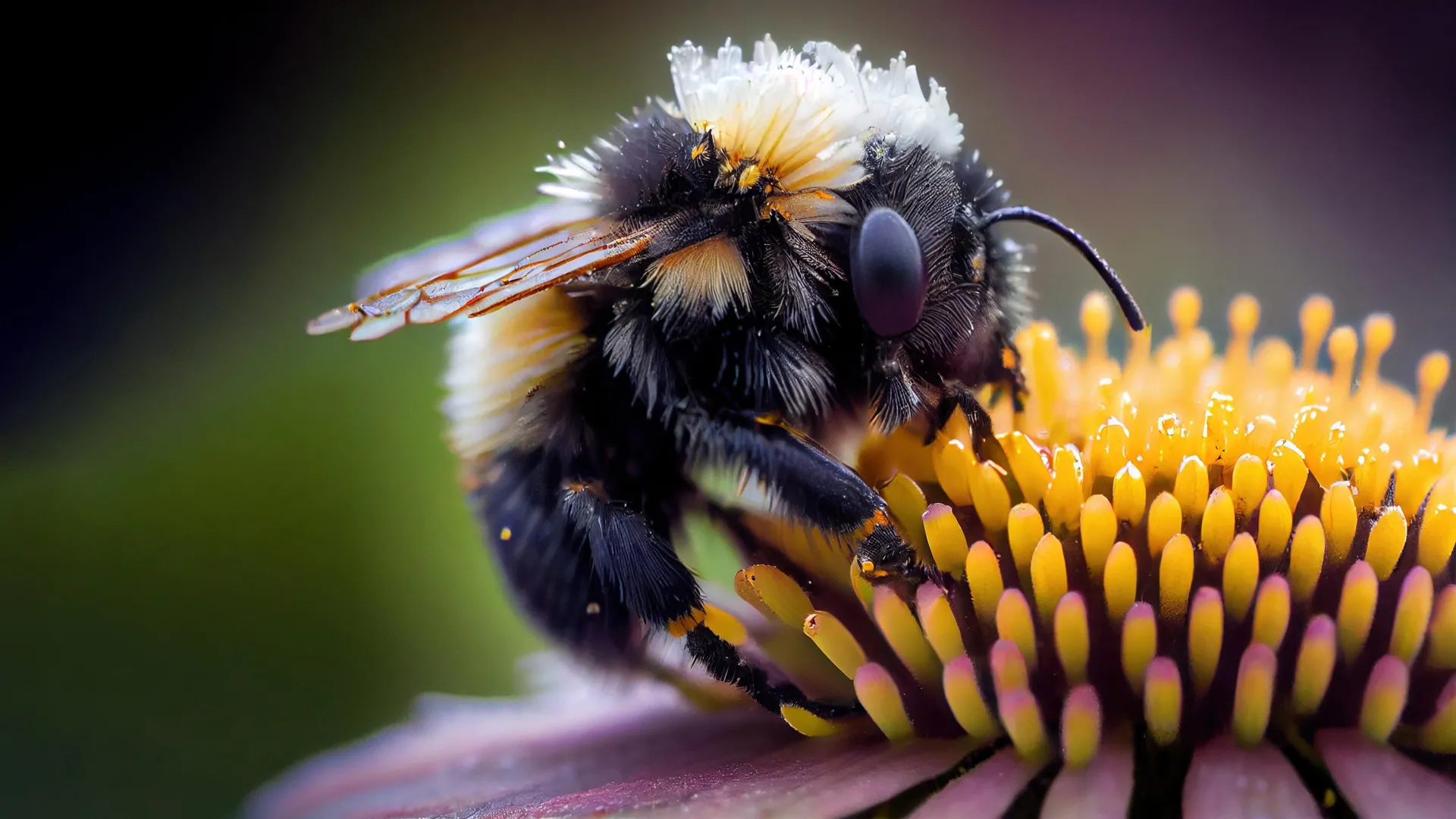
Environmental researchers at the University of Cambridge have published a groundbreaking study revealing that bumblebees can accumulate up to seven times more toxic heavy metals than honeybees, even when both species forage side by side in the same rural environment. The findings, recently published in the peer-reviewed journal Ecological Entomology, are prompting scientists to reevaluate how hidden environmental pollution impacts vital wild pollinator populations. While heavy metal contamination is traditionally associated with heavy industry, smelting operations, and urban centers, this research demonstrates that agricultural practices and atmospheric deposition can introduce these persistent toxins into seemingly pristine rural ecosystems, posing a disproportionate threat to native bumblebee species.
The study underscores a critical gap in traditional environmental monitoring. For decades, conservationists and regulatory bodies have relied on honeybees as primary bioindicators to assess the health of local ecosystems and measure the prevalence of environmental pollutants. Because honeybee colonies are large, easily managed, and forage over vast territories, they have served as the standard proxy for environmental exposure. However, this new research highlights that relying solely on honeybees creates a blind spot regarding wild pollinators. Bumblebees, characterized by distinct biological traits, nesting habits, and foraging ranges, absorb significantly higher concentrations of metals such as arsenic, cadmium, chromium, cobalt, lead, and tin, rendering them far more vulnerable to the cumulative stressors of modern landscapes.
Background Context and the Evolution of Bioindication
The intersection of industrial pollutants and pollinator health has become a pressing concern for entomologists and environmental toxicologists over the past two decades. As global populations face accelerating biodiversity loss, researchers have increasingly looked beyond habitat destruction and systemic pesticides—such as neonicotinoids—to examine how heavy metals compound ecological stress. Heavy metals are persistent environmental contaminants; unlike organic pollutants, they do not break down over time and can bioaccumulate within food webs.
Historically, honeybees (Apis mellifera) were chosen for monitoring pollution because their managed hives allow researchers to easily sample honey, beeswax, pollen, and the bees themselves. Urban beekeeping initiatives in major metropolitan areas frequently test honey to gauge localized air quality and heavy metal fallout. Yet, wild bees, including numerous bumblebee species (Bombus), have received far less attention in heavy metal exposure assessments. The University of Cambridge study addresses this oversight by providing a direct, side-by-side comparative analysis of managed honeybees and wild bumblebees foraging in identical geographical settings.
Methodology and Chronology of the Cambridge Study
The research project was spearheaded by Dr. Sarah Scott during her tenure at the University of Cambridge’s Department of Zoology, in collaboration with senior author Professor Lynn Dicks. Funding for the investigation was provided by the Royal Society, reflecting the high scientific priority of understanding pollinator vulnerability in changing landscapes.
The field research was conducted in Cambridgeshire, England, a region where baseline soil contamination is generally classified as low to moderate, far removed from heavy industrial centers or active mining zones. To ensure accuracy, the research team placed honeybee hives and monitored wild bumblebee populations in close proximity to one another, ensuring that both groups were exposed to identical floral resources, atmospheric conditions, and soil matrices.
During the active foraging season, researchers deployed specialized pollen traps to collect provisions brought back to the colonies. They subsequently conducted rigorous chemical analyses to measure the concentrations of six key heavy metals: arsenic, cadmium, chromium, cobalt, lead, and tin. The analysis measured contamination levels in both the collected pollen reserves and the bodies of adult bees.
The chronological progression of the study moved from initial site selection and hive placement to multi-week pollen collection, laboratory spectrometry analysis, and comparative data evaluation. The results, finalized and peer-reviewed for publication in Ecological Entomology—the official journal of the Royal Entomological Society—upended several long-held assumptions regarding uniform exposure among generalist pollinators.
Comparative Data: The Disparity Between Species
When the laboratory results were tabulated, the researchers observed a striking dichotomy between the two species. Although both honeybees and bumblebees flew across the exact same fields, hedgerows, and garden plots, the chemical burden carried by the bumblebees was dramatically higher.
Pollen gathered by bumblebees contained between two and seven times higher concentrations of heavy metals across the spectrum of tested elements compared to the pollen collected by honeybees. Furthermore, when analyzing the physical bodies of the adult insects, scientists discovered that bumblebees had accumulated roughly three times higher concentrations of heavy metals internally.
Dr. Scott noted that while the absolute concentrations of metals detected were typically below acute lethal thresholds—meaning they did not instantly kill the insects—the sub-lethal implications are profound. Chronic exposure to low-dose heavy metals can severely compromise neurological function, disrupt learning and memory pathways, and impair spatial navigation. For an organism whose survival depends entirely on locating, remembering, and returning to profitable floral patches, any cognitive deficit can drastically reduce foraging efficiency and colony survival rates.
Anatomy, Behavior, and Why Bumblebees Face Greater Risk
To understand why bumblebees accumulate such drastically higher levels of toxins than their honeybee counterparts, the research team analyzed the fundamental differences in biology, nesting ecology, and foraging behavior between the two groups. Several key factors contribute to this heightened exposure:
First, nesting habits create vastly different baselines for contact with soil and sediment. Honeybees construct complex, elevated nests in hollow trees, rock cavities, or managed wooden hives well above the ground. In contrast, most bumblebee species build their nests directly in the ground, underground in abandoned rodent burrows, or deep within dense leaf litter. This subterranean or ground-level placement exposes bumblebees and their developing brood to continuous, direct contact with soil dust and sediment that may harbor higher concentrations of settled heavy metals.
Second, foraging ranges and plant selection habits diverge significantly. Honeybees are prolific generalists with large foraging workforces that can number between 30,000 and 60,000 individuals per colony. They routinely travel distances of up to 10 kilometers from their hive, drawing nectar and pollen from a wide array of plant species. This broad dietary breadth effectively dilutes their exposure to localized contamination.
Bumblebees, however, maintain much smaller colonies, typically consisting of only 50 to 500 individuals. Their foraging radius is considerably more restricted, generally limited to a distance of about 1.5 kilometers from the nest. Consequently, bumblebees cannot easily bypass localized pollution hotspots. Furthermore, bumblebees tend to collect smaller quantities of pollen from a narrower selection of plant species, making their overall toxicological burden highly dependent on the hyper-accumulation traits of specific local flora.
Third, morphological differences play a physical role in particle retention. Bumblebees possess significantly hairier, denser coats than honeybees. These specialized branched hairs, designed to efficiently trap pollen grains, also act as a physical trap for airborne particulate matter, dust, and industrial fallout settling on vegetation. As bumblebees move through the landscape, particulate heavy metals cling to their dense pelage, increasing their external contaminant load before it is transported back to the nest.
Implications for Rural Landscapes and Food Security
The findings challenge the comforting assumption that rural environments are inherently safe havens for wildlife. Professor Lynn Dicks emphasized that even in landscapes far removed from smokestacks and open-pit mines, industrial byproducts, agricultural fertilizers, sewage sludge applications, and vehicle emissions from distant roadways can deposit heavy metals into soils and plants.
The ecological consequences of these hidden toxins are particularly acute for wild species. Because bumblebee colonies are orders of magnitude smaller than honeybee colonies, the loss of even a small number of foraging workers can trigger a cascading failure of the colony. With fewer individuals available to provision the brood, maintain the nest, and regulate internal temperatures, reproductive success drops, leading to fewer new queens produced for the following year. This dynamic provides a compelling partial explanation for the ongoing, documented declines in native wild bee populations across North America and Europe.
Official Responses and Ongoing Scientific Dialogue
The publication of the Cambridge study has generated widespread discussion within the entomological and conservation communities. Agricultural extension agencies and environmental protection groups are reviewing the data to determine whether current soil management guidelines adequately account for bioaccumulation in wild fauna.
Related parties, including agricultural stakeholders and environmental policymakers, have noted that while agricultural inputs like phosphate fertilizers and organic amendments (such as treated sewage sludge) are regulated for macronutrients and immediate pathogen safety, their long-term accumulation of trace heavy metals warrants more stringent lifecycle tracking. Trace metals such as cadmium and lead can persist in agricultural topsoils for decades, slowly taken up by crops and wild flowering plants alike.
Despite the sobering findings, the researchers were careful to frame their conclusions constructively, urging the public not to abandon conservation gardening efforts.
"Bees play a critical role in both natural biodiversity and agricultural food security," Dr. Scott emphasized. "We would still strongly encourage people to plant flowers to help them, even if you live in an area more likely to be contaminated. At the end of the day, bees still need food. Even if it carries traces of heavy metals, having some food is fundamentally better than having no food at all."
Future Directions in Pollinator Toxicology
As scientific inquiry shifts toward multi-stressor models—examining how chemical exposure interacts with climate change, habitat fragmentation, and pathogens—studies like the one conducted at the University of Cambridge provide foundational insights. Future research initiatives are expected to expand testing across a wider geographical area, incorporating diverse soil types and a greater variety of wild bee species, including solitary bees and mining bees, to map out the full scope of heavy metal vulnerability in the insect kingdom.
For now, the work serves as an urgent reminder that environmental pollution is deeply pervasive, and that protecting vulnerable pollinators requires looking far beyond obvious industrial zones to safeguard the delicate ecological web upon which global food production depends.
