
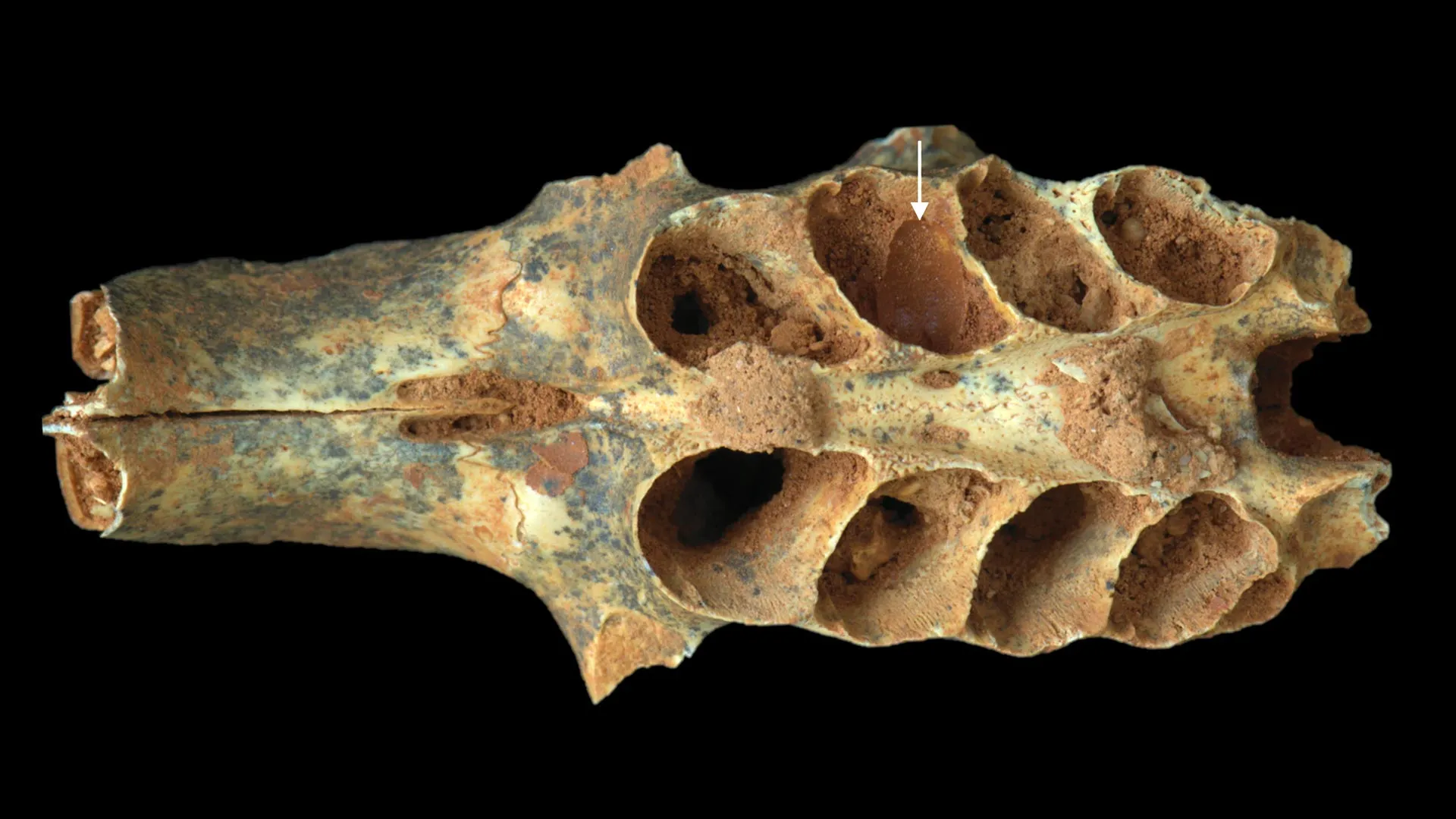
Deep within a limestone cave on the Caribbean island of Hispaniola, an extraordinary prehistoric ecosystem has come to light, offering unprecedented insights into the adaptability of ancient insects. According to a landmark study recently published in the scientific journal Royal Society Open Science, researchers have discovered that solitary bees utilized the fossilized tooth sockets of ancient small mammals as subterranean nurseries approximately 20,000 years ago. This remarkable finding represents the first documented instance of bees employing vertebrate skeletal remains as a nesting strategy, expanding our modern understanding of insect behavior, paleoecology, and the intricate interactions between ancient species.
The discovery unfolded through a meticulous examination of a fossil-rich deposit situated in the heart of Hispaniola, an island shared by the nations of Haiti and the Dominican Republic. For generations, the cave served as an active roost for successive colonies of owls. These nocturnal raptors regularly regurgitated compacted pellets of indigestible material containing the bones of their prey. Over millennia, these discarded skeletal remains accumulated alongside the bones of the owls themselves, as well as occasional amphibians, reptiles, and mammals that accidentally tumbled into the subterranean chambers. The resulting accumulation created a rich, multi-layered fossil archive spanning thousands of years, preserved beneath carbonate layers formed during prehistoric rainy periods.
The Investigation and Initial Discovery
The scientific expedition that uncovered this unique behavior was led by Lazaro Viñola López, a postdoctoral researcher at the Field Museum in Chicago, alongside colleagues from the University of Florida, the Florida Museum of Natural History, and the Museo Nacional de Historia Natural in the Dominican Republic. The site itself had initially been identified by Juan Almonte Milan, curator of paleobiology at the Dominican Dominican museum and a leading authority on the island’s natural history.
Accessing the fossil deposit required a rugged descent into the subterranean limestone network. Researchers secured climbing ropes to the surface and rappelled approximately ten meters down into the darkness, navigating environments populated by resident tarantulas and damp tunnels. Once inside, the team encountered a stratigraphically complex fossil bed containing the remains of more than 50 distinct animal species, dominated heavily by rodents, sloths, birds, and reptiles.
While cleaning and cataloging mammal jawbones recovered from the owl pellets, Viñola López noticed a recurring anomaly. Rather than being filled with ordinary windblown sediment or mineralized debris, the empty tooth sockets of several fossilized jaws contained smooth, concave deposits. The precise geometry of these structures immediately caught the researcher’s attention. Drawing upon previous undergraduate fieldwork experience in Montana—where he had observed fossilized wasp cocoons—Viñola López suspected that the strange formations were not geological accidents, but rather the traces of ancient insect architecture.
Unlocking Microscopic Secrets Through Advanced Technology
To confirm their suspicions without damaging the delicate fossil specimens, the research team employed high-resolution computed tomography (CT) scanning. This non-invasive imaging technique generated detailed, three-dimensional digital models of the material compacted within the tooth sockets.
The digital scans revealed that the structures bore an unmistakable morphological resemblance to the mud nests constructed by modern solitary bees. Furthermore, microscopic analysis of the interior chambers identified preserved grains of ancient pollen. This botanical evidence confirmed that the chambers served as functional brood cells, where mother bees provisioned food supplies for their developing larvae before sealing the cavity.
Solitary bees, unlike their eusocial counterparts such as honeybees and bumblebees, do not build large, complex colonies governed by a queen. Instead, individual females operate independently, seeking out small cavities to lay their eggs. While various modern solitary species utilize hollow plant stems, abandoned beetle burrows in wood, or even discarded snail shells in parts of Europe and Africa, none had ever been documented nesting inside the cranial bones of vertebrate animals. Measuring smaller than the eraser at the end of a standard pencil, these miniature nurseries utilized saliva mixed with fine dirt to construct durable walls inside spaces designed to anchor teeth.
Taxonomic Classification and Ecological Implications
Because the warm, humid climate of the Caribbean is exceptionally detrimental to the preservation of fragile insect exoskeletons, the researchers did not recover any fossilized bee bodies within the bone cavities. The absence of physical insect remains meant the team could not definitively link the architecture to a specific living or extinct species.
To honor the scientific significance of the find and acknowledge the contributions of Juan Almonte Milan—who first recognized the extraordinary potential of the Hispaniola cave—the researchers formally classified the trace fossils as a new ichnospecies, naming them Osnidum almontei.
The emergence of Osnidum almontei raises compelling questions regarding the biodiversity of prehistoric Hispaniola. Because many vertebrate species preserved within the same cave layers are now extinct, scientists cannot rule out the possibility that the bees responsible for the nests have also vanished from the fossil record. Conversely, given the relative lack of scientific documentation concerning contemporary island bee ecology in the Caribbean, the architects of these bone nests could potentially belong to a living species whose nesting habits have simply remained unobserved until now.
Environmental Pressures and Evolutionary Adaptations
The unprecedented behavior documented in the study highlights the remarkable resourcefulness of insects responding to environmental constraints. Geologically, the island of Hispaniola is characterized by extensive karst topography and limestone formations, which frequently feature rugged terrain with sparse topsoil. In landscapes devoid of deep soil or suitable soft wood, traditional nesting substrates are often severely limited.
Simultaneously, the resident owl population provided a steady, reliable supply of structural cavities. By utilizing the hollow tooth sockets of rodent jaws, the ancient bees bypassed the scarcity of earth and wood, turning the byproduct of a predatory food chain into safe, stable nurseries. Researchers note that nesting deep within dense bone structures may have offered crucial evolutionary advantages, providing thermal insulation and robust physical protection against parasitic wasps and other predators seeking to prey on defenseless larvae.
Broader Impacts on Paleontological Research
The discovery of Osnidum almontei carries substantial methodological implications for the broader scientific community. Paleontologists frequently focus their efforts on large vertebrate fossils, often removing or disregarding adhering matrix material during the cleaning process. This study serves as a critical reminder that micro-stratigraphic details and trace fossils—the preserved indirect evidence of biological activity, such as tracks, burrows, and nests—can offer profound insights into ancient ecosystems.
By paying closer attention to invertebrate interactions within vertebrate fossil assemblages, researchers can reconstruct ancient food webs, climate conditions, and micro-habitats with greater precision. As scientists continue to explore the complex limestone cave systems of the Caribbean and beyond, the findings underscore a fundamental truth of evolutionary biology: given sufficient time and ecological pressure, organisms will adapt and utilize virtually any available resource to ensure the survival of the next generation.
