
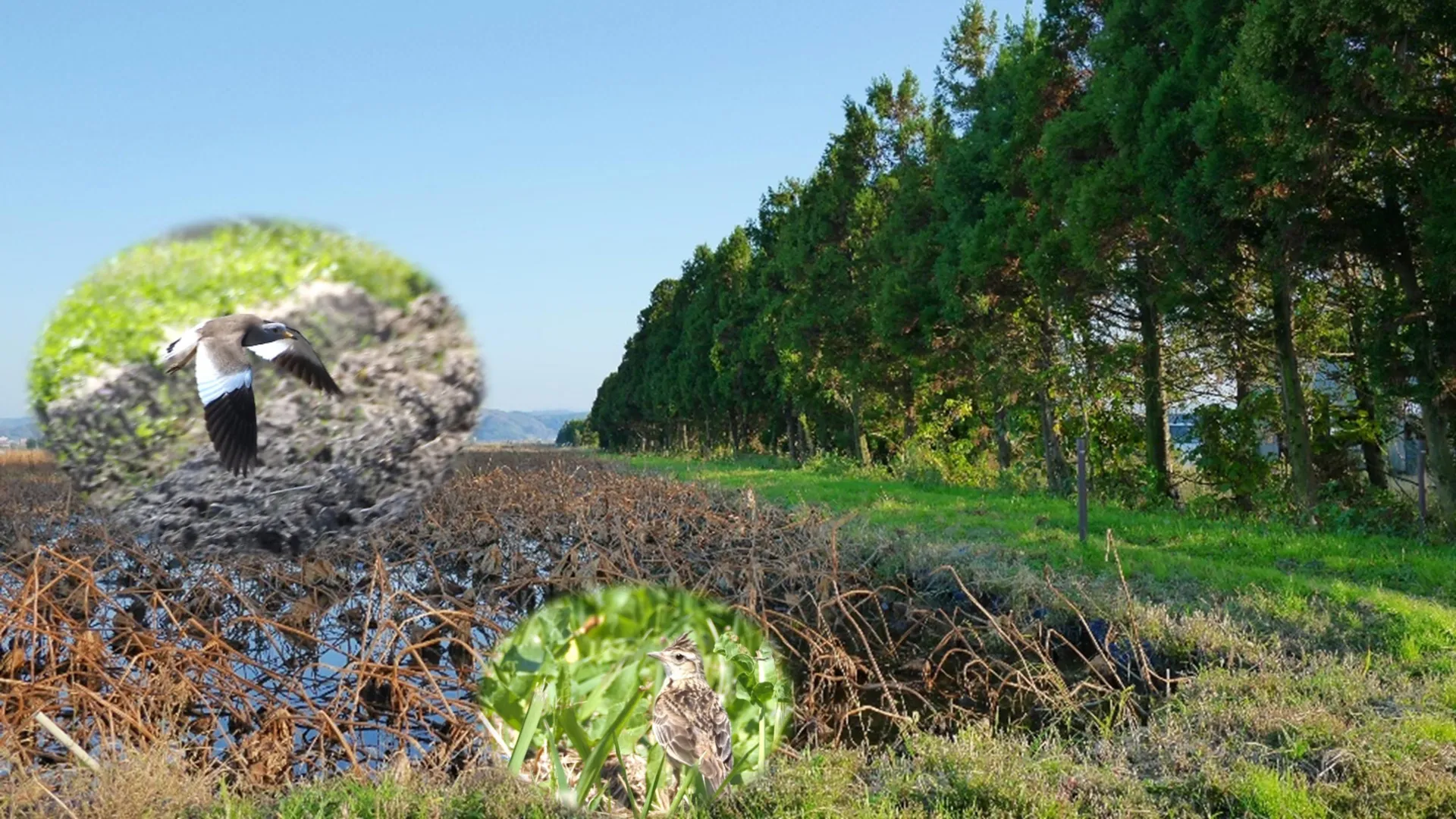
The conventional wisdom surrounding agricultural conservation has long championed a simple, green-thumbed rule: plant more trees. Across the globe, environmental programs encourage farmers to establish shelterbelts, hedgerows, and woody windbreaks to foster biodiversity, prevent soil erosion, and enhance the aesthetic and ecological value of working lands. However, a comprehensive new study published in the prestigious Journal of Environmental Management challenges this one-size-fits-all approach, revealing that while tree-planting initiatives benefit certain wildlife, they can simultaneously devastate populations of birds that rely on wide-open spaces, particularly in agricultural wetlands.
Led by an interdisciplinary team of researchers from institutions including Hiroshima University, The University of Tokyo, and Kyoto University, the study focused on the fragile, highly modified wetland ecosystems of central Japan. The findings suggest that the ecological impacts of linear tree plantings are far more complex than previously understood, creating sharp divisions between "winners" and "losers" among avian communities. As global climate pressures mount and agricultural landscapes face intense transformation, the study provides critical insights for land managers attempting to balance food production with wildlife preservation.
The Ecological Paradox of Agricultural Shelterbelts
For decades, conservation strategies have drawn heavily from research conducted in terrestrial cropland and grassland systems across Europe and North America. In those regions, introducing woody vegetation consistently correlates with higher species richness, providing nesting sites, foraging grounds, and protective cover for a wide array of woodland and edge-dwelling birds. Consequently, international agricultural policies have heavily incentivized the proliferation of shelterbelts.
Yet, these assumptions have rarely been tested in wet farming landscapes—such as rice paddies and irrigated agricultural basins—which cover vast swathes of Asia and serve as vital substitute wetlands for migrating and resident wildlife. These wetland environments are disappearing at an alarming rate worldwide, making the remaining agricultural wetlands indispensable for avian biodiversity.
"The central question of our study is, ‘Do shelterbelts and other woody linear features benefit all farmland birds equally in agricultural wetland landscapes, or do they create trade-offs by disadvantaging species that depend on open habitats?’" explained Dr. Masumi Hisano, assistant professor at Hiroshima University’s Graduate School of Advanced Science and Engineering and the corresponding author of the study.
This question holds profound implications for conservation. Agricultural wetlands perform a dual mandate: they must sustain human populations through high-yield food production while functioning as critical surrogate habitats for migratory birds navigating major international flyways. If the widespread implementation of windbreaks inadvertently degrades habitat quality for grassland and wetland specialists, well-intentioned green initiatives could accelerate the decline of vulnerable species.
Chronology of the Field Study: Investigating Lake Kahokugata
To unravel the ecological consequences of agricultural windbreaks, the research team focused their investigations on the diverse agricultural basin surrounding Lake Kahokugata in central Japan. This geographical region represents a microcosm of intensive wet-farming systems, characterized by expansive networks of rice paddies interspersed with lotus fields, cultivated croplands, and pastoral acreage.
Because the Kahokugata region is geographically exposed to severe seasonal weather patterns—including punishing winter gales and strong storms blowing off the Sea of Japan—local farmers have historically relied on shelterbelts. These dense rows of trees act as mechanical shields, protecting fragile crops and newly flooded paddies from wind-induced damage and soil degradation.
Furthermore, Lake Kahokugata occupies a strategic geographical position as a crucial stopover, wintering, and breeding ground along the East Asian-Australasian Flyway, one of the world’s primary migratory bird corridors. Historical ecological records indicate that nearly 300 distinct bird species utilize the basin across different seasons.
To capture accurate ecological data across changing seasonal pressures, the researchers structured their field methodology across two distinct phases:
- Late Winter Baseline (February and March 2021): This period captured avian communities during peak wintering conditions, when migratory waterfowl and cold-hardy grassland species heavily utilize the open rice stubble and flooded basins.
- Summer Breeding Season (June 2023): This phase evaluated resident and breeding summer visitors nesting within the agricultural matrix, recording territorial behavior, foraging preferences, and species distribution.
Using a standardized point-count survey methodology, the researchers systematically measured bird abundance and species diversity at sites immediately adjacent to shelterbelts versus open control sites located approximately one kilometer away from any major woody linear features.
Empirical Findings: Winners, Losers, and Ecological Walls
The survey data yielded a stark ecological trade-off. While shelterbelts successfully fostered populations of shrub-dwelling birds and generalist species adapted to habitat edges, they exerted a profoundly negative impact on species dependent on open landscapes.
Most notably, the abundance of typical grassland birds plummeted near windbreaks. According to the empirical data collected by the team, the population density of grassland species was more than 70 percent lower at survey sites immediately adjacent to shelterbelts compared to open control sites just one kilometer away. Furthermore, overall species diversity among wetland-dependent birds dropped significantly in areas dominated by these woody barriers.
To conceptualize this phenomenon, the researchers utilized a striking metaphor. "A useful way to think about this is that shelterbelts act like ecological walls," Hisano noted.
Rather than serving as neutral landscape enhancements, these narrow corridors of trees physically and behaviorally fragment the environment. For birds evolutionarily adapted to sweeping, unobstructed vistas—where they can easily spot approaching predators and forage across broad expanses—tall rows of trees represent artificial barriers. These barriers not only shrink usable foraging and nesting space but also create ambush corridors for avian and terrestrial predators, thereby escalating predation pressure on ground-nesting species.
"Our study provides clear, quantitative evidence that small-scale landscape features can have large ecological consequences, directly relevant to land-use planning and environmental management," Hisano emphasized.
Policy Implications and the Shift Toward Context-Aware Conservation
The implications of the Hiroshima University-led study extend far beyond the rice paddies of central Japan. As governments worldwide allocate billions of dollars toward agri-environmental schemes, carbon sequestration initiatives, and biodiversity enhancement programs, the push to plant trees remains a default policy instrument.
However, the researchers caution against framing trees as a universal ecological good. Instead, the findings demand a paradigm shift toward context-aware land management—one that carefully weighs the structural complexity of a landscape against the specific evolutionary needs of its resident and migratory wildlife.
"Biodiversity-friendly farmland management must balance structural complexity with the ecological needs of open-habitat species, especially in landscapes where wetlands have already been heavily modified by humans," said Hisano.
This is particularly urgent in East Asia and other intensive farming regions where natural wetlands have been systematically drained, leaving human-managed rice paddies as the primary refuge for declining waterbirds. In such environments, transforming open floodplains into compartmentalized, woody-edged plots can inadvertently destroy the very surrogate ecosystems these species require for survival.
Future Research and the Road to Evidence-Based Agri-Policy
Recognizing the complexity of human-modified agricultural matrices, the research team is calling for expanded investigations. Future phases of the research will examine how specific structural variables—including shelterbelt width, canopy height, spatial configuration, inter-tree spacing, and tree species composition—differentially impact wildlife across varied regional climates and annual cycles.
Additionally, scientists aim to quantify the indirect ecological cascades triggered by windbreaks, such as shifts in insect population dynamics, localized microclimate alterations, and changes in predator-prey interaction networks.
Ultimately, the overarching objective of this research is to replace generalized tree-planting mandates with sophisticated, evidence-based agri-environmental policies. Rather than promoting a simplistic, ubiquitous approach of planting trees everywhere, conservation planners are urged to adopt landscape-level zoning strategies. By strategically integrating open wetland patches alongside necessary woody features, land managers can sustain diverse avian communities, preserve vital ecosystem services, and maintain agricultural productivity.
Through careful, scientifically guided planning, agricultural wetlands can continue to feed human populations while remaining resilient sanctuaries for wildlife in a rapidly changing world.
The research team behind the study includes Masumi Hisano (Hiroshima University, The University of Tokyo, and Kyoto University); Shota Deguchi (Fukui City Museum of Natural History); Wenhuan Xu (University of British Columbia and Simon Fraser University); Xike Xiao (Hiroshima University); Keinosuke Sannoh (Nihonkai Eco Engineering Technologies); Xinli Chen (Zhenjiang A&F University); and Ken Motomura (Nakano City Hall).
This collaborative research initiative was generously supported by the Kahokugata Lake Institute and the Japan Society for the Promotion of Science (JSPS) KAKENHI grants.
