

Woodpeckers have long captured the fascination of ornithologists, backyard bird enthusiasts, and wildlife biologists alike, serving as both loyal visitors to residential feeding stations and subjects of intense biomechanical study. While their vibrant plumage and rhythmic drumming are familiar features of temperate and tropical woodlands, the evolutionary adaptations that enable their demanding lifestyle represent one of nature’s most remarkable engineering feats. To survive an existence that requires striking dense arboreal surfaces at high velocities, these birds rely on a specialized suite of anatomical, physiological, and behavioral traits that continue to inform modern biomechanical research, aerospace design, and concussion studies.
The Mechanics of High-Velocity Impact
The primary defining characteristic of the woodpecker family (Picidae) is its specialized method of foraging, excavating nesting cavities, and communicating through rhythmic drumming on trees. This activity is deceptively punishing. When a woodpecker drills into a tree trunk to uncover wood-boring insects or construct a nesting cavity, its head can strike the wood at speeds reaching up to 13 miles per hour (approximately 21 kilometers per hour).
This sudden deceleration generates an impact force of roughly 10 Gs. For context, continuous impacts of this magnitude would readily cause severe brain trauma, retinal detachment, or fatal concussions in most other avian species. Human brains, by comparison, are estimated to be significantly more vulnerable to concussive forces at equivalent thresholds, with human tissues lacking the specialized protective geometry found in the avian skull.
To prevent catastrophic neural injury, woodpeckers have evolved a highly specialized cranial architecture. Contrary to the common assumption that a woodpecker’s head acts as a rigid, unyielding hammer, modern scientific observations indicate that the skull functions as a finely tuned shock absorber. The skull structure consists of a lightweight, spongy, air-filled network of pneumatic bone reinforced by intricate bony struts. This design provides structural integrity while minimizing mass. Furthermore, the volume of the woodpecker’s brain is exceptionally small relative to the overall size of its skull, leaving minimal intracranial space for the brain to shift, rattle, or sustain impact against the inner cranial wall during heavy strikes.
Self-Sharpening and Self-Healing Anatomy
The constant friction and physical resistance encountered while fracturing dense wood present another evolutionary challenge: bill degradation. If a woodpecker’s bill were composed of static, unchanging keratin like human fingernails or typical avian beaks, it would quickly wear down to a blunt nub under the rigorous demands of daily excavation.

To counter this, woodpeckers possess chisel-pointed bills featuring specialized cellular composition at the distal tips. As the outer layers wear away through continuous contact with abrasive tree bark and dense heartwood, specialized generative cells constantly replace the lost material. This continuous growth cycle ensures that the bill remains structurally sound, resilient, and sharp. In effect, the bill continuously self-sharpens with every blow, maintaining an optimal chisel edge for penetrating deep into timber.
Advanced Ocular and Respiratory Protection Systems
Excavating wood at rapid intervals generates a substantial volume of airborne debris, including wood chips, fine sawdust, and splintered bark fragments. Without sophisticated protective mechanisms, this debris would pose a constant hazard to the bird’s respiratory tract and sensitive optical organs.
Over millions of years of evolutionary refinement, woodpeckers have developed natural biological equivalents to safety equipment used in industrial trades. The avian respiratory system is safeguarded by dense tufts of stiff, specialized feathers that grow directly over both nostrils. These nasal tufts act as an effective particulate filter, preventing fine wood dust and foreign particles from entering the nasal cavity during excavation.

Simultaneously, the visual system is protected by a specialized nictitating membrane—often referred to as a protective third eyelid. This transparent or translucent membrane sweeps rapidly across the eyeball just milliseconds before impact, shielding the cornea from flying debris while allowing the bird to maintain a degree of visual awareness during the drilling process. Once the strike is completed, the membrane retracts, clearing away any accumulated particles.
Implications for Biomechanics and Engineering
The unique physiological adaptations of woodpeckers have long extended beyond the realm of ornithology, drawing significant interest from aerospace engineers, automotive safety researchers, and neuroscientists. By analyzing how woodpeckers dissipate high-impact kinetic energy without sustaining traumatic brain injury, researchers have sought to improve human safety equipment.
Insights gained from avian cranial structures have directly influenced the design of high-performance protective headgear, sports helmets, and vehicular crash structures. Engineers attempting to replicate natural shock-absorption systems look closely at the spongy bone distribution and hyoid bone structure of woodpeckers—a long, cartilaginous tongue apparatus that wraps around the back of the skull to further cushion the brain during impact. By translating these biological principles into synthetic materials, researchers hope to develop next-generation protective gear that minimizes concussion risks in contact sports and high-risk industries.

Attracting and Supporting Woodpecker Populations in Backyard Habitats
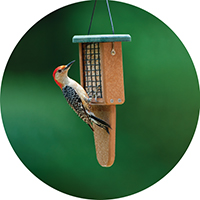
For wildlife enthusiasts and amateur ornithologists seeking to observe these resilient birds up close, residential landscapes offer an ideal viewing environment, provided the appropriate nutritional resources are made available. Because woodpeckers possess specialized dietary requirements—favoring high-protein, high-fat foods such as insects, suet, and nuts—standard seed blends are frequently insufficient to sustain their interest.
Wildlife management and bird-feeding organizations, including Wild Birds Unlimited (WBU), recommend specific formulations to attract a diverse array of woodpecker species, ranging from the downy and hairy woodpeckers to the larger red-bellied and pileated woodpeckers. Essential offerings include high-energy suet cakes, no-melt suet doughs for warmer months, specialized bark butter products, shelled peanuts, and nutrient-dense seed cylinders designed specifically for cavity-foraging birds.
By supplying these high-calorie foods, homeowners can support local avian populations throughout the seasonal shifts while gaining an unobstructed view of one of nature’s most resilient and specialized families of birds. Continued public interest in backyard ornithology not only enhances residential green spaces but also fosters broader appreciation for the complex evolutionary marvels present in everyday ecosystems.
