
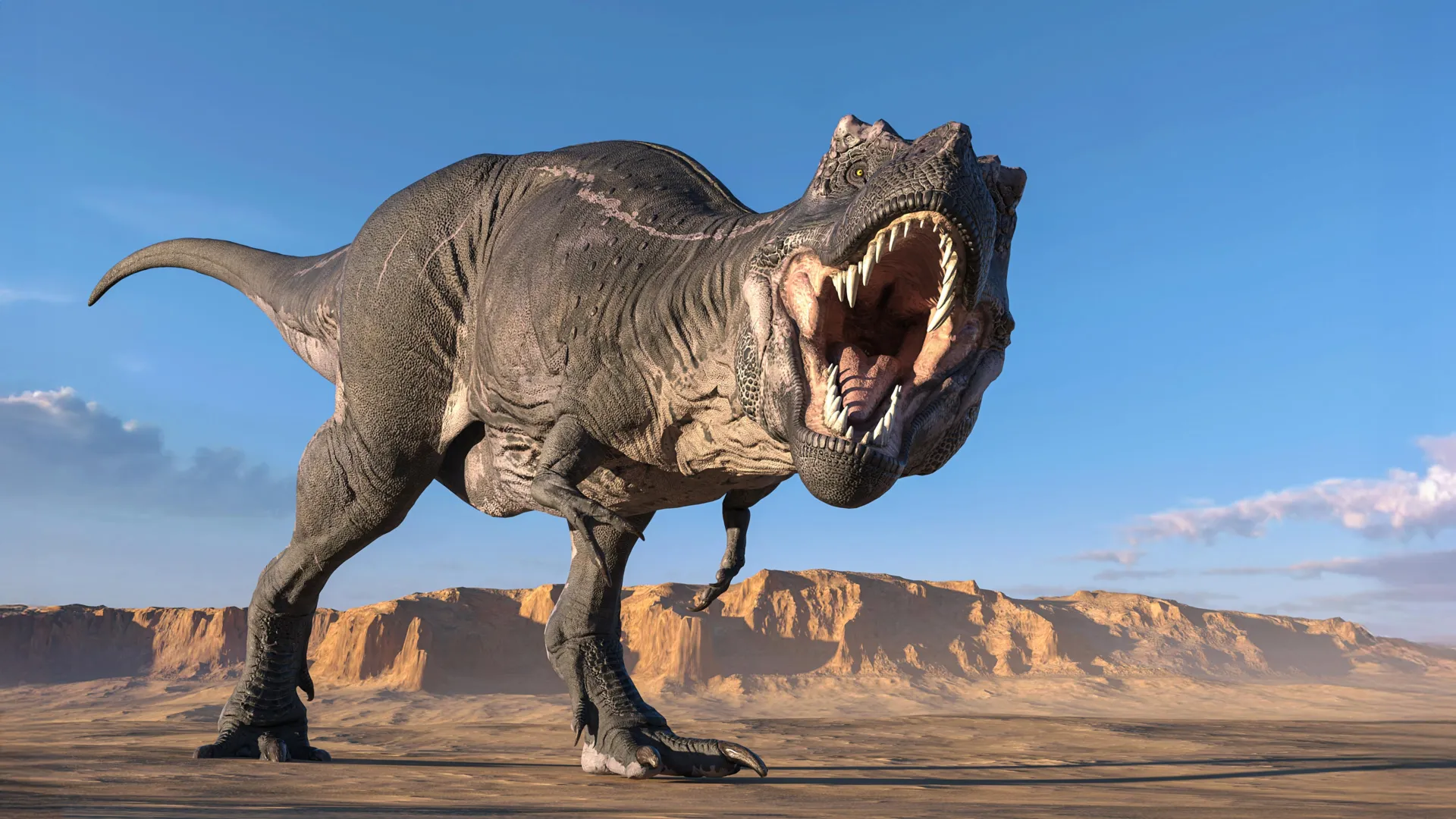
For more than a century, the physiological nature of Tyrannosaurus rex has remained one of paleontology’s most fiercely debated subjects. Since the discovery of the apex predator’s remains, researchers have attempted to reconstruct its biology using bones, teeth, footprints, and fossilized traces left behind more than 60 million years ago. While historical depictions often portrayed the giant theropod as a sluggish, cold-blooded reptile dependent on external heat sources like the sun, modern discoveries have steadily challenged that paradigm. Fossils unearthed as far north as Alaska hinted that T. rex possessed remarkable cold-tolerance, sparking a decades-long scientific quest to determine whether the king of the dinosaurs was truly endothermic (warm-blooded) like modern birds and mammals, or ectothermic (cold-blooded) like modern reptiles.
Now, a team of researchers at the University of California, Los Angeles (UCLA), has achieved what was once thought impossible: they have successfully measured the body temperature of a Tyrannosaurus rex. By refining a specialized geochemical technique and applying it to pristine fossilized teeth, the research team determined that T. rex maintained an internal body temperature of approximately 37 degrees Celsius (97 degrees Fahrenheit). This reading places the iconic dinosaur remarkably close to the average body temperature of a modern human, bridging the evolutionary gap between ancient reptiles and their modern avian descendants.
The groundbreaking findings, published in the peer-reviewed journal Science Advances, offer definitive physical evidence supporting the view of T. rex as an active, high-metabolism predator and scavenger. Furthermore, this internal thermal regulation sheds light on how tyrannosaurs successfully colonized and dominated colder, high-latitude environments that would have proven fatal to strictly cold-blooded reptiles.
A Decade of Technological Refinement
The journey toward taking the temperature of a 66-million-year-old apex predator required years of methodical technological advancement. Approximately ten years prior to the study, geobiologists at UCLA pioneered a prehistoric thermometer technique designed to analyze the metabolic status of extinct organisms using skeletal remains. However, applying this method to a specimen as historically and scientifically significant as a Tyrannosaurus rex presented a profound obstacle.
In its initial stages of development, the geochemical technique required a relatively large quantity of fossil material. Museums and institutional curators charged with protecting irreplaceable paleontological specimens could not justify sacrificing the substantial amounts of bone or tooth required for the analysis. For years, the cutting-edge technology outpaced its practical application for rare, complete specimens.
Over the subsequent decade, however, the UCLA research team—led by geobiologist Robert Eagle and lead author Randy Flores—dramatically optimized the procedure. Through rigorous chemical engineering and methodological adjustments, the researchers reduced the required mass of fossil material by roughly 90%.
This monumental reduction in sample size proved persuasive. Officials at the Natural History Museum of Los Angeles County (NHM) evaluated the refined technique and agreed to grant access to Thomas the T. rex, one of the most complete and towering tyrannosaur skeletons housed within the museum’s dinosaur hall. The collaboration marked a pivotal turning point, allowing science to transition from theoretical models of dinosaur metabolism to empirical measurement.
Decoding the Molecular Thermometer
The secret to measuring a prehistoric animal’s internal temperature lies not in the bulk structure of the skeleton, but within the microscopic chemical bonds preserved deep inside tooth enamel over millions of years.
The technique relies on clumped isotope geochemistry. Rare isotopes of carbon and oxygen naturally occur in the environment and are incorporated into biological structures like teeth as animals eat and drink. These heavy isotopes have a thermodynamic preference to bond with one another, and the frequency of these bonds is strictly governed by temperature. Specifically, cooler environments encourage a higher frequency of carbon-oxygen-13 and oxygen-18 isotope pairing, whereas warmer conditions inhibit bond formation.
By measuring the exact abundance of these clumped isotope bonds in fossilized tooth enamel, scientists can reconstruct the ambient temperature of the body at the time the enamel crystallized. While other parts of the skeleton, such as bones, undergo continuous remodeling, resorption, and replacement throughout an animal’s life, tooth enamel features exceptionally large, durable crystalline structures. This durability renders enamel uniquely resistant to chemical alteration, groundwater leaching, and environmental contamination over eons of fossilization.
To execute the test, Eagle and Flores utilized a specialized dental drill to harvest microscopic quantities of enamel powder from the museum’s T. rex teeth. The powdered samples were then dissolved in phosphoric acid to release carbon dioxide gas containing the targeted isotope bonds. Using a high-precision mass spectrometer, the team measured the isotope ratios within the gas. To overcome the minute sample sizes made possible by their refined methods, the researchers pressurized the gas to generate a denser stream of CO2, ensuring accurate and reliable readings from just milligrams of material.
The resulting analysis yielded a precise reading of 36 to 37 degrees Celsius (97 degrees Fahrenheit). For comparison, modern cold-blooded reptiles typically maintain internal temperatures ranging between 28 and 30 degrees Celsius (82 to 86 degrees Fahrenheit), while modern birds—the direct evolutionary descendants of theropod dinosaurs—possess considerably higher body temperatures, generally between 40 and 43 degrees Celsius (104 to 109 degrees Fahrenheit). T. rex occupied a unique metabolic middle ground: while it remained a scaly, egg-laying reptile in terms of taxonomy and physical appearance, its thermal physiology aligned much more closely with modern warm-blooded mammals.
Physiological Implications: Built for an Active Life
The confirmation of a 97-degree Fahrenheit body temperature carries profound implications for our understanding of dinosaur ecology, behavior, and evolutionary history.
Maintaining an elevated internal body temperature requires a significant and continuous intake of energy, reinforcing the consensus that T. rex was an exceptionally active, high-metabolism animal. Rather than relying heavily on environmental thermoregulation—such as basking passively in the sun like modern crocodiles or lizards—an endothermic or mesothermic T. rex would have generated its own internal heat. This physiological capability would have provided the sustained stamina and explosive energy necessary to hunt complex prey or efficiently scavenge across vast territories.
Furthermore, internal temperature regulation offers a compelling explanation for the geographic distribution of tyrannosaurs. During the Cretaceous Period, Earth experienced a hyper-thermal greenhouse climate, with global temperatures significantly warmer than they are today. Yet, even within this generally warm world, polar regions such as ancient Alaska experienced extreme seasonal darkness and freezing winter conditions.
Paleontological surveys of Cretaceous Alaska have consistently failed to recover the fossilized remains of cold-blooded reptiles such as lizards, turtles, or crocodilians, which would have succumbed to hypothermia during the protracted polar winters. In contrast, Tyrannosaurus fossils have been reliably recovered from northern latitudes. Co-author Alessandro Chiarenza, a paleontologist at University College London, noted that this physiological adaptation effectively opened up new ecological niches. By utilizing paleoclimate models alongside the new empirical temperature data, researchers were able to map out a historical North American range stretching from modern-day Mexico to Alaska, delineated strictly by the thermal boundaries where a 97-degree body temperature could survive.
The Curatorial Decision: Balancing Preservation and Discovery
The acquisition of data from Thomas the T. rex highlights the delicate ethical and scientific balancing act routinely managed by museum curators. Destructive analysis—any scientific procedure that drills, cuts, or permanently alters a museum specimen—is rarely approved lightly.
Luis Chiappe, curator of the NHM Dinosaur Institute and director of research and collections, emphasized the rigorous scrutiny applied to such requests. The Natural History Museum houses tens of millions of irreplaceable specimens spanning minerals, animals, and fossils. Every destructive sampling request requires a cost-benefit analysis weighing potential damage against the acquisition of fundamental knowledge about the natural world.
Ultimately, Chiappe and his colleagues concluded that sacrificing microscopic portions from two non-display teeth belonging to Thomas the T. rex was a justified trade-off. The successful extraction of physiological data demonstrated that modern analytical chemistry can unlock deep-time secrets without compromising the visual integrity or public exhibition value of iconic paleontological treasures.
Control Testing and Scientific Validation
In any study involving geochemical analysis of ancient materials, researchers must rigorously rule out false positives caused by diagenesis—the chemical and physical alterations that occur to fossils while buried in sedimentary rock over millions of years.
To validate their findings, the research team analyzed ancient crocodilian fossils excavated from the exact same geological formation: the Hell Creek formation in Montana. Because these crocodilians shared the identical burial environment and thermal history as the T. rex specimen, they served as a crucial experimental control.
The analysis revealed a body temperature of approximately 30 degrees Celsius (86 degrees Fahrenheit) for the ancient crocodilian—substantially lower than the 36 degrees Celsius recorded for the T. rex. If the surrounding geology, groundwater movement, or post-burial thermal history had been responsible for altering the isotopic composition of the fossils, both species would have yielded identical or indistinguishably similar temperature readings.
The stark divergence between the two temperature profiles confirmed that the chemical signatures preserved within the tooth enamel reflected genuine biological differences rather than environmental artifacts. The research was supported by grants from the National Science Foundation, paving the way for future applications of the clumped isotope technique across other dinosaur taxa.
Broader Impact on Paleontology
The successful deployment of the clumped isotope thermometer marks the dawn of a new era in paleobiology. For decades, debates over dinosaur metabolism relied primarily on indirect proxies, such as bone histology, growth rates, body size ratios, and biogeographic distributions. These methods, while valuable, often yielded conflicting interpretations, leaving the scientific community divided.
By directly measuring body temperatures across a broader array of extinct species, researchers hope to map the precise evolutionary origin of endothermy within the dinosaur lineage. Did warm-bloodedness evolve early among all dinosaurs, or was it a specialized adaptation unique to specific lineages like theropods and ornithopods?
As laboratories continue to refine geochemical testing procedures and museum collections open their doors to non-destructive micro-sampling, science moves steadily closer to answering these foundational questions. The day when researchers could routinely take the temperature of extinct giants was once considered a scientific impossibility; today, it stands as a testament to the power of interdisciplinary research, forever transforming our understanding of the king of the dinosaurs.
