
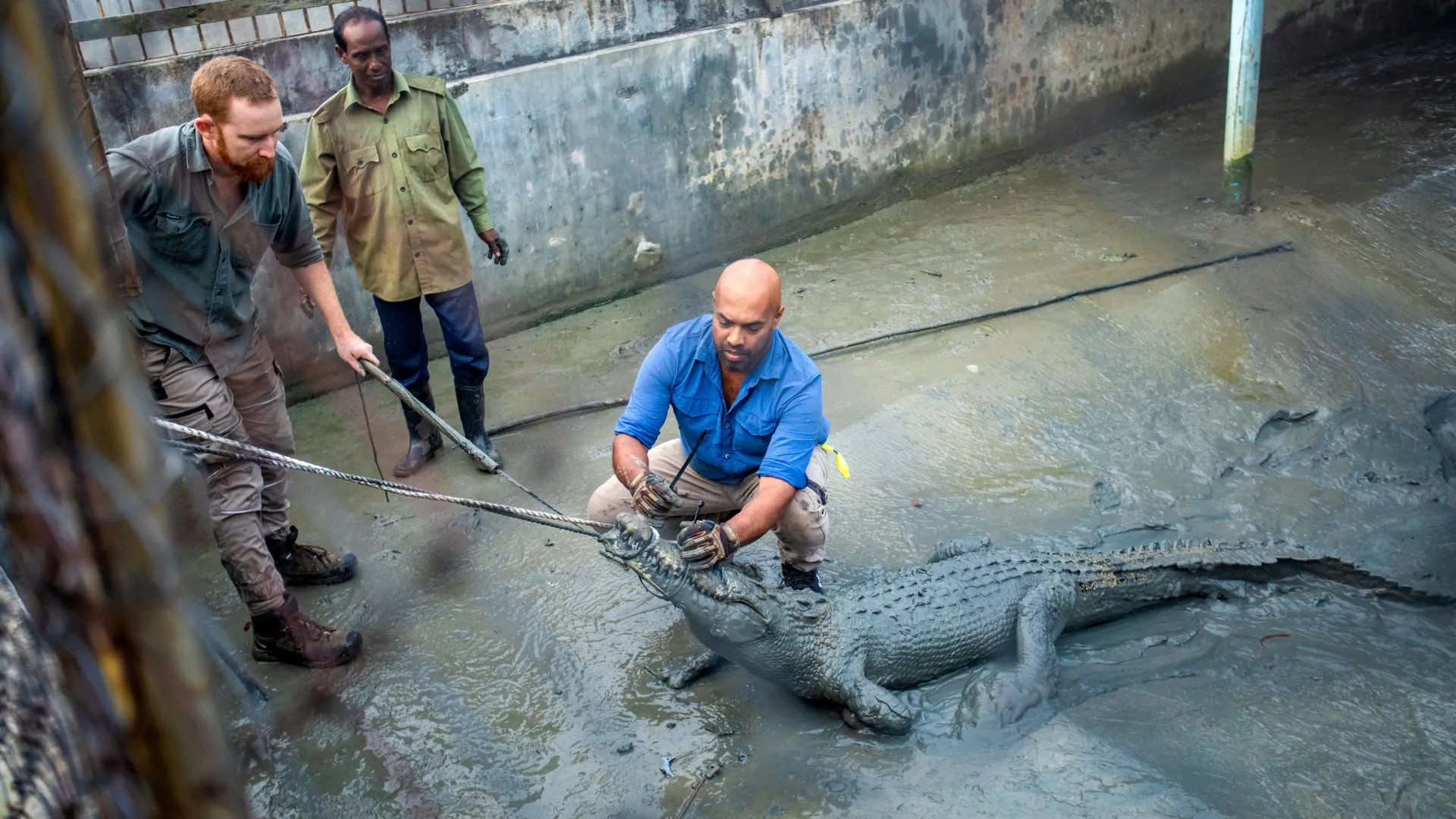
The global conservation community has long wrestled with a fundamental dilemma in species restoration: how to successfully reintroduce apex predators into depleted natural habitats without triggering maladaptive behaviors that lead to their demise or withdrawal from target ecosystems. For decades, traditional conservation paradigms favored releasing very young animals, such as hatchlings, under the assumption that they would naturally imprint upon the wild environment. However, this strategy is plagued by severe biological limitations, chief among them being notoriously low survival rates during the most vulnerable early life stages and protracted timelines required for individuals to reach reproductive maturity.
A groundbreaking study recently published in the scientific journal Wildlife Research may fundamentally alter this calculus. Conducted by an international coalition of researchers, conservationists, and governmental bodies—including Murdoch University, IUCN Bangladesh, the Bangladesh Forest Department, and funding from the Deutsche Gesellschaft für Internationale Zusammenarbeit (GIZ)—the research investigates the post-release movements of saltwater crocodiles (Crocodylus porosus). The findings indicate that saltwater crocodiles born or raised in captivity do not exhibit the compulsion to return to their breeding centers once released into the wild. Instead, these mature captive-reared individuals display movement patterns remarkably similar to their wild-born counterparts, suggesting a seamless adaptation to novel natural environments and opening a promising new frontier for the replenishment of dwindling wild populations.
Historical Context and the Plight of the Sundarbans Saltwater Crocodile
To fully appreciate the significance of this study, one must examine the precarious status of the saltwater crocodile within the specific landscape of its execution: the Sundarbans mangrove forest in Bangladesh. Spanning the delta of the Ganges, Brahmaputra, and Meghna rivers across Bangladesh and India, the Sundarbans represents one of the largest mangrove forests in the world. Historically, this labyrinth of tidal waterways, mudflats, and small-island forests served as an impenetrable stronghold for a rich diversity of tropical and subtropical wildlife, most notably the formidable saltwater crocodile—the largest of all living reptiles.
During the late 19th and early 20th centuries, these apex predators maintained robust populations across the region. However, relentless commercial exploitation for their prized hides severely devastated the species. Throughout the colonial period and into the mid-20th century, unmitigated hunting pushed the saltwater crocodile to the brink of local extinction in Bangladesh. Although the government officially granted saltwater crocodiles legal protection under wildlife conservation acts in 1973, the legislative shield arrived too late to reverse the profound demographic collapse.
Decades later, the species has failed to mount a natural recovery. Contemporary ecological surveys paint a sobering picture of survival against the odds. Most of Bangladesh’s remaining saltwater crocodiles are restricted entirely to the remote reaches of the Sundarbans. Even within this critical refuge, the population remains dangerously small and demographically fragile. The most recent comprehensive wildlife surveys estimate that the entire mature population within the Bangladeshi Sundarbans hovers at an alarming 140 individuals. At such low numbers, the population faces heightened vulnerability to stochastic environmental events, inbreeding depression, and ongoing anthropogenic pressures, making proactive conservation interventions not merely beneficial, but an absolute necessity for long-term survival.
The Complex Psychology of Crocodilian Homing Behavior
In the broader context of vertebrate behavioral ecology, spatial orientation and homing instincts represent critical evolutionary adaptations. Across the animal kingdom, the ability to navigate back to a home range, nest, or breeding site underpins individual survival and reproductive success. While some species execute predictable, short-range daily commutes between foraging grounds and resting refuges, others traverse oceanic basins or continental expanses over weeks and months, guided by celestial cues, geomagnetic fields, or olfactory gradients.
Crocodilians occupy a fascinating and unique niche within this behavioral spectrum. As the apex predators of tropical and subtropical freshwater, estuarine, and brackish environments, they possess an extraordinarily potent homing instinct. Behavioral ecologist and Adjunct Associate Professor Ru Somaweera of Murdoch University emphasizes the magnitude of this trait. According to historical field observations and translocation studies globally, crocodilians exhibit a remarkable proficiency for navigational mapping. When displaced from their territories, individuals frequently demonstrate the capacity to navigate back to their original capture sites over substantial distances, often navigating complex networks of rivers and coastal marine environments with pinpoint accuracy.
While this robust homing drive serves wild animals well in maintaining territory integrity and accessing optimal microhabitats, it poses a profound operational challenge for wildlife managers. Conservation relocation programs—which involve moving nuisance animals away from human settlements or reintroducing rehabilitated individuals—frequently suffer diminished success or outright failure precisely because the displaced predators relentlessly attempt to return to the exact locations from which they were removed.
Until recently, however, a critical knowledge gap persisted within conservation science: how this powerful homing instinct manifests in individuals that have spent extended periods—sometimes decades—confined within captive breeding facilities before being introduced to natural ecosystems. If captive-raised crocodiles retained an instinctive compulsion to return to their rearing enclosures or artificial breeding centers, any multi-year reintroduction initiative would inevitably collapse as the animals abandoned wild release sites to seek out human-managed infrastructure.
Methodology and Satellite Telemetry Tracking
To bridge this critical knowledge gap, the research team designed a controlled tracking study within the challenging terrain of the Sundarbans. The scientific inquiry sought to contrast the post-release spatial ecology of captive-reared adult crocodiles with that of wild-born individuals subjected to differing displacement scenarios.
The experimental cohort comprised five mature saltwater crocodiles fitted with advanced satellite telemetry tracking devices capable of relaying precise geographical coordinates over extended periods. This cohort was strategically diversified to capture distinct behavioral baselines:
- The Captive-Reared Group: Three mature female saltwater crocodiles that had spent between 8 and 22 years continuously housed in captive breeding facilities.
- The Control Wild Individual: A local wild-born saltwater crocodile captured within the study area and promptly released at the exact site of capture.
- The Translocated Wild Individual: A second wild-born adult male crocodile, designated by researchers as "Jongra," which was captured and subsequently translocated over a significant distance—approximately 132 kilometers—away from his original home range prior to release.
Following the deployment of the satellite tracking hardware, the research team monitored the real-time movements, habitat selection, and daily travel distances of all five apex predators continuously for several months.
Divergent Paths: Captive Adaptation Versus Wild Homing Drives
The empirical data yielded striking contrasts that challenge traditional assumptions regarding the behavioral limitations of captive-raised wildlife.
The primary breakthrough centered on the three captive-reared females. Despite spending up to two decades in artificial environments lacking the complex spatial and predatory dynamics of a wild ecosystem, none of the individuals exhibited any behavioral indications of attempting to locate or return to their origin breeding facilities. Instead, the telemetry data revealed that upon release into the Sundarbans, these animals rapidly acclimated to their surroundings. They established small, well-defined home ranges and displayed movement velocities and daily travel metrics statistically comparable to the local wild control crocodile. According to Associate Professor Somaweera, this behavioral alignment strongly implies that mature captive-raised saltwater crocodiles possess a latent neurobehavioral plasticity that enables them to integrate into wild ecosystems far more seamlessly than previously theorized.
Conversely, the data gathered from the translocated wild crocodile, Jongra, vividly illustrated the formidable nature of wild crocodilian homing instincts. Released 132 kilometers from his capture site, Jongra immediately initiated a purposeful, highly directed journey back toward his native territory. Throughout the tracking period, Jongra’s behavioral metrics diverged radically from both the local control and the captive-reared cohort:
- Elevated Daily Travel Speeds: Jongra covered significantly greater linear distances each day than any other monitored crocodile.
- Expansive Spatial Footprint: The absolute geographic area encompassed by his post-release movements was exceptionally vast.
- Burst Locomotion: The tracking array recorded single-day movement spikes exceeding 30 kilometers—a classic behavioral signature of animals driven by a persistent homing imperative.
Although Jongra did not successfully complete the entire 132-kilometer trek back to his original capture site within the monitoring window, the vector of his daily movements left no doubt among researchers as to his directional motivation.
Strategic Implications for Global Crocodilian Conservation
The stark dichotomy observed between the captive-reared crocodiles and the translocated wild individual carries immediate, highly practical implications for wildlife management agencies and conservation planners worldwide.
For decades, conservation biology dogma dictated that attempting to reinforce depleted wild populations using subadult or adult captive-bred animals was an inefficient, high-risk endeavor, largely due to fears that these animals would fail to forage independently, interact dangerously with human settlements, or attempt to return to captivity. Consequently, programs relied almost exclusively on releasing fragile hatchlings, despite their exceptionally high mortality rates from avian and mammalian predation, salinity stress, and starvation.
The findings from the Sundarbans study suggest a viable paradigm shift. By demonstrating that mature captive-reared crocodiles can adapt successfully to wild conditions without exhibiting destructive homing behaviors toward human-managed facilities, the study validates the strategic use of older, hardier captive-bred individuals in reintroduction pipelines. Releasing larger animals bypasses the catastrophic mortality bottlenecks associated with early life stages, instantly injecting reproductively capable adults into depleted ecosystems.
At the same time, the study offers cautionary lessons regarding the management of wild-born nuisance or problem crocodiles. The intense, directed travel exhibited by Jongra underscores the reality that translocating adult wild crocodiles over short or medium distances within connected waterways is often an exercise in futility. If a wild crocodile is moved without adequate consideration of its home range tenacity, it will likely expend massive amounts of energy attempting to return home, potentially coming into lethal conflict with human communities along the way. Therefore, the research emphasizes that future translocation protocols must incorporate rigorous pre-release planning, barrier analysis, or long-distance permanent sanctuary placements when dealing with established wild adults.
Conclusion and Future Outlook
As the study, titled "What is home? Post-release movements of captive-reared and translocated mature saltwater crocodiles in Bangladesh," circulates within the international scientific community, its authors hope it will inspire renewed, data-driven approaches to species recovery in South Asia and beyond.
Supported by the Deutsche Gesellschaft für Internationale Zusammenarbeit and spearheaded collaboratively by IUCN Bangladesh and the Bangladesh Forest Department, this research demonstrates the vital role that rigorous field science plays in modern conservation. By unlocking the behavioral secrets of both captive and wild apex predators, conservationists are now better equipped to draft intelligent management plans that respect the complex instincts of these ancient reptiles while offering a genuine lifeline to populations teetering on the edge of extinction.
