
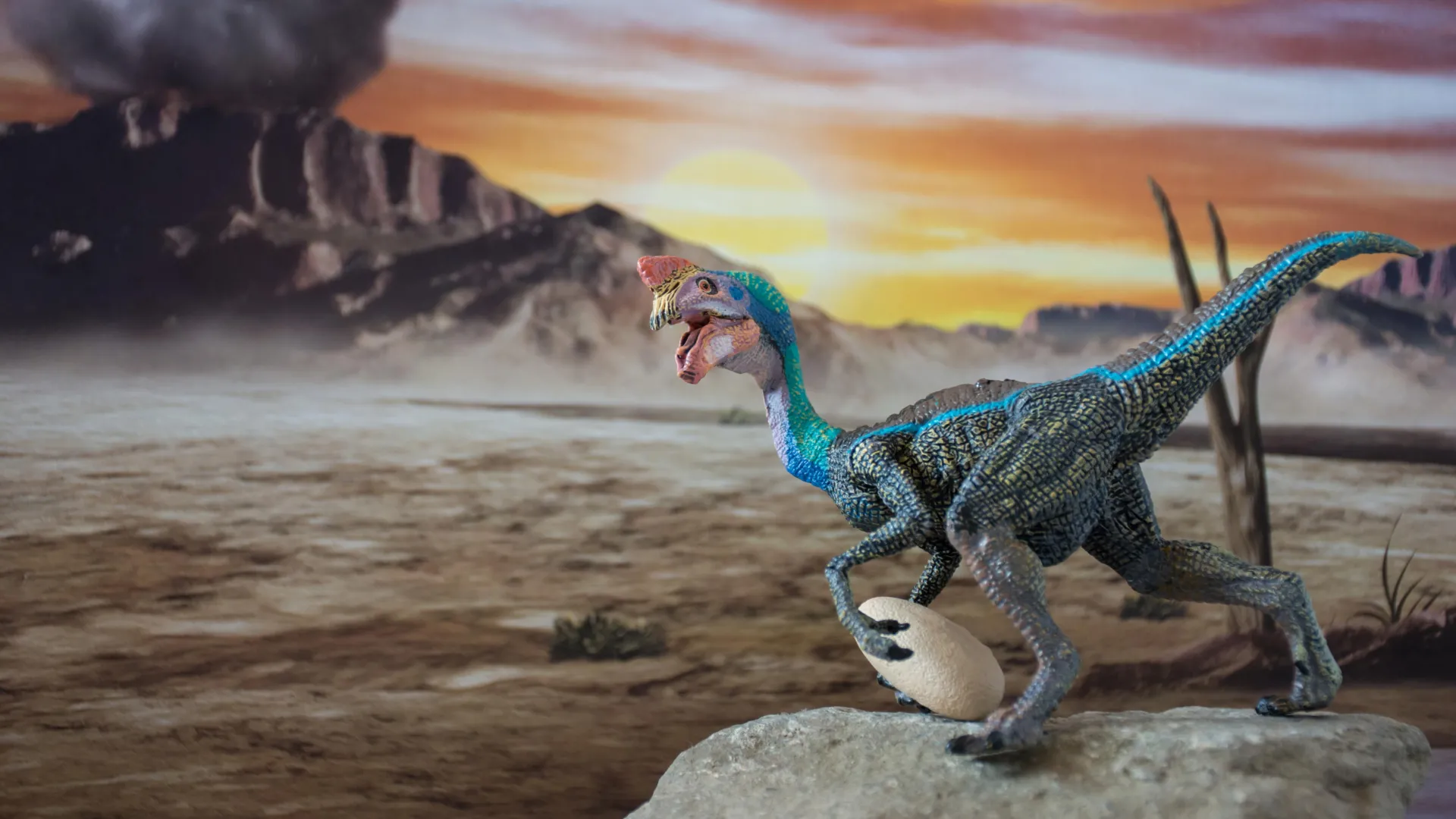
The evolutionary journey from non-avian dinosaurs to modern birds has long captivated both the scientific community and the general public. Among the most intriguing links in this evolutionary chain are the oviraptors—a group of feathered, bipedal dinosaurs that roamed the Earth during the Late Cretaceous Period, roughly 100 to 66 million years ago. While researchers have spent decades studying their skeletal structures, diets, and nesting grounds, how these prehistoric creatures brought their young into the world has remained a persistent evolutionary mystery. Could these flightless, bird-like animals incubate their eggs with the precision of modern avians, or did they rely more heavily on environmental heat sources, akin to modern-day reptiles like crocodiles and turtles?
A groundbreaking study recently published in the scientific journal Frontiers in Ecology and Evolution has cast fresh light on this ancient reproductive behavior. Spearheaded by researchers in Taiwan, the study bridges a critical gap in paleontology by combining rigorous physical experiments with advanced computer simulations. By constructing a life-sized model of an oviraptor and pairing it with artificial resin nests, the scientific team has successfully mapped out how these dinosaurs warmed their clutches and how efficiently their offspring hatched. The findings suggest that oviraptor parenting was a unique, hybrid process—one where the brooding adult and the sun acted as co-incubators, operating under a system fundamentally different from anything seen in the natural world today.
Recreating the Cradle of a Late Cretaceous Predator
To understand the mechanics of dinosaur brooding, the research team focused on a specific, well-documented oviraptor species: Heyuannia huangi. Living between 70 and 66 million years ago in the arid and semi-arid environments of what is now China, Heyuannia huangi was a relatively compact creature, measuring roughly 1.5 meters (nearly 5 feet) in length and weighing about 20 kilograms (44 pounds). Crucially, fossil records show that this species constructed semi-open nests arranged in intricate, multi-layered rings of elongated eggs.
Recreating this prehistoric nursery required an extraordinary engineering effort. The research team built a life-sized physical model of the adult dinosaur. The torso was constructed using a sturdy wooden framework and lightweight polystyrene foam, while layers of cotton, specialized cloth, and bubble paper were meticulously applied to simulate the soft tissues and muscle mass of a living animal.
Manufacturing the eggs posed an even greater challenge. Because oviraptor eggs possess unique morphological characteristics that do not match the eggshell structures of any living species, the team had to cast custom resin eggs. These artificial eggs were then arranged in precise double-ring formations to replicate the exact spatial layouts preserved in fossilized nests discovered across Asia.
"Part of the difficulty lies in reconstructing oviraptor incubation realistically," noted Chun-Yu Su, the study’s first author, who was a high school student at Washington High School in Taichung when the research was conducted. "For their eggs are unlike those of any living species, so we invented the resin eggs to approximate real oviraptor eggs as best as we could."
The Sun and the Skin: Dissecting Thermal Dynamics
With the physical model and nests prepared, the researchers subjected the setup to various thermal and environmental simulations to observe how heat transferred from the adult’s body and the surrounding environment to the developing eggs.
The experiments revealed a stark contrast in incubation outcomes depending on ambient weather conditions. Under cooler atmospheric conditions, eggs located in the outer ring of the nest—further away from the central brooding body of the adult—exhibited temperature discrepancies of up to 6 degrees Celsius compared to inner eggs. In biological terms, such a substantial thermal gradient would have triggered asynchronous hatching, a phenomenon where eggs within the same clutch hatch at different times over a span of several days or even weeks.
Conversely, when the researchers simulated warmer environmental conditions, the temperature gap between the inner and outer rings dropped dramatically to just 0.6 degrees Celsius. This dramatic shift highlighted the crucial role that solar radiation played in the process. Rather than relying solely on the body heat of the parent, oviraptors living in warm, open environments depended heavily on sunlight to supplement nest temperatures.
Dr. Tzu-Ruei Yang, senior author of the study and an associate curator of vertebrate paleontology at Taiwan’s National Museum of Natural Science, elaborated on this behavioral strategy. "It’s unlikely that large dinosaurs sat atop their clutches. Supposedly, they used the heat of the sun or soil to hatch their eggs, like turtles. Since oviraptor clutches are open to the air, heat from the sun likely mattered much more than heat from the soil," Yang explained.
Oviraptors Versus Modern Birds: A Different Class of Care
To fully appreciate the significance of these findings, scientists must compare oviraptor brooding habits with thermoregulatory contact incubation (TCI)—the strategy utilized by nearly all modern birds.
True TCI depends strictly on three biological and behavioral conditions:
- The brooding parent must maintain direct physical contact with every individual egg in the clutch.
- The parent must serve as the primary, dominant source of thermal energy.
- The parent must maintain all eggs within a remarkably narrow, tightly regulated temperature range to ensure synchronous hatching.
The physical and thermal data gathered by the Taiwan-based team indicate that oviraptors simply could not meet these rigorous requirements. Due to the wide, semi-open architecture of their nests and the sheer geometry of their bodies, adult oviraptors were incapable of making direct, simultaneous contact with every egg in their multi-layered clutches.
Consequently, the researchers concluded that oviraptors and ambient sunlight functioned as co-incubators. While this cooperative thermal strategy resulted in an overall incubation efficiency significantly lower than that of modern birds, the researchers caution against viewing this as an evolutionary failure or an inferior trait.
"Moreover, we obtained an estimate of the incubation efficiency of oviraptors, which is much lower than that of modern birds," Su noted. However, Dr. Yang emphasized that the comparison should not be framed as a competition.
"Modern birds aren’t ‘better’ at hatching eggs. Instead, birds living today and oviraptors have a very different way of incubation or, more specifically, brooding," Yang pointed out. "Nothing is better or worse. It just depends on the environment."
Historical Background: Misunderstood Predators Turned Devoted Parents
The shifting understanding of oviraptor biology represents one of the most compelling narrative arcs in modern paleontology. When the first oviraptor fossil was unearthed in Mongolia during the early 20th century, it was discovered directly on top of a nest filled with fossilized eggs. At the time, scientists assumed the dinosaur had been caught in the act of raiding a nest belonging to another species. This assumption inspired the genus name Oviraptor, which translates directly from Latin as "egg thief."
For decades, this reputation stuck. It was not until the late 20th century, with the discovery of more pristine fossil specimens—including embryonic remains preserved inside the very eggs the adults were sitting upon—that paleontologists realized the tragic truth. The fossilized dinosaurs were not raiding the nests; they were brooding parents protecting their unhatched offspring from predators and environmental hazards, often dying valiantly atop their clutches during sudden sandstorms or geological disasters.
Today, oviraptors are recognized as vital evolutionary waypoints. Their avian-like features—including complex feather coverts, furcula (wishbones), lightweight pneumatic bones, and dedicated parental care—prove that many behavioral and physiological traits long thought unique to modern birds actually originated deep within the theropod lineage, millions of years before the first true bird took flight.
Implications for Future Paleontological Research
While the new study provides unprecedented quantitative data regarding dinosaur reproduction, the authors acknowledge certain limitations. The mathematical and physical models were calibrated to a specific nest reconstruction and modern climatic baselines. Earth’s atmosphere, atmospheric pressure, and solar radiation levels during the Late Cretaceous Period varied from contemporary conditions, factors that would have subtle influences on thermodynamic heat transfer. Furthermore, comparative biological data suggests that oviraptors likely required longer overall incubation periods than modern avian species.
Nonetheless, the methodological approach pioneered by this research team opens exciting new avenues for the study of ancient life. By merging tactile physical reconstruction with advanced thermal fluid and heat transfer modeling, scientists can now quantitatively interrogate complex behavioral questions that have historically eluded researchers relying solely on static fossil bones.
Beyond its academic contributions, the study serves as an inspiring milestone for the international scientific community in regions far removed from traditional fossil-rich excavation sites. Dr. Yang highlighted this aspect with personal pride, noting the collaborative nature of the project and its inclusion of young researchers.
"It also truly is an encouragement for all students, especially in Taiwan," Yang concluded. "There are no dinosaur fossils in Taiwan, but that does not mean that we cannot do dinosaur studies."
As analytical techniques continue to evolve, the ancient world continues to surrender its secrets, proving that even millions of years after extinction, the devoted parents of the Late Cretaceous still have much to teach us about the enduring nature of life.
