
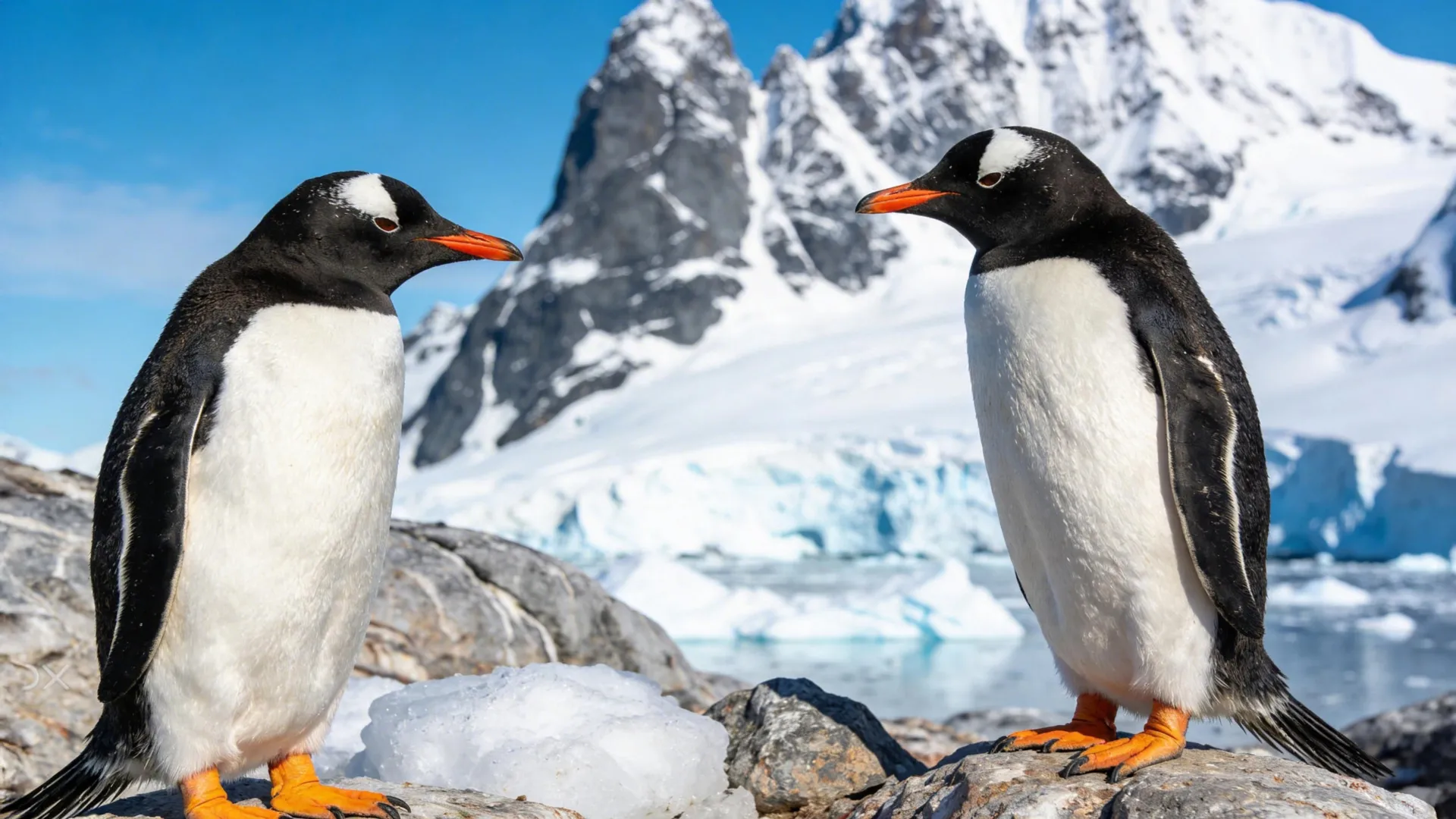
For more than a century, the gentoo penguin has stood as a singular, uniform entry in taxonomic databases, recognized broadly across the Southern Hemisphere by its distinctive white head stripe and bright orange-red bill. Yet, beneath this familiar exterior lies a profound biological secret. A comprehensive international genomic study has revealed that what science long categorized as a single widespread species is actually four distinct, genetically isolated species—including one entirely new to formal classification. Published in the journal Communications Biology, the findings mark the first time a new penguin species has been officially named in more than 100 years.
The discovery stems from a massive collaborative effort led by researchers in Chile and at the University of California, Berkeley. By sequencing the whole genomes of gentoo penguins from across their sprawling sub-Antarctic and Antarctic range, the research team has finally settled a century-old taxonomic debate. However, this reclassification is more than an academic milestone; it carries urgent conservation implications. As global temperatures rise and marine ecosystems shift, these newly defined species face drastically different futures, forcing international governing bodies to rethink how they protect the southernmost reaches of the planet.
A Century of Taxonomic Confusion and Genomic Resolution
The debate over gentoo taxonomy (Pygoscelis papua) dates back decades, with previous generations of biologists proposing up to six distinct subspecies based on minor variations in body size, plumage, and geographic distribution. Lacking the tools to peer into the underlying DNA of isolated island populations, however, earlier scientists struggled to reach a consensus.
To break this historical deadlock, UC Berkeley Museum of Vertebrate Zoology curator Rauri Bowie, Andrés Bello National University professor Juliana Vianna, and University of Chile professor Elie Poulin assembled a global consortium of penguin specialists. The team analyzed whole-genome sequences from 64 individual penguins gathered across 10 distinct breeding colonies, representing the most exhaustive geographic sampling of gentoo populations ever undertaken.
Led by University of Chile graduate student and first author Daly Noll, the researchers evaluated thousands of genetic variations known as single nucleotide polymorphisms (SNPs). They paired this genetic data with behavioral and physical observations, analyzing variations in vocalizations, breeding schedules, diets, and coloration.
The genomic evidence proved definitive. What was once considered a single species splits cleanly into four lineages that evolved in isolation over the past 300,000 to 500,000 years. Among them is a cryptic species residing on the remote Kerguelen Islands—nearly 2,000 miles from any permanently inhabited landmass—which had never been formally recognized. Furthermore, three populations previously designated as subspecies have been elevated to full species status based on their profound genetic divergence.
An Evolutionary Tapestry Forged by Geography and Diet
To understand how a single ancestral lineage diversified into four separate species, researchers had to look deep into the evolutionary history of penguins. Previous research published by Bowie and Vianna established that modern penguins originated near Australia and New Zealand approximately 22 million years ago. As Antarctica and the surrounding oceans cooled and shifted, lineages diverged. Emperor and King penguins split early on, anchoring themselves to the extreme cold of the Antarctic and sub-Antarctic islands, respectively.
Approximately 12 million years ago, the strengthening of the Antarctic Circumpolar Current created a powerful oceanic conveyor belt. This current facilitated the dispersal of other penguin groups across the Southern Ocean, allowing them to colonize isolated archipelagos and eventually reach as far north as the coasts of South America and Africa.
For gentoo penguins, survival and diversification were heavily influenced by two factors: geographical isolation and dietary flexibility. Unlike many of their penguin relatives, which rely heavily on a narrow range of prey such as Antarctic krill, gentoos are opportunistic feeders. They consume an eclectic diet of fish, squid, cuttlefish, and various crustaceans.
Ironically, this dietary flexibility helped drive speciation. Because gentoos could find adequate sustenance near their breeding grounds without undertaking massive migrations, they routinely returned to the same nesting sites year after year. Over millennia, populations stranded on distant, wind-swept islands adapted to their specific local environments. Natural selection subtly altered their genomes, while geographic boundaries—most notably the Antarctic Polar Front, a turbulent oceanic zone where water temperatures and salinity shift abruptly—prevented interbreeding between distant colonies.
Mapping the Four Gentoo Lineages
The genomic analysis mapped the four distinct gentoo species to specific geographical and ecological niches across the Southern Hemisphere:
- The Northern Gentoo (Pygoscelis papua): Confined primarily to the Falkland (Malvinas) Islands and Martillo Island in South America, this lineage inhabits warmer waters north of the Polar Front. Genomic analysis revealed enrichments in genes related to digestion, heart contraction, and muscle excitation, likely supporting the sustained physical activity required for prolonged foraging in these regions.
- The Eastern Gentoo (Pygoscelis taeniata): Inhabiting the Crozet, Marion, and Macquarie Islands, this lineage displays genetic adaptations focused on efficient carbohydrate metabolism and enhanced diving performance. Traits linked to oxygen transport, blood vessel formation, mitochondrial activity, and lung development allow these birds to remain underwater longer in oceans with relatively low biological productivity.
- The Southeastern Gentoo (Pygoscelis kerguelensis): This is the newly recognized cryptic species, native to the Kerguelen Islands (known in French as the Desolation Islands) and likely the nearby Heard Island. Situated near the Antarctic Polar Front, this relatively small, isolated population remained unrecognized for generations due to its striking physical similarity to other gentoos.
- The Southern Gentoo (Pygoscelis ellsworthi): Representing the most numerous lineage, this species inhabits the Antarctic Peninsula, coastal Antarctica, and South Georgia Island. Genetically distinct for life in extreme polar conditions, these penguins carry a higher concentration of genes associated with heat production, fat and lipid storage, and specialized light perception to cope with dramatic seasonal shifts in daylight and intense solar reflection off sea ice.
Divergent Fates in a Warming World
As global climate change reshapes the polar and sub-Antarctic regions, the newly defined gentoo species face starkly divergent environmental pressures. The research team utilized climate models to project habitat availability for the year 2050 under moderate warming scenarios.
The outlook is alarming for the island-dwelling sub-Antarctic species. The northern, eastern, and southeastern gentoos risk losing suitable habitat across their current island ranges. Because these islands are deeply isolated and surrounded by expansive deep oceans, the birds have nowhere to migrate when their local environments warm.
"In terms of climate change, island species that have really low population sizes could be compared with the sub-Antarctic gentoo penguins," noted senior author Juliana Vianna. Drawing parallels to other imperiled island endemics, she warned that like Galápagos penguins, these populations cannot easily colonize alternative regions.
Conversely, the southern gentoo (Pygoscelis ellsworthi) in Antarctica may prove remarkably resilient. Climate projections suggest that as sea ice retreats and conditions warm along the continental margins, the southern gentoo’s suitable range could actually expand. While other iconic Antarctic residents—such as Emperor, Adélie, and chinstrap penguins—struggle with collapsing krill populations and disappearing sea ice, gentoos on the Antarctic Peninsula have demonstrated a capacity for population growth.
A Call for Multi-Nation Conservation Frameworks
The elevation of gentoo penguins into four distinct species transforms the landscape of wildlife management in the Southern Hemisphere. Because the sub-Antarctic islands are governed by a patchwork of nations—including Chile, France, South Africa, Australia, New Zealand, the United Kingdom, and the Netherlands—protecting these birds requires unprecedented international cooperation.
"It’s very important that conservation institutions in all the different countries involved recognize and take appropriate action to save these three gentoo penguin species," Vianna emphasized.
Beyond climate change, these island populations face a litany of anthropogenic threats, including warming ocean temperatures, habitat destruction, predation by introduced species like rats and feral dogs, competition with commercial fisheries, and accidental entanglement in fishing gear.
Furthermore, the implications of this research extend far beyond taxonomy. By establishing a robust, whole-genome baseline for penguin populations, scientists have unlocked powerful new tools for conservation biology. Vianna and her colleagues are already utilizing the genomic dataset to investigate genetic markers associated with resistance to avian influenza—a devastating virus currently threatening wild bird and mammal populations across the globe. By identifying which populations carry natural resistance and which remain highly vulnerable, conservationists can better prioritize intervention strategies.
As the scientific community digests the implications of the study, the message from the sub-Antarctic islands is clear. The gentoo penguin is no longer a single, resilient monolith capable of absorbing environmental shocks anywhere it roams. Instead, it is a diverse family of species, each uniquely sculpted by evolution to fit a specific corner of the globe—and each requiring targeted, localized protection to survive the century ahead.
