
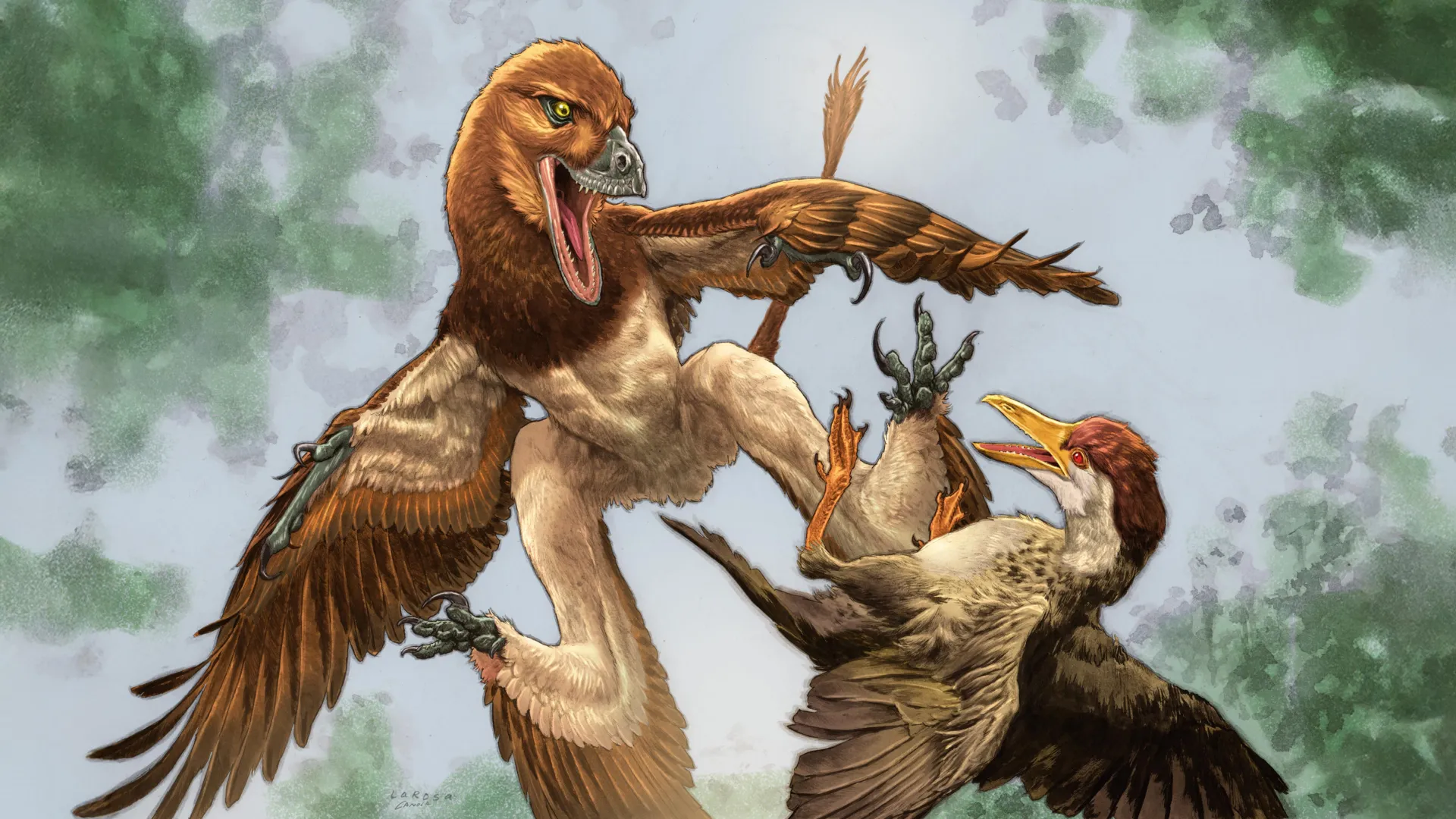
Paleontologists working in the hyper-arid badlands of northwestern China have solved a long-standing ecological mystery that has puzzled the scientific community for decades. A remarkable fossil site in the Changma Basin of Gansu Province, renowned globally for yielding hundreds of exquisite prehistoric bird remains, has finally surrendered a piece of the puzzle regarding who—or what—was hunting these ancient avian species. For years, researchers had documented clusters of shattered, compressed bird bones preserved in pellet-like masses eerily reminiscent of the regurgitations produced by modern owls. While these distinctive fossilized deposits strongly implicated a larger, predatory animal, direct physical evidence of the culprit remained frustratingly elusive.
That void has now been filled with the formal description of a newly identified dinosaur species. Published in the Annals of Carnegie Museum, a comprehensive new study details the discovery of a previously unknown feathered carnivore that prowled the ancient landscapes of the Cretaceous period. The newly christened dinosaur, Jian changmaensis, is a close relative of the famous Velociraptor and belongs to a specialized subgroup of dromaeosaurs known as microraptors. Armed with distinct morphological features in its arm and shoulder bones, alongside its imposing size relative to the local fauna, Jian is now prime suspect number one for the mysterious bird bone accumulations that have captivated and confused paleontologists for years.
This breakthrough not only identifies a formidable prehistoric predator but also illuminates the complex ecological dynamics of a critical evolutionary epoch, offering fresh perspectives on how early birds coexisted with their predatory, non-avian cousins millions of years before an asteroid impact forever altered the trajectory of life on Earth.
Decoding the Changma Mystery: A Trail of Shattered Bones
The Changma fossil deposit in Gansu province has long been celebrated as one of the world’s most significant windows into early Cretaceous avian history. Over decades of painstaking excavation, international and domestic research teams have unearthed more than a hundred fossilized specimens of early birds, revealing a diverse, thriving ecosystem of primitive flying fauna. However, nestled among these delicate skeletons were unusual geological anomalies: dense, compressed clusters of fragmented bird bones.
To evolutionary biologists, the morphology of these bone beds bore an unmistakable signature. Modern owls consume their prey whole or in large chunks, digesting the consumable soft tissues before regurgitating compact pellets composed of indigestible bones, feathers, and fur. The discovery of remarkably similar bone accumulations in the Changma Basin suggested that an analogous predatory mechanism was at play during the Cretaceous. Yet, despite decades of searching, excavations failed to turn up any teeth, claw marks, or skeletal remains of a predator that could account for these remains—until now.
"Scientists have found these weird, broken-up clusters of bird bones at this site, and we didn’t know what made them. This new microraptor dinosaur, Jian changmaensis, is our best guess," explains Dr. Jingmai O’Connor, associate curator of fossil reptiles at the Field Museum in Chicago and the senior author of the study describing the new species. "It’s the only dinosaur found at this site that wasn’t a bird, it was a carnivore, and it was much bigger than everything else that we’ve found there."
The singularity of the find is striking. While avian fossils are abundant in the basin, Jian changmaensis represents the sole non-avian dinosaur discovered at the locality to date. This scarcity underscores its ecological role: rather than living in massive, social packs, apex or mesopredators like Jian may have maintained wide territories, occasionally visiting the lake environments where prehistoric birds congregated.
Anatomy of a Prehistoric Predator: A Feathered Relative of Velociraptor
To understand the evolutionary significance of Jian changmaensis, scientists must place it within the broader context of theropod dinosaurs. Today, modern birds stand as the sole surviving lineage of dinosaurs, having miraculously endured the catastrophic Cretaceous-Paleogene (K-Pg) mass extinction event triggered by a massive asteroid impact approximately 66 million years ago. Long before that cataclysm, however, avian ancestors shared the globe with a rich tapestry of non-avian dinosaur groups during the Jurassic and Cretaceous periods.
Among the closest evolutionary cousins of early birds were the dromaeosaurs—a diverse clade of small- to medium-sized, highly agile, feathered theropods. Popularized globally by cinematic franchises like Jurassic Park, Velociraptor is the most famous representative of this group, though scientific reality paints a far more avian-like portrait of these animals than Hollywood blockbusters suggest. Real dromaeosaurs were densely covered in intricate plumage, possessing sophisticated skeletal adaptations geared toward agility, balance, and precision hunting.
Jian changmaensis belongs to a specialized branch of dromaeosaurs known as the microraptors. While the vast majority of known microraptor species were diminutive creatures—some scaling no larger than a modern crow—Jian breaks the mold by pushing the upper limits of the subgroup’s physical dimensions.
"Jian is one of the biggest microraptor specimens that has ever been found," notes O’Connor. "The piece of its upper arm bone that we have is about 4 inches long, so the entire dinosaur probably had something like a four-foot wingspan, around the size of a barn owl."
Although the fossil record for this specific specimen is currently limited to partial arm and shoulder elements, comparative anatomy allows paleontologists to reconstruct its probable morphology with a high degree of confidence. The diagnostic features preserved in the humerus and pectoral girdle provide the definitive clues that link Jian to the unique biomechanics of microraptors, setting the stage for its lifestyle as an arboreal or semi-arboreal glider.
The Four-Winged Glider: Mechanics and Mythology
One of the most fascinating aspects of microraptors is their distinctive integumentary system. Fossil evidence from related species in other deposits across China has revealed that these animals were blessed with elaborate, asymmetrical flight feathers on not only their forelimbs but also their hind limbs, effectively granting them two pairs of wings.
While aerodynamic analyses indicate that Jian and its kin lacked the robust pectoral musculature and skeletal fusion required for powered, flapping flight akin to modern sparrows or eagles, they were brilliantly adapted for life in the canopy.
"Jian and the other microraptors probably weren’t capable of true, powered flight, but they could probably glide like a flying squirrel," O’Connor observes.
This gliding capability would have transformed the Changma ecosystem from a purely terrestrial playing field into a three-dimensional hunting ground. Perched high in the prehistoric gymnosperms or ferns, a four-winged predator like Jian could silently launch itself from above, using its long hind-wing feathers to maneuver through dense foliage before ambushing unwary prey along the margins of ancient lakes and river systems.
The nomenclature chosen for the new species pays homage both to its ethereal, winged biology and its geographical provenance. In traditional Chinese mythology, the Jian is a legendary, mythical bird characterized by having only one eye and one wing, requiring a pair to cooperate and fly in harmony. Meanwhile, the specific epithet changmaensis honors the Changma Basin within Gansu province, cementing the region’s pivotal status in the annals of paleontological discovery.
Filling the Ecological Gap in the Changma Basin
The formal introduction of Jian changmaensis does more than simply name a new dinosaur; it fundamentally reshapes our comprehension of Cretaceous food webs. For years, the profound asymmetry of the Changma fossil record—overflowing with birds yet entirely devoid of the terrestrial carnivores that would have kept their populations in check—baffled researchers attempting to reconstruct the ancient food chain.
Dr. Matt Lamanna, corresponding author of the study and the Mary R. Dawson Curator of Vertebrate Paleontology at the Carnegie Museum of Natural History, emphasizes the critical role this discovery plays in paleoecology.
"Jian changmaensis reveals that non-avian dinosaurs lived in what is now the Changma Basin, an area famous for its fossil birds," says Lamanna. "Our team has recovered more than a hundred bird fossils at Changma, but only this single non-avian dinosaur specimen. Jian provides critical new insight into the biological history of the Changma region and the ecological context of the ancestors of today’s birds."
By establishing the presence of an agile, mid-sized arboreal predator in the immediate vicinity of major bird nesting and feeding grounds, the discovery bridges a missing link in trophic interactions. It confirms that the prehistoric avians of Changma faced constant predation pressure from sophisticated, feathered hunters operating within the same habitat niches.
Furthermore, analyzing these intricate predator-prey dynamics offers invaluable context regarding the evolutionary pressures that shaped early avian morphology. Understanding how early birds defended themselves, adapted their flight strategies, and navigated environments shared with dangerous, close-relative competitors helps scientists isolate the unique biological traits that ultimately allowed one single lineage of dinosaurs to survive the apocalyptic events of the Cretaceous-Paleogene extinction.
Broader Implications and Future Research Directions
The collaborative research behind the identification of Jian changmaensis highlights the global and multidisciplinary nature of modern paleontology. The international research team behind the study features an esteemed roster of specialists, including Ling-Qi Zhou of the Gansu Geological Museum, Matthew Lamanna of the Carnegie Museum of Natural History, Ashley Poust of the University of Nebraska State Museum and the University of California Museum of Paleontology, Da-Qing Li of Gansu Agricultural University, Hai-Lu You of the Institute of Vertebrate Paleontology and Paleoanthropology at the Chinese Academy of Sciences, and Jingmai O’Connor of the Field Museum.
As these institutions continue to analyze existing collections and prospect new outcrops within the Changma Basin, expectations remain high that additional skeletal elements of Jian will eventually be unearthed. Discoveries of more complete skulls, vertebrae, and lower limb bones will allow researchers to refine estimates of the dinosaur’s exact weight, running speed, and visual acuity, further verifying whether its digestive habits truly align with the mysterious bone pellets discovered at the site.
Ultimately, the unveiling of Jian changmaensis serves as a poignant reminder of how much remains to be learned about the deep history of our planet. As O’Connor aptly summarizes, investigating the origins of the world’s most successful surviving land vertebrates is essential to understanding contemporary biodiversity.
"You cannot understand life on the planet today without looking at its origins," O’Connor concludes. "Birds are arguably the most successful group of land-dwelling vertebrate animals on Earth today. Learning about early birds and their close non-bird dinosaur relatives gives us a better understanding of what made the group of birds that survived so special."
Through meticulous fieldwork, advanced anatomical analysis, and a commitment to interdisciplinary collaboration, scientists are slowly piecing together the vibrant, complex tapestry of a Cretaceous world where feathered predators glided through the shadows, leaving behind clues that continue to captivate science more than a hundred million years later.
