
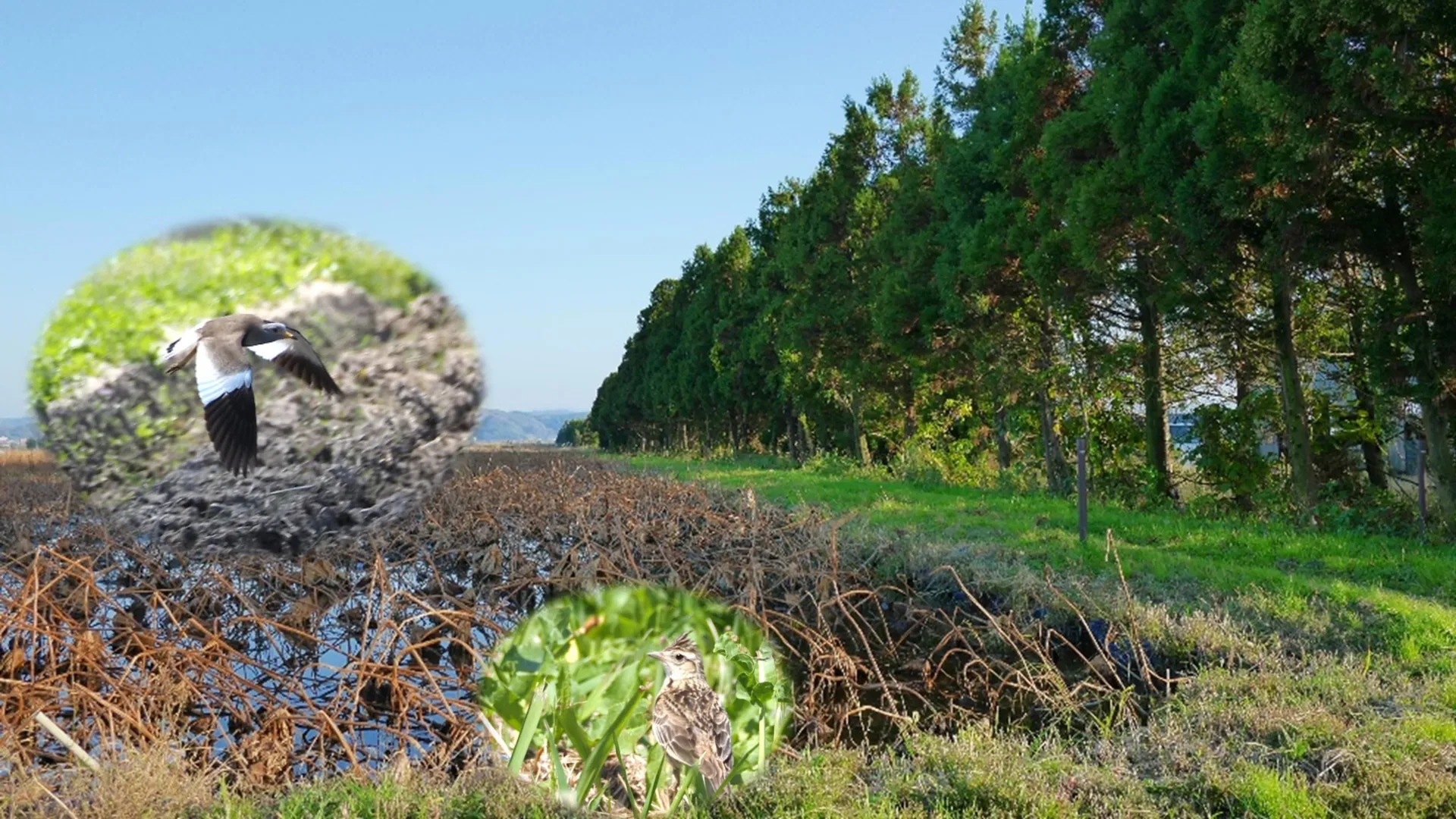
The modern push for agricultural sustainability often relies on a straightforward, globally accepted rule: plant more trees. Across North America, Europe, and parts of Asia, conservation initiatives routinely encourage farmers to introduce hedgerows, wooded patches, and windbreaks—collectively known as shelterbelts—to bolster biodiversity, prevent soil erosion, and capture carbon. For decades, these arboreal networks have been championed as ecological assets that transform sterile crop fields into thriving sanctuaries for wildlife. However, a comprehensive new study published in the Journal of Environmental Management challenges this universal greening dogma, revealing a complex ecological trade-off that threatens vulnerable wildlife populations in agricultural wetlands.
Led by an international team of researchers from institutions including Hiroshima University, The University of Tokyo, and Kyoto University, the study investigates the effects of shelterbelts on bird communities in the wet-farming landscapes of central Japan. While these linear rows of trees successfully cultivate habitats for shrub-loving and edge-adapted bird species, they simultaneously trigger steep declines in the abundance and diversity of birds that rely on vast, unobstructed vistas. The findings highlight a critical oversight in global conservation planning: when tree planting is applied indiscriminately across modified wetland ecosystems, it can inadvertently marginalize the very species that depend on open environments for survival.
Unpacking the Ecological Paradox of Agricultural Wetlands
To understand the weight of these findings, researchers emphasize the dual nature of agricultural wetlands, particularly rice paddies. Spanning millions of hectares across Asia and other parts of the world, these intensely managed landscapes serve a dual purpose. Primarily, they are critical nodes in global food security, feeding billions of people. Simultaneously, because natural wetlands have suffered catastrophic global declines due to human development, agricultural wetlands function as vital substitute ecosystems.
These human-made wet environments provide sanctuary for a vast array of wildlife, acting as critical stopover, wintering, and breeding grounds for migratory birds traveling along major international flyways, such as the East Asian-Australasian Flyway. Nearly 300 bird species have been documented utilizing these dynamic agricultural zones. Consequently, environmental managers face a delicate balancing act. Introducing trees to protect crops from fierce seasonal winds can alter the physical architecture of the landscape, turning open feeding and nesting grounds into fragmented, enclosed spaces.
"The central question of our study is, ‘Do shelterbelts and other woody linear features benefit all farmland birds equally in agricultural wetland landscapes, or do they create trade-offs by disadvantaging species that depend on open habitats?’" said corresponding author Masumi Hisano, an assistant professor at Hiroshima University’s Graduate School of Advanced Science and Engineering.
Chronology and Methodology of the Lake Kahokugata Surveys
The empirical foundation for this study was built upon rigorous field surveys conducted around Lake Kahokugata in central Japan. This specific region represents a classic agricultural wetland matrix, characterized by expansive rice paddies interspersed with lotus fields, cultivated croplands, and pasturelands. Because the geography of the area leaves it highly vulnerable to intense winter winds and severe seasonal storms from the Sea of Japan, local farmers have long relied on shelterbelts to safeguard their yields.
At the same time, Lake Kahokugata holds immense ecological significance as a designated stopover and destination along the East Asian-Australasian Flyway. The region experiences distinct seasonal shifts in avian populations, hosting wintering species that brave the colder months in the flooded paddies, and welcoming breeding species during the warm summer months.
To capture these seasonal shifts and measure avian responses to landscape structure, the research team deployed a meticulous point-count survey methodology across two distinct phases. The first phase took place during the height of the wintering season in February and March 2021, capturing the baseline distribution of cold-weather visitors. The second phase was executed in June 2023, allowing researchers to evaluate breeding populations and summer-resident dynamics. By sampling sites adjacent to shelterbelts as well as open control sites located roughly one kilometer away, the team gathered robust comparative data on bird abundance, species richness, and community composition.
Winners and Losers: Quantifying the Impact of "Ecological Walls"
The data collected around Lake Kahokugata exposed a stark dichotomy in how different avian guilds respond to linear woodland features. The surveys revealed that shelterbelts successfully functioned as habitats for generalist species, woodland birds, and edge-dwellers. However, this local enrichment came at a severe ecological cost to open-habitat specialists.
Most notably, the research team documented a dramatic reduction in population metrics for grassland and wetland-dependent birds. According to the study, the abundance of grassland birds was more than 70 percent lower at monitoring sites immediately adjacent to shelterbelts compared to open control sites situated one kilometer away. Furthermore, overall species diversity among wetland-dependent birds plummeted in the shadow of the trees.
Dr. Hisano and her colleagues conceptualized this phenomenon through a vivid structural metaphor. "A useful way to think about this is that shelterbelts act like ecological walls," Hisano explained.
Rather than serving as neutral additions to the scenery, these narrow bands of trees fundamentally alter the behavioral ecology of the landscape. For open-habitat birds, which rely on unobstructed lines of sight to detect approaching predators and locate foraging patches, towering rows of trees introduce physical and visual barriers. These linear features not only reduce the total usable surface area for ground-nesting and foraging species, but they also create ambush corridors for avian and terrestrial predators, thereby elevating predation risk and driving down local survival rates.
Broader Implications for Global Agri-Environmental Policy
The implications of the Hiroshima University study extend far beyond the rice paddies of central Japan. As governments and international bodies ramp up funding for climate-smart agriculture and biodiversity action plans, tree-planting campaigns are frequently deployed as a one-size-fits-all remedy for environmental degradation.
Environmental scientists and conservation planners warn that failing to account for regional landscape history and ecosystem type can lead to well-intentioned policies backfiring. In regions historically dominated by forests or shrublands, hedgerows and shelterbelts are natural restorative elements. However, in naturally open systems—such as grasslands, steppes, and agricultural wetlands mimicking open mudflats and shallow marshes—the uncalculated addition of woody vegetation can drive native open-habitat specialists toward local extinction.
"Our study provides clear, quantitative evidence that small-scale landscape features can have large ecological consequences, directly relevant to land-use planning and environmental management," Hisano noted.
This perspective does not advocate for the wholesale removal of windbreaks or the cessation of all agricultural tree-planting initiatives. Instead, it calls for a paradigm shift from simplistic greening to nuanced, context-dependent landscape management. Biodiversity-friendly farmland management, the researchers argue, must carefully balance structural complexity with the precise ecological needs of open-habitat specialists, particularly in ecosystems that have already undergone severe anthropogenic modification.
Future Directions in Landscape Ecology
As the scientific community absorbs these findings, the research team is already looking toward the horizon to refine conservation guidelines. Future studies must delve deeper into the microscopic design parameters of shelterbelts, analyzing how specific variables—such as tree species composition, canopy height, structural width, spacing, and spatial configuration—interact with wildlife populations across different geographic regions and microclimates.
Additionally, researchers hope to unpack the complex web of indirect ecological effects triggered by windbreaks. These include examining how linear wooded features influence the ranging behavior and hunting efficiency of mesopredators, how they alter microclimates at the crop-edge boundary, and how they impact functional connectivity for non-avian taxa, such as amphibians and insects that also utilize agricultural wetlands.
Ultimately, the goal of this ongoing research is to empower policymakers, agronomists, and conservationists to design evidence-based agri-environmental policies tailored to wet-farmed landscapes worldwide. Moving away from rigid, dogmatic prescriptions like planting trees everywhere will allow planners to embrace sophisticated, landscape-level zoning. By strategically combining open wetland habitats with targeted woody features, agricultural regions can maintain high crop productivity while safeguarding the rich biological diversity of migratory and resident bird populations in an era of rapid environmental change.
The study’s collaborative effort included contributions from researchers across multiple prestigious institutions, including Fukui City Museum of Natural History, the University of British Columbia, Simon Fraser University, Nihonkai Eco Engineering Technologies, Zhenjiang A&F University, and Nakano City Hall. Financial and logistical support for the project was provided by the Kahokugata Lake Institute and the Japan Society for the Promotion of Science KAKENHI, underscoring the collaborative international commitment to resolving the complex ties between modern agriculture and avian conservation.
