
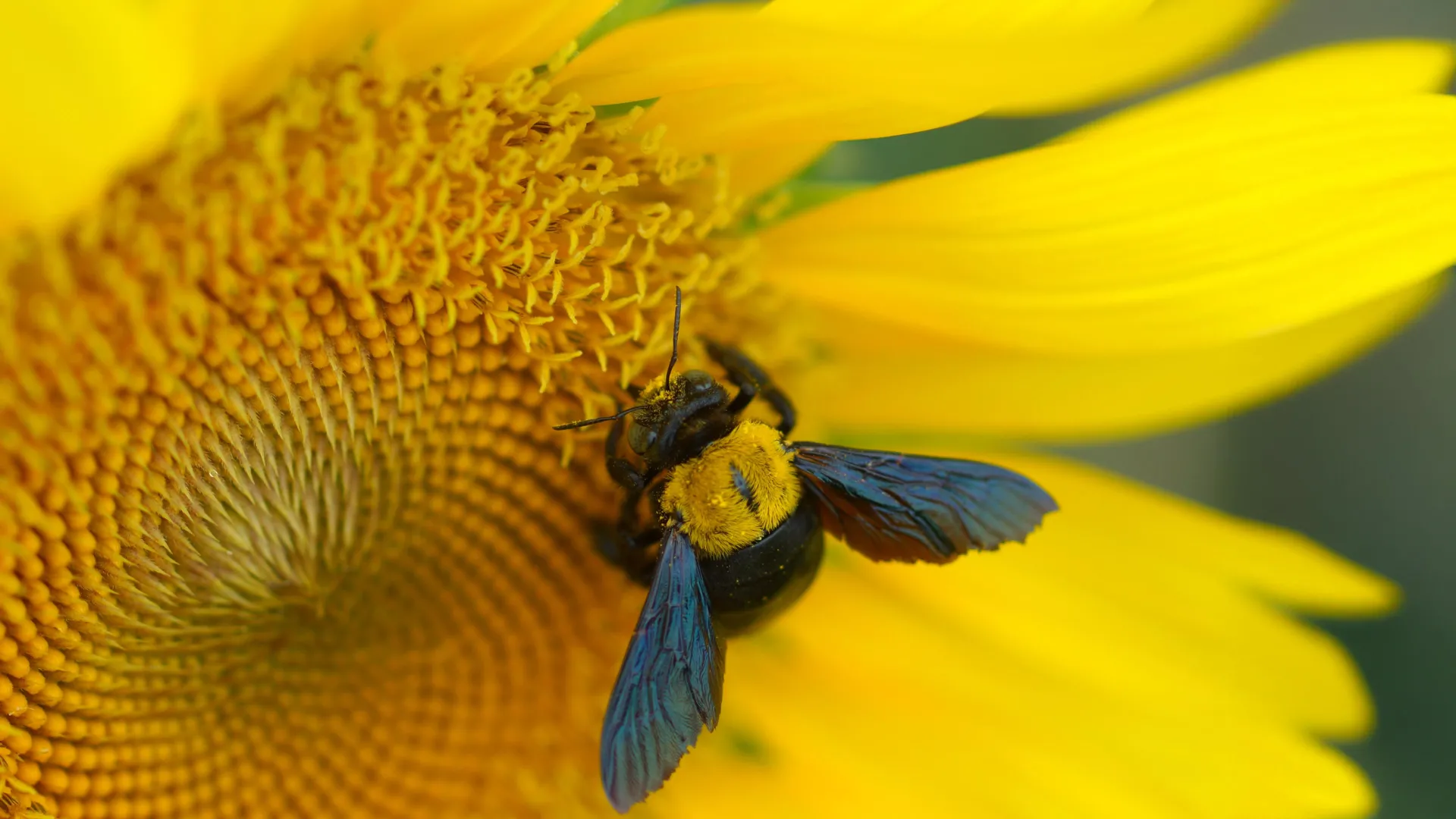
The escalating pace of global climate change is exerting unprecedented pressures on biodiversity across the globe, with recent scientific investigations revealing that insect populations are facing critical vulnerabilities that could destabilize entire ecosystems. Among these vital creatures, native bee species that construct their nests within fragile plant stems are now identified as facing the most immediate and severe threats from rising ambient temperatures. In stark contrast, their subterranean counterparts—those that burrow deep beneath the soil—appear notably better equipped to evade dangerous, potentially lethal heat waves through natural insulation.
These pivotal findings emerged from a comprehensive multi-institutional study recently published in the esteemed scientific journal Nature Communications. The research project undertook an exhaustive examination of heat tolerance thresholds across 95 distinct native bee species. Spanning the diverse geographical landscapes of eastern mainland Australia, the study areas ranged from the tropical northern territories down to the significantly cooler southern climatic regions.
The undertaking was spearheaded by a collaborative consortium of researchers representing a broad spectrum of Australia’s leading academic institutions. Experts from Macquarie University, The University of Sydney, La Trobe University, Flinders University, University of Wollongong, Adelaide University, and The University of Queensland pooled their collective expertise. Together, they sought to unravel the complex evolutionary trajectories of heat tolerance among different bee lineages and to rigorously assess their overall vulnerability to an increasingly warming planet.
Architectural Vulnerabilities: How Nesting Habits Dictate Thermal Exposure
To fully comprehend the gravity of the study’s conclusions, one must examine the diverse reproductive and nesting behaviors exhibited by Australia’s rich entomological heritage. The continent boasts an estimated 1,700 unique native bee species, an astonishing diversity that contributes profoundly to both regional biodiversity and agricultural productivity. Ecologically, these native pollinators generally segregate into three distinct architectural categories based on their nesting preferences: those that excavate burrows directly into the earth; those that utilize pre-existing cavities in dead wood, such as rotting tree hollows and fallen branches; and those that select narrow plant stems or tiny natural holes found within twigs.
The choice of nesting real estate, as the study powerfully demonstrates, acts as a primary determinant of survival in a heating world. Underground nests benefit from the profound thermal buffering capacity of soil, which maintains relatively stable temperatures even when surface air temperatures reach extremes. Conversely, above-ground habitats offer virtually no such protection.
"Bees that nest underground can hide from extreme heat – as a result, they don’t experience temperatures as high as those that live above ground, particularly species that live in thin plant stems that offer very little insulation from the heat outside," explained lead author Dr. Carmen da Silva, a Research Fellow within the Pollinator Futures Research Centre at Macquarie University in Sydney.
Dr. da Silva further emphasized the acute peril facing arboreal architects, noting that stem-nesting species appear to possess the absolute lowest capacity to escape unfavorable environmental temperatures. Consequently, these delicate insects are projected to suffer the most immediate and devastating impacts resulting from anthropogenic climate change. This structural exposure means that standard meteorological heatwaves translate directly into life-threatening microclimate crises for the larvae and adults residing within hollow twigs and thin-walled plant stalks.
Ecological Significance: Why Native Bee Survival Underpins Natural and Agricultural Systems
The potential decline or localized extinction of these native bee populations extends far beyond the realm of entomological curiosity; it poses a direct and tangible threat to the stability of natural ecosystems and global food security alike. Unlike the introduced European honeybee (Apis mellifera), which has been extensively studied and managed for commercial agriculture, native Australian bees often possess specialized symbiotic relationships with indigenous flora.
Dr. da Silva underscored the irreplaceable ecological functions these insects perform on a daily basis. "Bees are critical in ecosystems all over the world because of their role as pollinators, and they’re under threat from warming and drying climates," she noted. "Bees sustain native ecosystems and play a crucial role in agricultural crop production — tropical native bees are vital pollinators for crops like macadamia nuts, avocados, mangos, and lychees."
The agricultural implications are particularly profound. In Australia’s tropical and subtropical agricultural belts, multi-million-dollar horticultural industries rely heavily on the efficient pollination services provided by native insect species. Crops such as macadamia nuts and various exotic fruits have evolved alongside native pollinators, meaning that artificial pollination alternatives are often inefficient or economically unviable. A disruption in pollinator populations driven by thermal stress could directly trigger declining agricultural yields, cascading upward to affect market prices and food supply chain resilience.
Latitude and Risk: Tropical Bees Face Magnified Dangers
Beyond architectural nesting habits, the research team uncovered a striking geographical pattern that complicates traditional assumptions regarding thermal adaptation. Conventional ecological theory often posits that organisms residing in warmer, tropical environments possess higher physiological adaptations to heat and are therefore better insulated against global warming. However, the study’s findings challenge this simplistic paradigm.
The investigators observed that bee species inhabiting latitudes closer to the equator exhibited heightened vulnerability to ongoing climatic shifts, placing tropical native bees at the apex of overall extinction risk. This counterintuitive finding highlights the intricate mechanisms governing physiological limits in ectothermic organisms.
Dr. Vanessa Kellermann, a Senior Lecturer in the Department of Ecology, Plant and Animal Sciences at La Trobe University and a senior author of the study, pointed out that these insights underscore the immense complexity inherent in ecological forecasting. Predicting which specific animal and plant populations will succumb to global warming remains one of the most formidable challenges facing modern environmental science.
"We found bee species with the highest heat tolerance were not necessarily the safest from warming, because many of them already live in extremely hot environments," Dr. Kellermann stated.
This revelation exposes a perilous ecological reality: even species that have evolved high physiological heat tolerances are currently operating at or near their absolute thermal limits. Having already adapted to blistering equatorial or semi-arid conditions, these organisms possess virtually no evolutionary headroom or physiological safety margin left to cope with additional anthropogenic warming. When temperatures spike even fractionally above historical baselines, these highly specialized tropical populations cross critical physiological tipping points.
Uncharted Territories: The Urgent Need for Behavioral Research
Despite the critical ecological services they provide, a staggering proportion of Australia’s native insect fauna remains scientifically undescribed and ecologically misunderstood. The sheer breadth of the continent’s biodiversity means that foundational data regarding basic life history traits, foraging ranges, and thermal thresholds are still missing for hundreds of species.
Dr. Ros Gloag, co-senior author of the study and a Senior Lecturer in Evolutionary Biology in the School of Life and Environmental Sciences at the University of Sydney, emphasized that this knowledge gap hampers comprehensive conservation planning.
"We still know so little about most of Australia’s amazing native bees," Dr. Gloag remarked. "This study helps us recognise that having a better understanding of native bee behavior is key to identifying the greatest threats to their wild populations."
Without granular data detailing how different species forage, reproduce, and seek micro-refuges during extreme weather events, conservationists and government agencies struggle to formulate targeted mitigation strategies. Traditional conservation frameworks, which often prioritize large vertebrate species or broad habitat preservation, must urgently adapt to incorporate the microscopic and behavioral needs of invertebrate pollinators.
Analytical Implications: Broader Ramifications for Global Biodiversity Policy
The publication of this research in Nature Communications arrives at a critical juncture for international environmental policy. As global greenhouse gas emissions continue to track along alarming trajectories, policymakers are increasingly forced to look beyond macro-level temperature targets—such as the Paris Agreement thresholds—and evaluate microclimatic impacts on regional flora and fauna.
The study serves as a stark warning that climate change impacts are highly heterogeneous. While certain mobile or subterranean species may demonstrate resilience in the short term, sessile or structurally exposed organisms—such as stem-nesting bees—face immediate, localized population collapses. These microhabitat-level vulnerabilities demonstrate that assessing a species’ extinction risk purely through broad macro-meteorological modeling is fundamentally insufficient.
Furthermore, the findings carry profound implications for agricultural management and land-use planning. Farmers and land managers operating in tropical and subtropical regions may need to actively modify agricultural landscapes to incorporate artificial micro-refuges. Strategies such as preserving dense understory vegetation, maintaining standing dead timber, and planting diverse hedgerows could provide crucial thermal refugia for above-ground and stem-nesting bees during extreme heatwaves.
As the scientific community continues to analyze the physiological limits of native pollinators, the imperative for aggressive climate action and localized conservation intervention becomes ever more urgent. Safeguarding the future of global food webs and terrestrial ecosystems will ultimately depend on protecting the smallest and most vulnerable architects of the natural world.
