
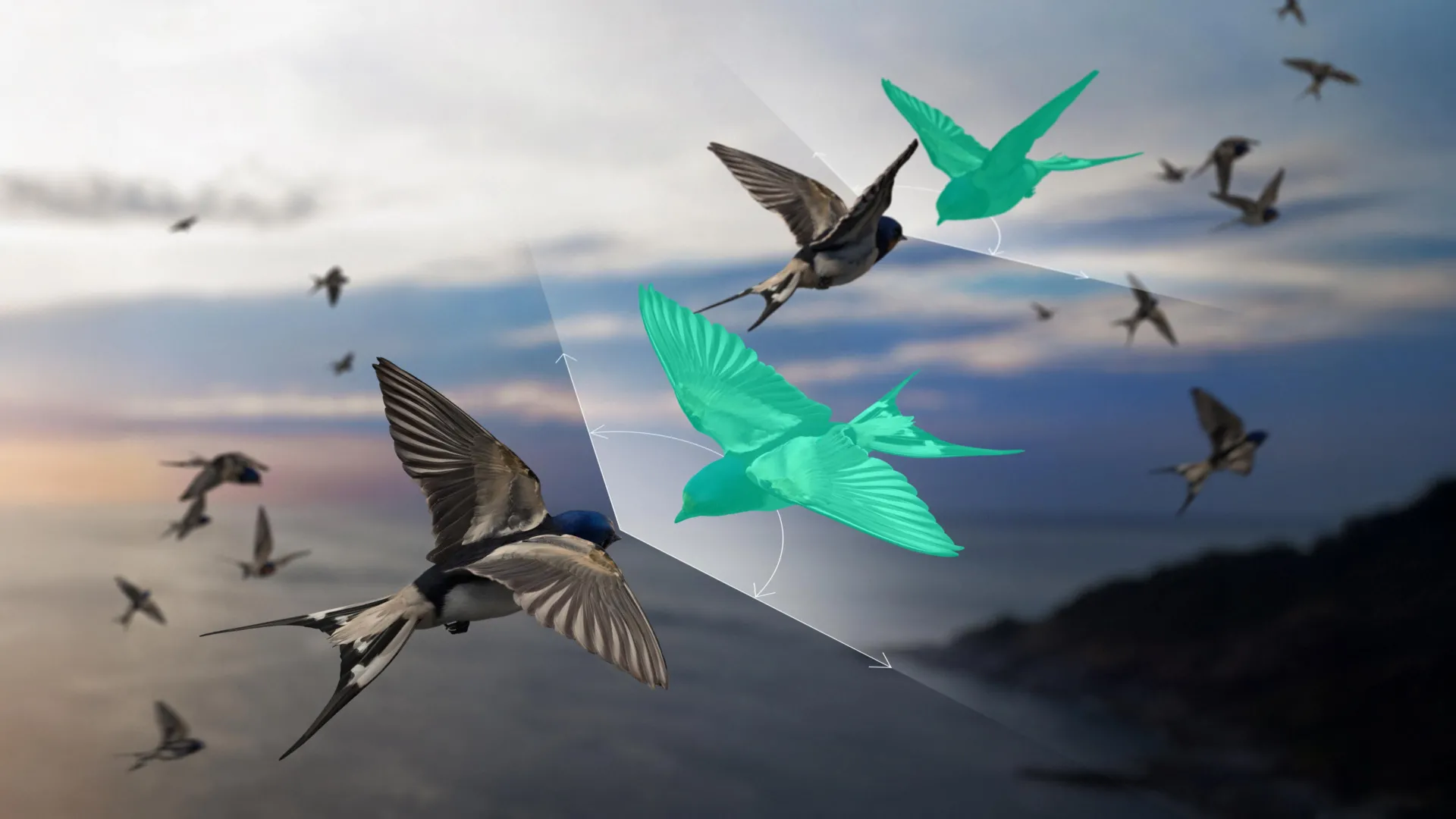
When starlings gather in massive, undulating formations known as murmurations, they create breathtaking spectacles across the evening sky. Millions of birds twist, turn, and cascade in unison, seemingly guided by a singular, collective consciousness. Yet, closer scientific observation reveals a striking limitation in their awareness. A flying bird responds exclusively to the movements of its immediate neighbors—specifically those beside it or directly ahead. It remains entirely oblivious to the birds trailing behind it.
This one-way flow of information creates an immediate theoretical dilemma for classical physics. According to Sir Isaac Newton’s third law of motion, formulated more than three centuries ago, for every action, there is an equal and opposite reaction. If bird A influences bird B, then bird B must exert a reciprocal force of equal magnitude back upon bird A. Yet, in the fluid choreography of a flock, this balance breaks down. The interaction is strictly non-reciprocal, meaning that action and reaction are fundamentally mismatched.
For generations, this asymmetry has represented a persistent blind spot in theoretical mechanics. Classical physics models, which form the bedrock of scientific education and research, are built almost entirely upon the assumption of reciprocal forces. However, a collaborative research team based in Dresden and Würzburg has finally breached this theoretical barrier. By developing a novel mathematical framework, scientists can now accurately describe and simulate non-reciprocal systems using established classical methods, potentially unlocking new frontiers in biology, sociology, and quantum physics.
The Weight of Tradition: Classical Mechanics and the Action-Reaction Principle
To understand the magnitude of the recent breakthrough, one must examine the foundational role that Newton’s third law has played in the development of modern science. Published in 1687 in the Philosophiæ Naturalis Principia Mathematica, Newton’s laws of motion transformed human understanding of the physical world. The third law, in particular, explains the fundamental symmetry of mechanical interactions.
In everyday life, this principle is intuitively obvious. When an athlete sprints across a track, their feet exert a backward force against the ground, and the ground simultaneously pushes the athlete forward with an equal and opposite force. The same foundational rule governs how internal combustion engines propel automobiles, how oarsmen navigate rivers through water displacement, and how compressed air escapes a deflating balloon to send it darting across a room.
"Whatever we normally teach our students in theoretical mechanics, it ultimately rests on the action-reaction principle," explains Marín Bukov, a research group leader involved in the recent study.
For over 300 years, this principle has served as an inviolable rule for macroscopic systems. However, as science advanced into the study of complex, multi-agent systems—ranging from microscopic bacterial colonies to human crowds—researchers increasingly encountered phenomena that refused to conform. In these systems, components selectively process information from their surroundings, creating a hierarchy of influence that flows strictly in one direction. Because traditional mathematical models were hardwired for reciprocal interactions, scientists struggled for decades to build accurate, predictive simulations of these non-reciprocal environments.
The Ubiquity of Non-Reciprocal Systems in Nature
The phenomenon of non-reciprocal interaction is far from an isolated botanical or zoological oddity; rather, it is a defining characteristic of active matter across vast scales of the universe.
Consider a dense swarm of bacteria navigating a nutrient-rich medium. Microbes propel themselves forward, sensing chemical gradients in front of them while leaving trailing wakes that physically disturb the fluid dynamics for trailing cells. The leading bacteria dictate the environment for those behind, but the trailing bacteria exert a negligible influence on the pioneers. Similarly, in dense human crowds navigating a metropolitan transit station, pedestrians continuously adjust their walking speeds and trajectories based on individuals approaching from the front or sides, largely ignoring the spatial dynamics of the crowds trailing directly behind them.
At a microscopic level, even biological tissues composed of living cells exhibit this behavior. During embryonic development or wound healing, cells migrate collectively, driven by mechanical and chemical signaling gradients that function in a strictly directional manner.
In all these scenarios, individual agents break the symmetry required by Newton’s third law. Physicists categorize these phenomena under the umbrella of non-reciprocal active matter. Prior to the recent breakthroughs, modeling these systems required ad-hoc adjustments and computationally heavy approximations that often failed to capture the true underlying dynamics. The inability to simulate these systems accurately created a significant bottleneck across multiple scientific disciplines, limiting researchers’ capacity to forecast collective crowd movements, understand biological tissue morphogenesis, or engineer synthetic active materials.
A Breakthrough in Dresden: Introducing Auxiliary Degrees of Freedom
The solution to this longstanding theoretical impasse emerged from the collaborative efforts of researchers working in Dresden and Würzburg, spearheaded by prominent physicist Roderich Moessner. Moessner serves as a Principal Investigator of the Würzburg-Dresden Cluster of Excellence ctd.qmat (Complexity, Topology and Dynamics in Quantum Matter) and directs the Max Planck Institute for the Physics of Complex Systems in Dresden.
Working alongside biophysicists and theoretical mechanics experts, the team successfully formulated and mathematically proven a new theoretical framework. This framework bridges the gap between reciprocal physics and non-reciprocal realities, allowing scientists to analyze systems previously deemed mathematically intractable.
"The research team has developed and proven a theory that makes much of what we teach our students applicable to non-reciprocal systems as well," notes Bukov. "These systems, where Newton’s third law does not apply, can now finally be described exactly and simulated precisely—even using established methods. This is exactly the kind of tool that has been missing in recent years."
The core innovation centers on extending the traditional action-reaction framework through the strategic introduction of auxiliary, or fictitious, mathematical variables. In standard physics, variables represent physical, measurable properties: a bird’s instantaneous spatial coordinates and velocity vector, a fish’s precise location within a school, or a vehicle’s telemetry data on a congested highway.
To resolve the asymmetry of non-reciprocal interactions, the research team devised a method that constructs a mathematical partner for every real component within the system. These are not physical entities existing in the natural world; rather, they are auxiliary degrees of freedom designed to absorb the directional imbalance.
"The trick behind the new theory is that it constructs a partner for each component of the system—a fictitious partner that doesn’t exist in nature," explains Ricard Alert, a biophysicist and co-author of the study. "The original non-reciprocal interactions are replaced by reciprocal interactions with these auxiliary degrees of freedom."
The Case of the Imaginary Bird: Practical Application of the Theory
Translating this abstract mathematical concept into a workable simulation model required a clear conceptual paradigm. The researchers tested their theoretical architecture on the classic model of collective animal behavior: the bird flock.
To simulate the exact aerodynamic and spatial dynamics of a flock without violating the computational assumptions of classical mechanics, the researchers utilized their auxiliary variable framework.
"To simulate the birds’ movements precisely, we describe the dynamic system ‘flock of birds’ using established methods—as if it were a reciprocal system, even though it is not," Alert elaborates. "The elegant solution is to artificially place a fictitious bird in front of each real bird, aligned in exactly the opposite direction."
In this computational setup, the imaginary partners act as mathematical balancing weights. By artificially coupling the real bird to its fictitious counterpart in a symmetrical, reciprocal manner, the complex, one-way information flow of the natural flock is effectively captured and resolved. The mathematical machinery of classical many-body physics can then process the system with high fidelity.
While the use of auxiliary degrees of freedom is an established technique in advanced theoretical physics—frequently deployed in quantum field theory and statistical mechanics—applying them specifically to resolve macroscopic non-reciprocal interactions represents a major paradigm shift.
Implications for Physics Research and Future Discoveries
The publication of these findings in the prestigious journal Nature Physics marks the conclusion of a theoretical quest, but it also opens the door to an expansive new domain of experimental and theoretical inquiry. By bringing non-reciprocal systems into the fold of traditional analytical methods, the research team has provided the scientific community with a robust toolkit for exploring complex, non-equilibrium states of matter.
Beyond animal behavior and cellular biology, the implications extend deeply into the realm of quantum matter—the primary focus of the Würzburg-Dresden Cluster of Excellence ctd.qmat. In quantum laboratories, researchers study microscopic particles that interact under extreme conditions, such as near absolute zero, giving rise to exotic macroscopic phenomena like high-temperature superconductivity, fractional quantum Hall effects, and lossless current transport.
A compelling question now facing physicists is whether these exceptions to Newton’s classical laws manifest at the quantum scale, potentially generating entirely novel forms of collective quantum behavior.
"In Würzburg and Dresden, we study quantum matter whose particles interact under certain conditions in ways that give rise to new phenomena such as magnetism or lossless current transport," says Moessner. "The exciting question now is whether these exceptions to Newton’s law lead to entirely new forms of collective quantum behavior. We still know very little about this—and that is precisely what makes this so fascinating."
As researchers begin applying the new theoretical framework across different scales—from the macroscopic choreography of bird flocks and human crowds to the microscopic dynamics of cellular tissue and quantum particles—science stands on the threshold of a broader understanding of complex systems. By looking beyond the rigid constraints of a 300-year-old law through the clever deployment of imaginary partners, physicists have illuminated a hidden symmetry within nature’s most asymmetrical dances.
