
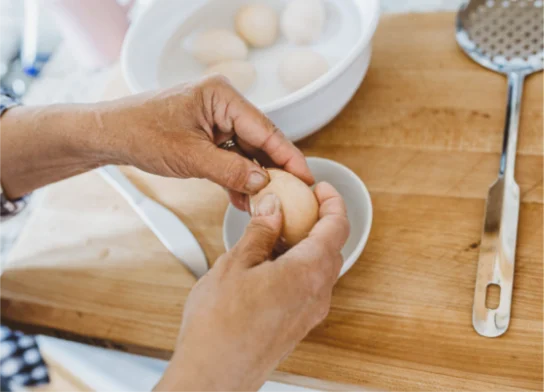
The challenge of peeling farm-fresh eggs has long been a point of contention among home cooks and culinary professionals alike. While conventional wisdom often suggests that eggs must be aged for several days or weeks before they can be successfully hard-boiled, recent shifts in culinary techniques have brought the practice of steam-cooking to the forefront. By abandoning the traditional submersion-boiling method in favor of steam, cooks are finding that the physical chemistry of the egg—specifically the contraction of the albumen—can be manipulated to ensure a seamless separation between the shell and the membrane.

The Science of the Peel: Understanding Membrane Adhesion
To understand why fresh eggs are notoriously difficult to peel, one must look at the pH levels within the egg. Freshly laid eggs possess a lower pH, which causes the egg white, or albumen, to bond tightly to the inner shell membrane. As an egg ages, the carbon dioxide within the shell dissipates, causing the pH level to rise. This increase in alkalinity weakens the bond between the protein in the egg white and the shell, making older eggs easier to peel.

However, relying on aging eggs compromises their structural integrity and flavor profile. Over time, air enters the shell through its porous surface, creating an enlarged air cell at the blunt end of the egg. This results in the characteristic "dented" look often seen in older, hard-boiled eggs. Furthermore, the aesthetic appeal of a perfectly oval, firm-boiled egg is significantly diminished when the white is damaged during the peeling process.

Historical Context and Conventional Methods
For decades, home cooks have attempted to mitigate the peeling issue through various kitchen hacks. Common strategies have included adding vinegar or baking soda to the boiling water, piercing the shell with a needle, or plunging the eggs into an ice bath immediately after boiling.

Culinary data suggests that while these methods are widely practiced, their effectiveness is largely anecdotal. For instance, while vinegar is often cited as a way to "dissolve" the shell, the quantity required to have a significant impact on the calcium carbonate structure would likely impart a strong acidic flavor to the egg. Similarly, while thermal shock via an ice bath is a legitimate technique to stop the cooking process and encourage contraction, it is often rendered ineffective if the initial cooking method does not address the fundamental bonding of the membrane to the shell.

The Shift Toward Steam Cooking
The transition from boiling to steaming represents a significant methodological shift. In a traditional boiling scenario, the temperature of the water often drops significantly when cold eggs are added, leading to a slow, inconsistent temperature rise. This inconsistency allows the egg white to remain in contact with the shell membrane for an extended duration, facilitating the chemical bond that makes peeling difficult.

Steam, by contrast, provides a consistent, high-heat environment. When eggs are placed in a steamer basket above boiling water, the rapid exposure to high-temperature vapor causes the egg white to contract almost immediately. This rapid contraction pulls the white away from the shell membrane before the protein has a chance to adhere. This "shock" effect is the primary driver behind the success of the steaming method, regardless of the age of the egg.

Step-by-Step Methodology for Steaming
The process for steaming eggs is straightforward and requires minimal specialized equipment. The essential requirements include:

- A large pot with a tight-fitting lid.
- A steaming implement, such as a stainless-steel colander, a bamboo steamer, or a dedicated vegetable steamer basket.
- A bowl filled with ice and water to facilitate the post-cooking thermal shock.
The procedure begins by bringing several inches of water to a rolling boil. Once the steam is established, the eggs—ideally at room temperature to prevent cracking—are placed in the steamer basket. The lid must be secured immediately to trap the steam. Cooking times vary based on the desired consistency of the yolk: 6 to 7 minutes for a soft-set yolk, and 10 to 12 minutes for a fully firm, hard-boiled result.

Once the timer concludes, the eggs must be transferred immediately into the prepared ice bath. This step is critical; it halts the residual heat that can cause the formation of a dark, greenish-gray ring around the yolk. This ring is a byproduct of a chemical reaction between the sulfur in the egg white and the iron in the yolk, forming ferrous sulfide. While safe to consume, its presence is generally considered a failure in culinary presentation.

Supporting Data and Broader Implications
The implications of this technique extend beyond simple convenience. For small-scale poultry keepers and consumers of farm-fresh products, the ability to process eggs immediately after collection increases the efficiency of kitchen operations. It allows for the rapid production of deviled eggs and egg salads without the need for pre-aging inventory.

From a food safety perspective, steaming is equally effective at reaching the necessary internal temperatures to neutralize common pathogens, such as Salmonella, provided the steaming duration is sufficient. Professional chefs have increasingly adopted this method in commercial kitchens, citing reduced waste and improved presentation as primary benefits.

Expert Perspectives and Culinary Consensus
While individual home-cooking blogs have championed this method for years, the science behind it is corroborated by food science institutions. The emphasis on "thermal shock" and the manipulation of protein contraction is a staple of modern culinary education. The consensus among experts is that the traditional method of boiling—which relies on the chaotic movement of water and inconsistent heat distribution—is less efficient than the steady, uniform environment provided by steam.

Furthermore, the integration of multi-cooker appliances, such as electric pressure cookers, has introduced a variation of the steaming method to a wider audience. These devices utilize high-pressure steam to achieve similar results, often in even less time. The versatility of the steaming method, which can be executed with a simple colander or a sophisticated appliance, makes it a highly accessible technique for all skill levels.

Conclusion: A Standard for Modern Cooking
The move away from boiling eggs in favor of steam is not merely a passing trend but a logical evolution in home cooking based on the chemical properties of poultry products. By focusing on the speed of protein contraction and the consistency of the heat source, cooks can achieve the desired aesthetic and texture with fresh ingredients.

The evidence is clear: the most common frustrations associated with farm-fresh eggs are not an inherent flaw in the product, but rather a limitation of the cooking technique. By applying the principles of steam-cooking, the culinary community has effectively solved one of the oldest problems in the kitchen. For those seeking perfect, easy-to-peel results, the path is no longer found in the age of the egg or the addition of additives to the water, but in the controlled application of steam. As this method continues to gain popularity, it is likely to become the standard practice for home and professional kitchens, further demonstrating how basic scientific principles can refine and improve everyday culinary tasks.
