
Human language is defined by its staggering complexity, consisting of thousands of distinct tongues and countless regional dialects. While this diversity allows for nuanced expression, it creates significant barriers to communication. However, human interaction is underpinned by a substratum of universal, non-verbal signals—a raised hand to signal a halt, a wide-eyed expression of alarm, or a primal shout—that transcend cultural and linguistic boundaries. A landmark 2025 study conducted by an international coalition of researchers from Cornell University, the Doñana Biological Station in Spain, and other global institutions suggests that the avian world operates on a similar, innate blueprint. This research indicates that birds possess a shared lexicon of alarm calls that function across species lines, effectively acting as an evolutionary "universal language" for survival.
The Evolutionary Hypothesis: Darwin’s Legacy in Avian Communication
The roots of this research trace back to the theories of Charles Darwin, who posited that the ability to signal danger was not merely a learned behavior but an innate biological imperative. For centuries, ornithologists have debated whether bird vocalizations are primarily culturally transmitted—learned through imitation of parents and flock members—or genetically hardwired.
The 2025 study provides compelling evidence that while many complex songs are indeed learned, fundamental alarm calls appear to be hardwired into the avian brain. By analyzing the vocalization patterns of 21 distinct bird species across disparate continents, researchers found a striking uniformity in how these animals signal the presence of brood parasites. This suggests that over millions of years, natural selection has favored the development of "built-in" vocalizations, ensuring that the warning of a predator or parasite is understood by any bird within earshot, regardless of its species or geographic origin.
Understanding Brood Parasitism: The Catalyst for Alarm
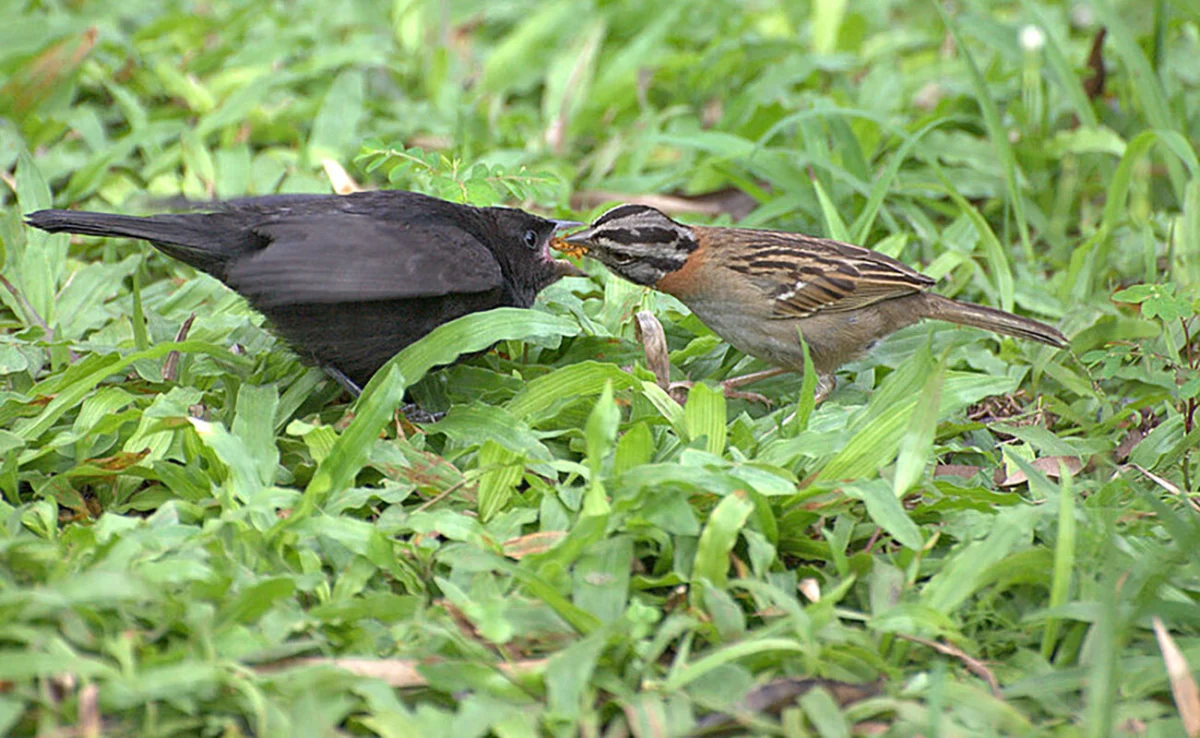
To grasp the significance of these findings, one must first understand the biological pressures imposed by brood parasites. Brood parasitism is a reproductive strategy in which a bird, such as a cuckoo or a cowbird, lays its eggs in the nest of another species. The host bird, often unaware of the deception, incubates the parasite’s eggs and provides food and protection for the hatchlings as if they were its own.
This interaction is frequently catastrophic for the host. In many instances, the newly hatched parasitic chick will instinctively push the host’s biological eggs or hatchlings out of the nest, effectively commandeering all resources provided by the unsuspecting foster parents. Because this behavior represents a significant evolutionary cost to the host, the ability to identify and repel parasitic threats is a matter of life or death. The "whining" alarm call identified in the study serves as an early-warning system, alerting the host that a potential intruder is nearby, thereby allowing the host to defend the nest before an egg is laid.
Chronology of the 2025 Cross-Species Study
The investigation was a multi-year effort that spanned diverse ecosystems. The following timeline outlines the progression of this scientific inquiry:
- 2022–2023: Researchers identified 21 host species across Asia, Australia, and North America that faced similar pressures from local brood parasites. Data collection began, focusing on the acoustic signatures of their alarm calls.
- 2024: The team utilized advanced digital signal processing to compare the frequency, duration, and modulation of the alarm calls. Despite the vast distances separating these populations, the spectral analysis revealed that the "whining" alarms shared fundamental structural similarities.
- Early 2025: Experimental trials were conducted in controlled environments. Researchers played recordings of alarm calls from foreign species to local bird populations. The observed reactions—including increased vigilance, defensive posturing, and nest monitoring—confirmed that the birds were interpreting the foreign calls as meaningful threats.
- Late 2025: The findings were finalized, confirming that these vocalizations represent an innate, cross-species warning system.
Supporting Data and Acoustic Analysis
The study utilized a dataset of over 500 hours of recorded avian vocalizations. By applying machine learning algorithms to map the acoustic landscape of these calls, the researchers discovered that the "warning" frequency consistently fell within a range that is easily detected by the auditory systems of most small passerine birds.

Notably, the study found that the "whining" quality of the call—a rapid, high-pitched oscillation—is particularly effective at cutting through ambient forest or grassland noise. Unlike a territorial song, which is designed to be melodic and repetitive to attract mates, these alarm calls are abrupt and jarring. This specific acoustic structure appears to trigger an immediate fight-or-flight response in the recipient, an observation that mirrors the startle responses seen in mammals.
The Cognitive Parallel: Bird Brains and Human Toddlers
One of the most intriguing aspects of the 2025 report is the cognitive comparison between birds and human infants. Researchers noted that the mechanism by which birds recognize these innate calls may be structurally similar to the way human toddlers begin to acquire language.
In humans, the brain is pre-wired to recognize the rhythmic structures of speech, even before the child understands the semantic meaning of the words. Similarly, the study suggests that a bird’s brain is "primed" at birth to recognize the structural patterns of an alarm call. This is not to suggest that birds possess human-level syntax, but rather that both humans and birds utilize a sophisticated neural architecture to process essential information quickly. This "biological scaffolding" allows for rapid learning and survival in a complex environment where slow processing could be fatal.
Implications for Conservation and Ecology
The implications of this discovery are profound for the field of conservation biology. As human activity continues to encroach on natural habitats, birds are increasingly exposed to stressors that disrupt their natural environments. Understanding that these species rely on a shared, innate warning network highlights the importance of preserving the acoustic integrity of ecosystems.
If a specific environment becomes too noisy due to human-induced activity—such as urban traffic or industrial noise—these essential cross-species warning calls may be drowned out. If a host species cannot hear the warning provided by its neighbors, it becomes significantly more vulnerable to brood parasitism. This could lead to a decline in population levels for species that are already struggling to survive.
Conservationists are now looking at "acoustic ecology" as a new frontier. By mapping the soundscapes of protected areas, scientists can better ensure that the "universal language" of the wild remains audible, protecting the delicate balance between host species and the parasites that challenge them.
A New Perspective on Biological Communication
The findings presented by the international research team shift our understanding of biological communication from a collection of isolated, species-specific behaviors to an interconnected web of shared information. This universal language does not rely on culture or social learning, but on the enduring and unyielding pressure of evolution.
As we continue to explore the nuances of animal intelligence, the "whining" alarm call serves as a humbling reminder that, in the struggle for survival, nature has converged on a common, elegant solution. Whether in the jungles of Brazil, the forests of China, or the suburban backyards of the United States, the warning signal remains the same: a plea for vigilance and a call to protect the next generation. This study reinforces the notion that while we are separated by vast biological distances, the fundamental need to communicate danger is a cornerstone of life on Earth, shared by all species that have survived the relentless testing of natural selection. The future of avian research will likely delve deeper into how these signals evolve alongside environmental changes, potentially revealing even more layers of this complex and ancient conversation.
