
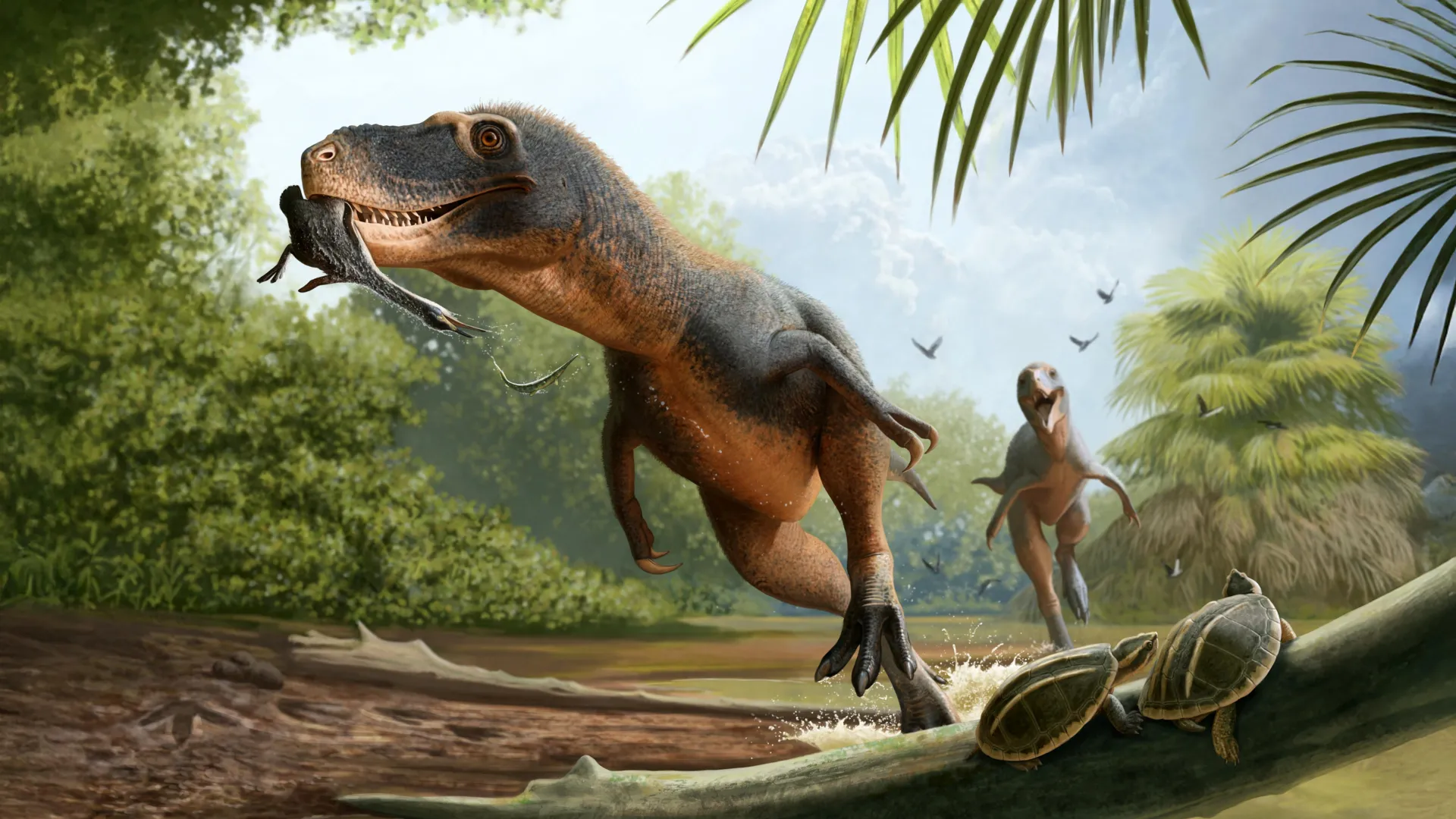
Paleontology has long relied on skeletal remains, amber inclusions, and occasional soft-tissue impressions to reconstruct the ancient world. However, a groundbreaking discovery recently detailed in the journal Current Biology demonstrates that crucial evolutionary evidence can emerge from the most unexpected of repositories: fossilized feces. Researchers analyzing a golf-ball-sized coprolite dating back approximately 66 million years have uncovered what is being hailed as the finest feather specimen ever recovered from the age of dinosaurs.
The extraordinary specimen, swallowed by a large apex predator such as a Tyrannosaurus rex or a Nanotyrannus shortly before the cataclysmic end-Cretaceous asteroid impact, offers unprecedented insight into ancient ecosystems. More importantly, it provides a compelling new hypothesis regarding why certain bird lineages managed to survive the global mass extinction while every other dinosaur branch perished.
An Accidental Discovery in the Hell Creek Formation
The story of this remarkable fossil begins in 2016 during routine fieldwork in the fossil-rich Hell Creek Formation of northeastern Montana. David DeMar, Jr., a research scientist and Hell Creek Project collections manager at the University of Washington Burke Museum, was traversing a rocky outcrop to collect fossilized fish remains when an unassuming geological nodule caught his attention.
The specimen was a dark, reddish-brown lump roughly half the size of a golf ball. Upon inspecting its surface through a hand lens, DeMar observed what appeared to be a tiny fossilized feather. Given that feathers had notoriously eluded discovery within the Hell Creek Formation despite more than a century and a half of intensive prospecting, the find initially warranted cautious optimism.
To examine the internal composition of the rock without damaging it, the research team employed high-resolution micro-CT scanning at the University of Southern California’s medical campus. By combining thousands of X-ray images into a high-definition three-dimensional digital model, scientists were able to peer deep inside the matrix.
According to Nate Carroll, a co-author of the study and paleontologist at the Carter County Museum, the true nature of the specimen only emerged as data processing continued. Every hour of digital reconstruction revealed intricate anatomical layers: additional feathers, microscopic fish scales, and delicate leg bones preserved in stunning three-dimensional detail. The object was identified not merely as a mineralized rock, but as a coprolite—fossilized dinosaur dung—containing the remnants of a prehistoric meal.
The Unfortunate Fate of an Ancient Diving Bird
The inclusion of both feathers and skeletal elements allowed the research team to attribute the remains to a specific group of prehistoric animals: the hesperornithiforms. Specifically, the leg bones and feather structures matched those of an aquatic, flightless bird ecologically comparable to modern loons.
Hesperornithiforms were specialized divers, utilizing powerful feet to propel themselves through water in pursuit of fish. The feathers recovered from the coprolite displayed morphological adaptations tailored for an aquatic lifestyle, mirroring traits observed in living waterbirds. However, despite their evolutionary success during the Cretaceous period, hesperornithiforms represented a distinct lineage separate from the ancestral group of modern birds, known scientifically as Neornithes.
During the late Cretaceous, avian diversity was dominated by enantiornithines—a diverse group of toothed birds that flourished globally. Alongside them lived the aquatic hesperornithiforms and the nascent Neornithes lineage. When the asteroid struck the Yucatán Peninsula 66 million years ago, bringing an abrupt end to the Mesozoic Era, the enantiornithines and hesperornithiforms were entirely wiped out, leaving only the Neornithes to establish the avian biodiversity observed on Earth today.
Challenging Hypotheses of Avian Survival
The survival of Neornithes through the Cretaceous-Paleogene (K-Pg) extinction event has perplexed paleontologists for decades. A long-standing hypothesis suggested that aquatic environments may have buffered certain species from the immediate thermal and atmospheric trauma of the impact. Because bodies of water absorb and retain heat differently than terrestrial landscapes, organisms tied to aquatic ecosystems were theorized to have better odds of enduring the devastating ecological collapse.
Yet, the discovery of the hesperornithiform remains complicates this narrative. These birds were explicitly adapted to aquatic environments, yet their entire lineage perished. Consequently, researchers concluded that habitat preference alone cannot adequately explain why Neornithes survived while other avian branches vanished.
The answer, researchers suggest, may lie in the microscopic architecture of their plumage and their physiological mechanisms of molting.
Insights from Primitive Plumage and the Impact Winter
Led by Jingmai O’Connor, associate curator of fossil reptiles at the Field Museum in Chicago and lead author of the study, the research team analyzed the structural characteristics of the preserved feathers. The analysis revealed that the hesperornithiform feathers occupied an evolutionary middle ground: they featured modern, waterproof characteristics necessary for diving, yet retained primitive, downy body feathers reminiscent of non-avian dinosaurs and enantiornithines.
Following the asteroid impact, Earth entered a prolonged period known as an "impact winter." Debris, dust, and soot ejected into the upper atmosphere blocked incoming solar radiation, causing global temperatures to plummet and shutting down photosynthesis across terrestrial and marine food webs.
During this severe thermal bottleneck, insulation became a matter of life and death. Modern Neornithes are characterized by advanced, highly efficient plumaceous feathers that provide superior thermal regulation. In contrast, if hesperornithiforms and enantiornithines possessed primitive or less efficient insulating plumage, they would have struggled to maintain core body temperatures against the dropping ambient warmth of the impact winter. This physiological disadvantage could have created the selective pressure that ultimately caused their extinction.
A New Methodological Frontier in Paleontology
Beyond its evolutionary implications, the study underscores the vast, untapped potential of coprolites in paleontological research. Historically, fossilized feces have been utilized primarily to study diet, trophic interactions, and ancient predator-prey dynamics. This study demonstrates that coprolites can also act as unexpected repositories for delicate soft tissues like feathers, which are ordinarily destroyed by bacterial decay or geological compaction before fossilization can occur.
Greg Wilson Mantilla, professor at the University of Washington and curator of vertebrate anatomy at the Burke Museum, emphasized the rarity of such preservation. Finding fossilized bird remains is an extraordinary event; finding them encapsulated within the digestive waste of an apex predator provides an exceptionally detailed snapshot of a 66-million-year-old food web.
O’Connor notes that the discovery relies heavily on serendipity—specifically, the way the coprolite fractured to expose the microscopic feather on its exterior. However, she advocates for a systematic shift in how institutions approach fossilized dung. By routinely subjecting archived and newly recovered coprolites to non-destructive micro-CT scanning, researchers worldwide may uncover a wealth of hidden microfossils.
Implications for Future Research
As museums and research institutions begin to re-evaluate their collections of fossilized feces, the techniques pioneered in this study could unlock a new dimension of paleo-ornithology. Understanding the exact evolutionary timeline of feather development, insulation efficiency, and molting strategies will allow scientists to map the resilience of avian lineages with unprecedented precision.
The accidental preservation of a single, minute feather inside a 66-million-year-old predator’s waste has transformed a basic dietary residue into a masterclass in paleontological detective work. By bridging the gap between predator biology, feather microstructure, and global extinction dynamics, researchers are steadily piecing together the exact mechanisms that allowed a single branch of the dinosaur family tree to take flight into the modern world.
