
For generations, the conventional dogma of paleontology and molecular biology was built upon a foundation of absolute loss. Scientists universally assumed that the grueling, complex process of fossilization acted as an unsparing chemical reset button, entirely obliterating original organic molecules within ancient bones, teeth, and soft tissues. Under this longstanding paradigm, delicate proteins, labile biomolecules, and complex cellular structures were theoretically incapable of cheating decay across vast expanses of geological time. Millions of years of groundwater percolation, mineral replacement, immense tectonic pressures, and microbial action were thought to leave behind nothing more than inorganic rock—shapely stone silhouettes devoid of any true biological chemistry.
However, a paradigm-shifting study published in the journal Analytical Chemistry has fundamentally challenged this foundational assumption. Led by an interdisciplinary team of researchers from the University of Liverpool, in close collaboration with the University of California, Los Angeles (UCLA) and the institution’s cutting-edge Materials Innovation Factory, new empirical evidence demonstrates conclusively that original organic materials can, under rare and exceptional conditions, survive inside Mesozoic fossils for tens of millions of years. By deploying state-of-the-art analytical chemistry techniques, the research team successfully detected and verified the presence of degraded collagen remnants preserved deep within the sacrum of an Edmontosaurus, a massive duck-billed dinosaur that roamed North America during the Upper Cretaceous period.
This breakthrough represents a watershed moment for vertebrate paleontology. It injects rigorous, empirical data into a contentious, fiercely contested scientific debate that has simmered for approximately three decades. More importantly, it bridges the historical chasm between morphological paleontology—the study of outward shapes and skeletal structures—and molecular biology, opening an unprecedented portal into the deepest biological secrets of extinct lifeforms.
The Anatomy of a Discovery: Inside the Hell Creek Specimen
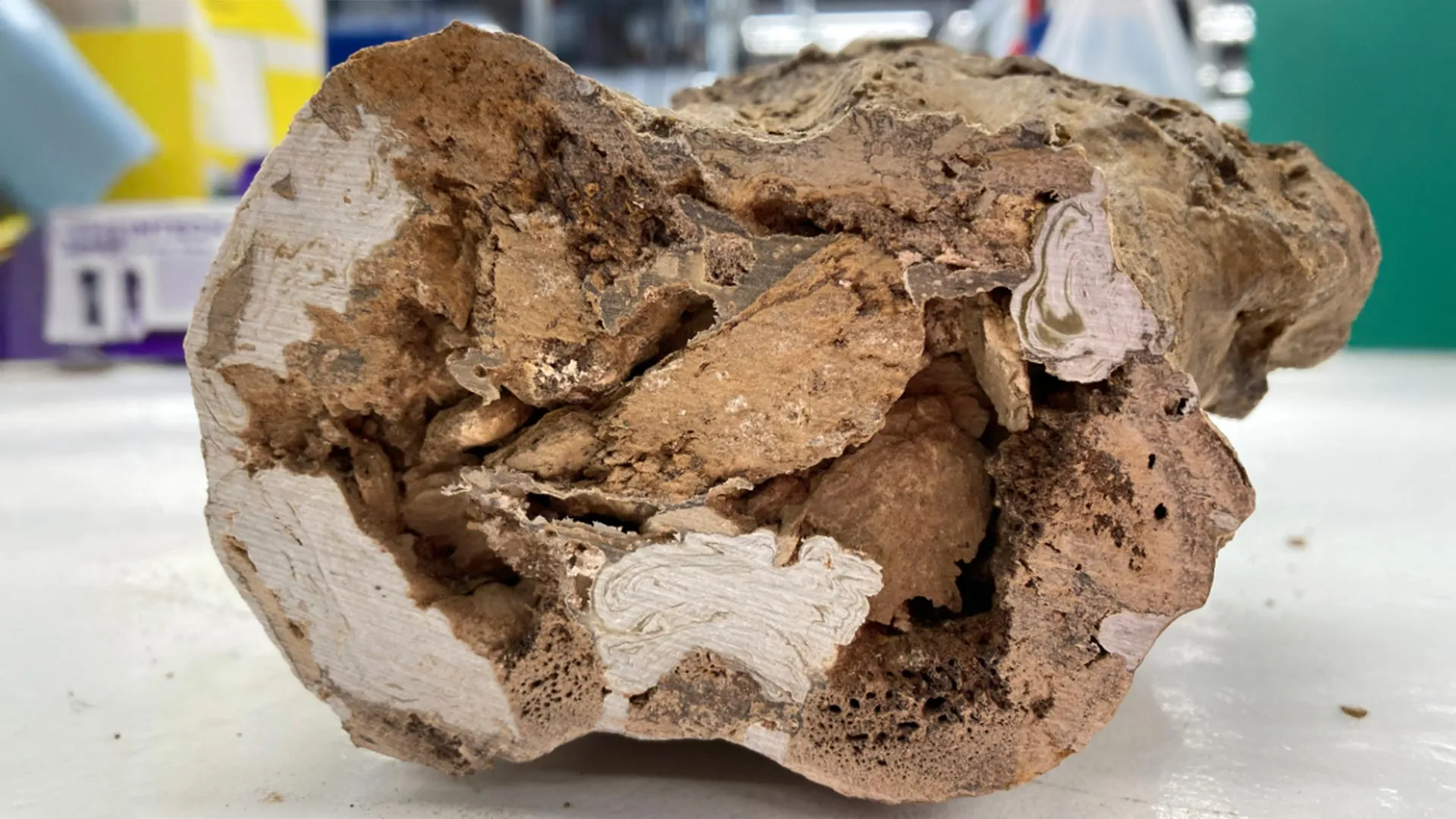
At the heart of this milestone research is an exceptionally well-preserved 22-kilogram sacrum—a fusion of vertebrae rigidly connecting the spine to the pelvis—belonging to an Edmontosaurus. This specific fossil was unceremoniously, yet carefully, excavated from the richly fossiliferous Upper Cretaceous rock strata of the Hell Creek Formation in South Dakota. World-renowned among paleontologists, the Hell Creek Formation preserves a critical window of Earth history, capturing terrestrial ecosystems that flourished immediately prior to the cataclysmic Cretaceous-Paleogene extinction event, which wiped out the non-avian dinosaurs approximately 66 million years ago.
Following its excavation, the sacrum was integrated into the permanent research collections at the University of Liverpool. Because the bone exhibited an unusually pristine state of macroscopic and microscopic preservation—largely insulated from the worst destructive forces of surrounding groundwaters and geochemical churning—it presented an ideal candidate for advanced molecular interrogation.
To determine whether the bone contained genuine endogenous biomolecules rather than mere mineral ghosts, the Liverpool research team deployed a battery of sophisticated analytical techniques. Forewarned by decades of skepticism from the broader scientific community, the researchers understood that any claim of ancient organic survival would face intense scrutiny. Consequently, their methodological approach required absolute precision, cross-verification, and multi-institutional validation.
The analytical campaign relied heavily on mass spectrometry, an advanced analytical technique that identifies and characterizes molecules by accurately measuring their mass-to-charge ratios and chemical fragmentation patterns. Mass spectrometry allows scientists to parse complex chemical mixtures down to their constituent parts, reading molecular signatures with extraordinary fidelity.
Working in tandem, specialists at the University of Liverpool’s Mass Spectrometry Research Group, the Centre for Proteome Research, and the Materials Innovation Factory applied rigorous protein sequencing and mass spectrometry protocols to samples extracted from the deep interior of the Edmontosaurus bone. Simultaneously, colleagues at UCLA brought specialized capabilities to the table, employing tandem mass spectrometry to search for specific amino acid markers. Crucially, the UCLA team successfully detected and quantified hydroxyproline—a specialized, modified amino acid that is heavily concentrated in collagen and serves as a reliable biochemical proxy for its presence in bone matrices.
Further compounding the validity of the discovery, the Centre for Proteome Research identified specific fragments of collagen alpha-1, the primary structural isoform of collagen found throughout vertebrate bone tissue. The convergence of these distinct molecular datasets provided an airtight case: the organic molecules detected within the 75-million-year-old fossil were not modern interlopers, but genuine, highly degraded remnants of the animal’s original structural biology.
Overcoming the Specter of Contamination
To fully appreciate the gravity of the University of Liverpool’s findings, one must understand the tumultuous history surrounding claims of ancient proteins. For roughly thirty years, paleoproteomics—the recovery and analysis of ancient proteins from fossils—has been treated by mainstream biochemistry with a healthy, often deeply skeptical dose of caution.
When pioneering researchers first reported finding soft tissues, blood vessel-like structures, and putative protein fragments in dinosaur bones during the 1990s and 2000s, the scientific community reacted with immediate, fierce pushback. The central pillar of this skepticism was the contamination hypothesis. Critics argued with considerable justification that any organic material discovered inside an ancient fossil must necessarily be the result of modern contamination. Proponents of this view suggested that exogenous biomolecules could easily infiltrate porous fossil bone post-excavation through handling, airborne fungal spores, bacterial biofilms, humic acids from surrounding soils, or modern laboratory reagents. Because proteins degrade via hydrolysis over geological timescales, standard biochemical calculations suggested that peptide bonds should break down completely within a few million years at most, rendering the survival of dinosaurian proteins theoretically impossible.
This skepticism created an effective empirical stalemate. Without definitive, repeatable proof that could definitively rule out environmental contamination, ancient protein research hovered on the fringes of mainstream paleontology.
The new research from Liverpool directly confronts and dismantles this contamination objection. By utilizing ultra-clean extraction protocols, multi-stage mass spectrometry, and targeting specific, highly degraded amino acid signatures like hydroxyproline that bear the distinct chemical scars of deep-time structural breakdown, the research team demonstrated that the recovered molecules possess structural alterations entirely consistent with millions of years of chemical decay. Modern bacterial or handling contaminants do not display the specific degradation profiles observed in the Edmontosaurus bone. This finding shifts the burden of proof, establishing that endogenous organic preservation in exceptionally preserved Cretaceous fossils is not only possible, but demonstrable.
A Century of Archives: Re-Examining Historical Microscopy
Beyond the immediate chemical confirmation of dinosaurian collagen, the study’s authors have outlined profound implications that stretch across multiple scientific disciplines. According to Professor Steve Taylor, chair of the Mass Spectrometry Research Group within the Department of Electrical Engineering & Electronics at the University of Liverpool, the ramifications of this discovery are both broad and immediate.
"This research shows beyond doubt that organic biomolecules, such as proteins like collagen, appear to be present in some fossils," Professor Taylor stated. Emphasizing the far-reaching nature of the team’s work, he noted that the findings directly refute the blanket hypothesis that all organic traces found in ancient fossils are modern artifacts of contamination.
Perhaps most provocatively, Professor Taylor suggests that this breakthrough should prompt a sweeping reassessment of historical scientific literature and archival collections. For approximately one hundred years, paleontologists and geologists have utilized cross-polarized light microscopy to examine thin sections of fossilized bone. This specialized optical technique employs polarized filters to reveal internal microstructures, crystallinity patterns, and anisotropic properties that remain invisible under standard brightfield illumination.
For a century, researchers have observed peculiar, anomalous patches and structural anomalies within these historical microscopy images without fully understanding their underlying chemical nature. Professor Taylor argues that these long-standing visual records should now be systematically revisited. It is entirely plausible, he notes, that many of these optical anomalies represent intact, highly mineralized patches of fossil bone collagen that have survived largely unnoticed in museum drawers and university archives around the globe.
If historical cross-polarized light microscopy can reliably serve as a visual screening tool for preserved organic matrices, museums and academic institutions may already possess a ready-made trove of high-potential fossil candidates. Rather than exhaustively screening every available bone using destructive, highly specialized mass spectrometry, researchers could theoretically comb through century-old slide collections and literature archives to pinpoint prime targets for molecular analysis. This retrospective methodology could exponentially accelerate the pace of paleoproteomic research, unlocking a vast reservoir of untapped biological data without requiring endless new field excavations.
The Broader Impact: Rewriting the Evolutionary Tree
The confirmation of ancient collagen in dinosaur fossils unlocks avenues of scientific inquiry that traditional morphological analysis—examining the external shapes of bones, teeth, and horns—simply cannot reach. While skeletal anatomy remains the foundational framework of paleontology, bones alone can sometimes obscure deep evolutionary relationships, particularly when convergent evolution causes distantly related animals to develop strikingly similar physical traits.
Proteins, by contrast, carry direct genetic echoes. Because proteins are translated directly from DNA templates, their primary amino acid sequences reflect the underlying genetic code of the organism. While ancient DNA is famously fragile and rarely survives beyond one million years under exceptional conditions—such as permafrost environments—proteins are significantly more chemically robust. They can persist much longer in the geological record, functioning as stable molecular proxies for genetic sequences.
By successfully extracting and sequencing ancient proteins like collagen alpha-1 from dinosaurs, scientists move closer to establishing robust, chemically driven phylogenetic trees for extinct lineages. Comparing the precise amino acid sequences of dinosaurian collagen with those of modern birds (the direct descendants of theropod dinosaurs), crocodilians, and mammals could allow researchers to map evolutionary divergences with molecular precision. This approach could definitively resolve long-standing debates regarding the precise family trees of enigmatic dinosaur groups, revealing fine-grained biological connections that remain invisible in skeletal remains alone.
The Enigma of Deep-Time Preservation
Despite the triumph of the analytical techniques used in the study, the discovery of ancient collagen brings a profound biological and chemical mystery into sharp relief: How do these fragile organic molecules manage to endure for 75 million years?
Proteins are fundamentally unstable over geological timeframes. Under standard environmental conditions, peptide bonds are continuously subjected to thermal decay, microbial consumption, and hydrolytic cleavage. In a typical fossilization scenario, organic components are entirely replaced by minerals such as calcium phosphate or silica during fossilization (permineralization).
To explain the survival of collagen across the entirety of the Mesozoic era, scientists must look closely at the micro-environment of the fossil bone itself. It is increasingly hypothesized that certain mineral matrices act as microscopic protective vaults. When bone mineralizes rapidly and uniformly, microscopic channels—such as the canaliculi and lacunae that once housed living bone cells (osteocytes)—can become effectively sealed off from circulating groundwater and microbial invasion. Furthermore, mineral-organic cross-linking, where proteins bind tightly to inorganic hydroxyapatite crystals, can sterically hinder the enzymes and water molecules responsible for protein degradation.
Unraveling the exact physico-chemical mechanisms that grant certain fossils this extraordinary preservation shield remains one of the most compelling frontiers in geochemistry and paleontology. Researchers at institutions like the University of Liverpool and the Materials Innovation Factory are actively working to model these long-term molecular stabilization processes, aiming to understand the exact tipping points that separate total molecular destruction from miraculous preservation.
A Collaborative Milestone
The success of this study underscores the immense value of interdisciplinary scientific collaboration. Resolving a debate that has divided the paleontological community for three decades required a seamless fusion of traditional field paleontology, materials science, advanced mass spectrometry, and proteomics.
By bringing together specialists from the University of Liverpool’s Department of Electrical Engineering & Electronics, the Centre for Proteome Research, the Materials Innovation Factory, and external partners including UCLA, the research team demonstrated the power of deploying modern, high-resolution analytical tools to ancient biological puzzles.
Ultimately, this work closes the book on decades of acrimonious debate regarding the absolute fragility of organic molecules in deep time. By proving that original biological molecules can indeed survive within exceptionally preserved Mesozoic fossils, the study dismantles old dogmas and flings open the door to a new era of molecular paleontology. As researchers begin to scour historical archives, refine extraction techniques, and apply advanced proteomics to the global fossil record, science stands on the precipice of retrieving biological data from extinct worlds that was once written off as lost to history forever.
