
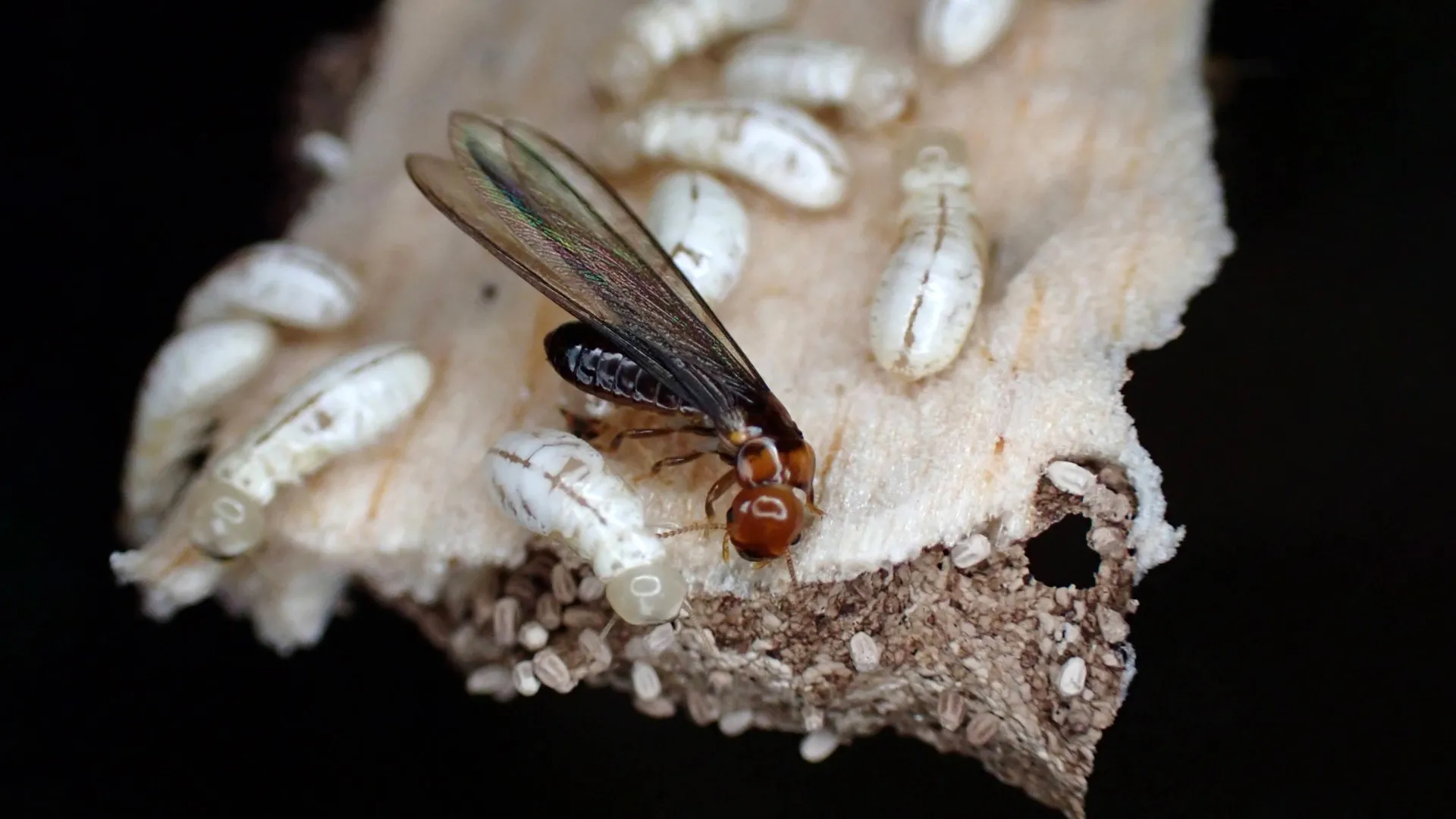
The western drywood termite (Incisitermitidae), a notorious structural pest native to the southwestern United States and northwestern Mexico, has long presented a formidable challenge to homeowners and pest control professionals alike. Operating entirely out of sight, these resilient insects carve intricate galleries deep within the beams, framing, and furniture of buildings without ever needing to make contact with the soil. This secretive lifestyle has traditionally rendered them exceptionally difficult to detect and eradicate, often forcing property owners to resort to drastic measures such as whole-structure fumigation—a disruptive, costly process that requires residents to vacate and leaves behind no residual protection against future infestations.
However, recent scientific breakthroughs from the University of California, Riverside (UCR) Department of Entomology are signaling a paradigm shift in how urban entomologists approach drywood termite management. By weaponizing the insects’ own biological vulnerabilities, social behaviors, and microbial profiles, researchers are developing targeted, low-impact strategies that could soon provide viable alternatives to widespread fumigation. Through a series of landmark studies published between 2024 and 2026, UCR researchers have illuminated new pathways for localized treatment, enhanced baiting mechanisms, and precise infestation diagnostics.
Turning Molting Biology Against the Colony
At the core of the recent UCR findings is a vulnerability that no termite can evade: the biological necessity of molting. Unlike mammals, which possess internal skeletons, insects rely on a rigid external armor known as an exoskeleton. A primary structural component of this outer shell is chitin, a durable natural biopolymer that also appears in fungal cell walls, fish scales, and the beaks of cephalopods. For a growing drywood termite, this armor cannot expand indefinitely; individuals must molt approximately seven times throughout their lifespan, shedding their old exoskeleton to step into a larger one.
In a study published in 2025 in the Journal of Economic Entomology, researchers focused on bistrifluron, an insect growth regulator classified as a chitin synthesis inhibitor. Rather than acting as a fast-acting poison that kills on immediate contact, bistrifluron disrupts an insect’s ability to manufacture sufficient chitin for its upcoming exoskeleton.
Controlled laboratory experiments yielded staggering efficacy rates. When termites were given a choice between treated and untreated wood, the chemical produced a 95.7 percent mortality rate. When subjected to continuous exposure on treated wood, mortality climbed to approximately 99 percent over a 60-day testing period at a 0.1 percent concentration.
Nicholas Poulos, a doctoral student in UCR’s Department of Entomology and corresponding author of the paper, emphasized the environmental and safety advantages of the compound. "This chemical is more environmentally friendly than ones traditionally used for drywood termite infestations," Poulos stated. "It’s specific to insects and can’t harm humans."
Senior paper author and UCR entomology professor Dong-Hwan Choe underscored the inevitability of the trap set by the chemical. "Once the termites reach a certain stage, they have to molt. They cannot avoid that," Choe explained. "With a lethal dose of this chemical, they’ll try to shed their old exoskeleton but won’t have a new one ready to protect them."
The Power of Social Transmission and Trophallaxis
One of the most profound discoveries in the UCR research involves the cascading effect of the treatment within a colony. Drywood termites are intensely social insects that routinely share food and nutrients, a behavior that normally bolsters the survival and resilience of the colony.
When researchers exposed a small fraction of a termite group to bistrifluron and reintroduced them to untreated nestmates—tracking the transfer using colored food dyes—they observed rapid distribution. Within 24 to 48 hours, material from the exposed insects successfully reached unexposed members. Most remarkably, groups where only 5 percent of the population was initially exposed still reached 100 percent mortality by day 90. A starting exposure rate of 50 percent yielded a similarly devastating survival pattern.
This phenomenon relies heavily on complex intra-colony exchanges. Later observations by the UCR team provided unprecedented visual documentation of western drywood termites engaging in proctodeal trophallaxis—a specialized feeding behavior wherein one termite receives hindgut material from another. While this exchange typically facilitates the sharing of vital wood-digesting gut microbes, it inadvertently serves as an efficient delivery mechanism for slow-acting insecticides.
Because bistrifluron works gradually, it allows contaminated individuals ample time to interact with, feed, and contaminate nestmates before succumbing to the compound. This delayed mortality transforms the termites’ own social cooperation into an Achilles’ heel, enabling localized spot treatments to eradicate entire hidden colonies without requiring direct chemical application to every single insect.
Chronology of Innovation: Lures and Diagnostics
The bistrifluron study builds upon a robust timeline of recent advancements from the same UCR laboratory aimed at refining localized pest control.
In May 2024, researchers published findings regarding pinene, a naturally occurring volatile organic compound released by many tree species. To western drywood termites, the scent of pinene acts as an environmental beacon, signaling attractive feeding grounds. By combining pinene with aqueous fipronil treatments, the research team successfully lured insects away from their clusters and toward localized insecticide deposits. Without pinene, mortality hovered around 70 percent; with the addition of the natural lure, efficacy surged past 95 percent. This innovation progressed further in October 2025, when a University of California patent application proposed incorporating alpha- or beta-pinene into localized insecticide injections to allow technicians to space treatment holes farther apart while reducing chemical volume and labor.
Following the bistrifluron breakthrough, the UCR team turned its attention to a perennial headache for pest management professionals: determining whether drywood termite evidence is current or historical. Drywood termites naturally eject hard, tiny fecal pellets from their galleries, leaving piles that alert homeowners to potential infestations. However, old droppings can persist in a structure long after a colony has vacated or died, leading to unnecessary treatments.
In research succeeding the bistrifluron publication, Poulos and his colleagues analyzed the bacterial DNA inside termite pellets across varying lifespans—ranging from fresh samples to those aged for three months, six months, and one year. The study revealed a dramatic biological clock: bacterial DNA quantities plummeted by up to 190-fold between fresh samples and those aged for a year in both hardwood-fed and Douglas fir-fed termites. Furthermore, specific bacterial families present in fresh pellets entirely vanished over time. The team anticipates that these distinct microbial signatures will form the basis of a diagnostic tool, allowing inspectors to accurately verify active infestations before applying localized remedies.
Practical Challenges and Industry Implications
Despite the promising laboratory metrics, significant hurdles remain before bistrifluron and related compounds become commercial mainstays in household pest control. In the experimental trials, researchers dissolved the chemical in acetone—a volatile solvent that allows uniform wood treatment as it evaporates. Due to its strong odor and high flammability, acetone is wholly unsuitable for residential application. Consequently, the research team is actively engineering safer, practical formulations for real-world scenarios.
Furthermore, industry experts note that transitioning from controlled laboratory environments to diverse residential structures requires extensive field validation. Structural fumigation, while disruptive and lacking residual defense, remains the gold standard for total eradication in severe, widespread infestations. Yet, the economic and operational burdens of fumigation—including temporary relocation, food safeguarding, and lack of long-term prevention—leave ample market space for targeted alternatives.
"Low-impact strategies like this one will become an attractive option in many cases," Choe noted, highlighting that residual chemical retention in treated wood could protect properties against future invasions.
Broader Economic and Environmental Impact
As global trade and the movement of lumber, furniture, and wooden packaging continue to transport Incisitermitidae far beyond its native southwestern range—establishing introduced populations in regions as diverse as Hawaii, New York, Florida, parts of Canada, China, Japan, Korea, and Australia—the demand for sophisticated, adaptable management tools intensifies. Climate shifts are expected to further widen the habitable zones for these wood-boring pests.
By shifting away from brute-force eradication and toward biologically informed management strategies—leveraging insect molting inhibitors, social trophallaxis pathways, chemical attractants, and microbial diagnostic clocks—science is redefining the battle against drywood termites. As these integrated methods advance toward commercialization, the structural pests that have spent centuries hidden safely inside human dwellings may soon find themselves entirely outmatched by their own biology.
