
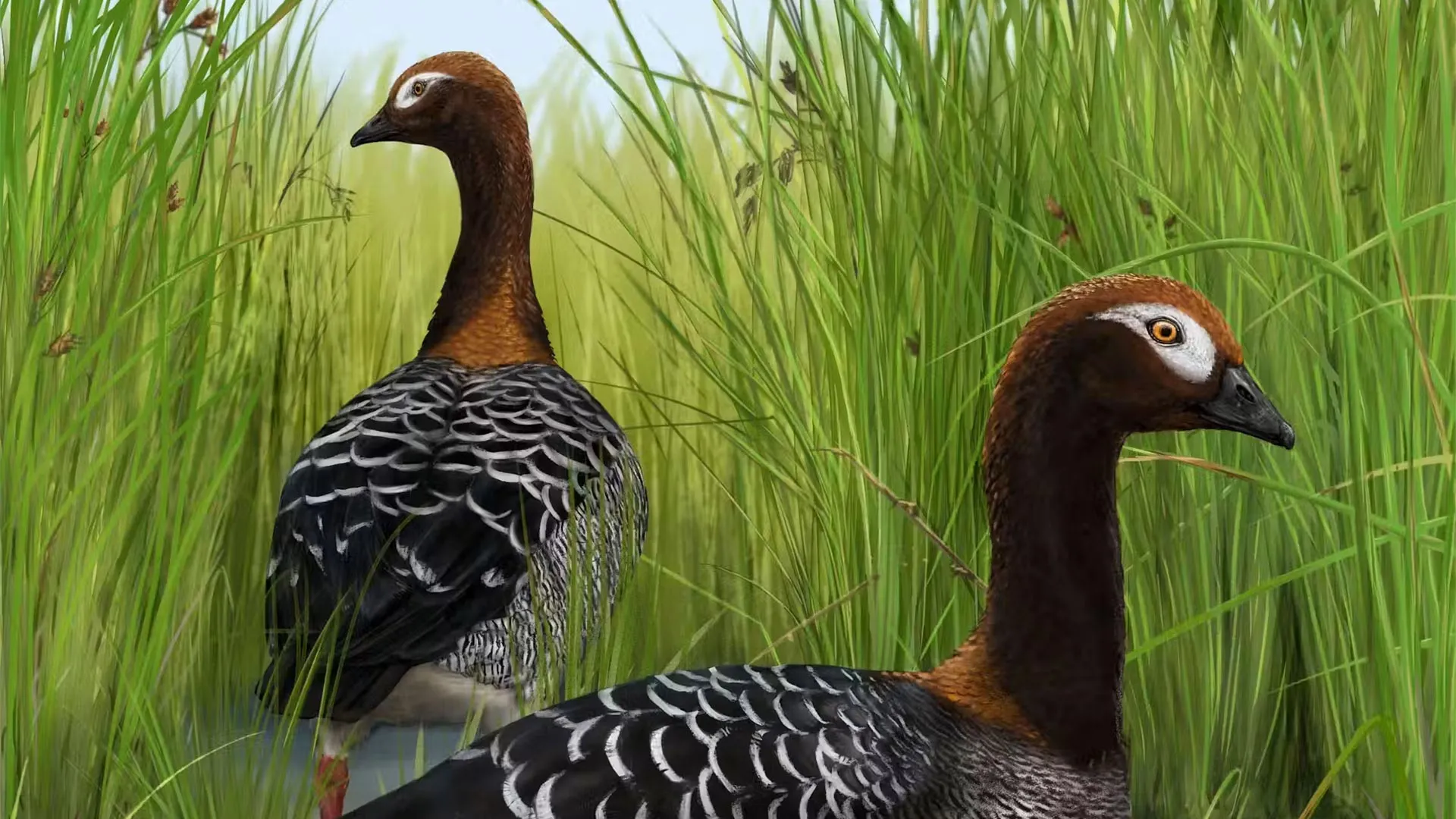
Deep within the fossil-rich sedimentary layers of an ancient Miocene lakebed in Central Otago, New Zealand, paleontologists have unearthed a remarkably preserved, rare fossil goose that is fundamentally altering our understanding of how Aotearoa’s iconic and highly isolated birdlife evolved. Discovered in the internationally renowned St Bathans fossil deposits, this newly identified waterfowl species is providing scientists with critical insights into the prehistoric waves of migration, evolutionary adaptation, and extinction that shaped the fauna of the submerged continent of Zealandia millions of years ago.
The groundbreaking research, published recently in the peer-reviewed scientific journal Historical Biology, was spearheaded by a multidisciplinary international team of scientists. Researchers from the University of Otago (known natively as Õtäkou Whakaihu Waka), the Museum of New Zealand Te Papa Tongarewa, and the University of Cambridge in the United Kingdom collaborated on the intensive study, combining classical comparative paleontology with advanced paleogenetic techniques. Their findings not only establish a brand-new species in the prehistoric fossil record but also resolve a long-standing scientific debate regarding the ancestral origins of New Zealand’s unique avian populations.
Unearthing Meterchen luti: A Hidden Species Among Abundant Waterfowl
The St Bathans fossil deposits have long been recognized as a treasure trove of Miocene paleontology, preserving a snapshot of life in New Zealand approximately 16 to 19 million years ago. While thousands of fossil fragments representing various ancient waterfowl, bats, crocodiles, and landbirds have been excavated from the site over the decades, goose remains have historically been exceptionally rare.
Associate Professor Nic Rawlence, Director of the Otago Palaeogenetics Laboratory and co-author of the new study, explained that the scarcity of goose fossils prompted the research team to conduct a comprehensive reassessment of the existing collections. Scientists systematically re-examined every single fossil bone from St Bathans that had previously been classified broadly as belonging to geese. They cross-referenced these ancient fragments with other fossilized waterfowl recovered from the same locality, while simultaneously comparing them against an extensive reference library of modern and extinct bird skeletons housed in institutional collections.
"When we systematically analyzed the morphology of the bones, we determined that they included an undescribed species, the size of a small goose," Rawlence stated.
The newly identified prehistoric bird has been formally designated Meterchen luti. The nomenclature carries a clever nod to both its physical recovery and literary history: the genus name Meterchen translates from ancient Greek to mean "mother goose," inspired by the classic nursery rhyme character "Old Mother Goose" and alluding to the imagery of an ancient waterfowl emerging directly from the thick mud of a prehistoric lake deposit. The specific epithet, luti, is derived from the Latin word for "of the mud."
According to the study’s morphological and phylogenetic analyses, Meterchen luti occupies a distinct branch on the evolutionary tree. Rawlence emphasized that the St Bathans goose is not closely related to the recently extinct giant, flightless New Zealand geese belonging to the genus Cnemiornis, nor is it a direct evolutionary ancestor to Australia’s Cape Barren goose, with which southern hemisphere waterfowl are frequently compared.
A Chronology of Colonization: Challenging the Long-History Paradigm
The discovery of Meterchen luti serves as a crucial piece of a much larger and more complex puzzle concerning the timing of bird migrations to New Zealand. For decades, paleontologists debated whether the diverse array of prehistoric birds found in Zealandia evolved entirely from ancient Gondwanan lineages that remained isolated as the continent drifted away, or if they were the result of multiple, continuous waves of trans-oceanic colonization over millions of years.
Lead author Alan Tennyson of the Museum of New Zealand Te Papa Tongarewa noted that while many bird species successfully reached New Zealand across vast expanses of the ocean over deep time, the genetic evidence reveals that the ancestors of some of the country’s most recognizable large birds actually arrived surprisingly late in the geological timeline. These more recent arrivals—dating back a mere four to five million years—include the flightless takahē, Forbes’ harrier, and the apex predator of the skies, the giant Haast’s eagle.
For years, proponents of an earlier evolutionary theory argued that the St Bathans goose represented the direct, uninterrupted ancestors of the giant flightless Cnemiornis geese. If correct, this hypothesis implied that the lineage had maintained a continuous, unbroken presence of at least 14 million years within the Zealandia landmass. However, this long-history model sat in direct contradiction with emerging genetic data. DNA profiling of modern and subfossil remains strongly suggests that the true evolutionary ancestors of the giant Cnemiornis geese split from their Australian relatives and arrived in New Zealand approximately seven million years ago. Supporters of the earlier theory had previously dismissed these genetic indicators.
The rigorous reassessment conducted by the Otago-Te Papa-Cambridge research team has firmly tipped the scales in favor of the later-arrival theory, reconciling the physical fossil record with modern genetic clocks.
DNA, Fossils, and the Dynamic History of Zealandia
The integration of ancient DNA analysis with classical paleontology has revolutionized how scientists reconstruct prehistoric ecosystems. Rawlence pointed out that while the ancestors of the St Bathans goose (Meterchen luti) successfully reached Zealandia more than 14 million years ago, their specific lineage ultimately followed an evolutionary dead end, disappearing from the fossil record without leaving any surviving modern descendants.
"Using all the tools in the toolbox, including DNA and fossils, we can reconstruct how the dynamic geological, climatic, and human history of Zealandia has shaped the evolution of Aotearoa’s fauna in ever more detail," Rawlence explained. He noted that the methodology allows researchers to look past simplistic assumptions about island biogeography and appreciate the constant turnover of species that characterized prehistoric New Zealand.
Furthermore, the study highlights how rapidly island environments can drive extreme morphological adaptations. The giant flightless Cnemiornis geese—which evolved long after the extinction of the ancient lineage represented by Meterchen luti—provide a striking textbook example of rapid island evolution, often referred to by biologists as island gigantism. Standing roughly one meter tall and tipping the scales at up to 18 kilograms, these magnificent birds were, at their peak, the largest geese anywhere in the world. Their rapid development from smaller colonizing ancestors demonstrates the incredible plasticity of avian biology when exposed to isolated ecosystems devoid of mammalian terrestrial predators.
Broader Scientific Implications and Future Horizons
The implications of the Meterchen luti discovery extend far beyond the taxonomy of prehistoric waterfowl. By demonstrating that New Zealand’s avifauna was shaped by multiple, distinct waves of migration and extinction over tens of millions of years, the study reinforces the view of Zealandia not as a static biological ark, but as a dynamic, shifting crossroads of oceanic dispersal.
Independent paleozoologists and evolutionary biologists not directly involved in the study have praised the research for its methodological rigor. By combining exhaustive anatomical comparisons of museum specimens with state-of-the-art paleogenetics, the international team has set a new benchmark for how complex fossil deposits should be re-evaluated.
As climate change and environmental degradation continue to threaten contemporary global biodiversity, understanding the historical resilience, vulnerability, and evolutionary adaptability of island ecosystems carries profound conservation value. The lessons encoded in the ancient mud of Central Otago remind scientists that New Zealand’s unique biological heritage is the product of a deeply complex, turbulent, and ongoing evolutionary journey—one where species rise, adapt, and vanish as the very face of the earth shifts beneath them.
Research into the St Bathans fossil deposits is ongoing, with excavation teams continuing to sieve through ancient lake sediments in search of further clues. As laboratory techniques improve and new fossil fragments are brought to light, scientists anticipate that more hidden chapters of Aotearoa’s prehistoric past will soon be uncovered, shedding further light on the remarkable animals that once walked, swam, and flew across primordial Zealandia.
