
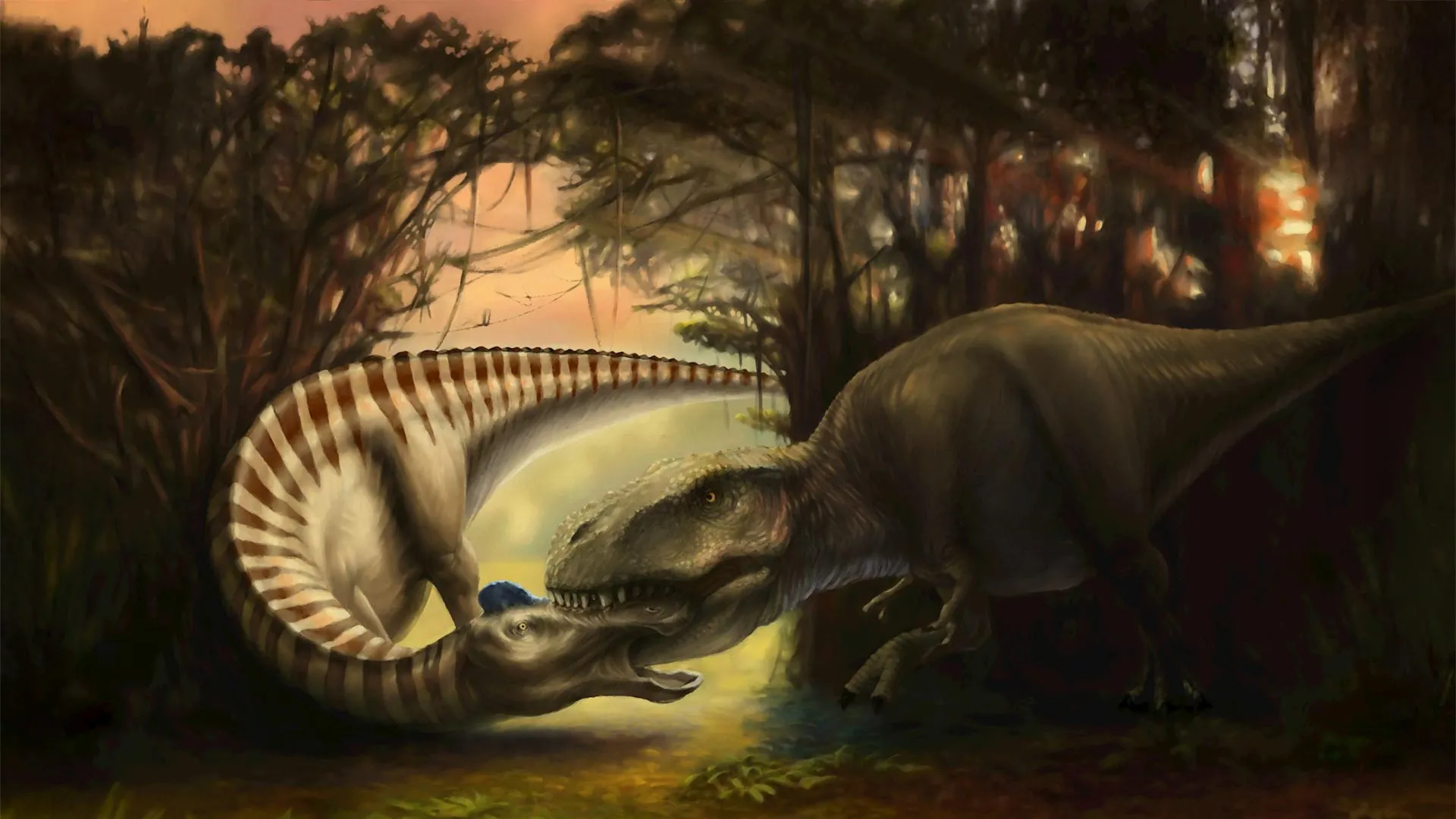
Paleontological research frequently relies on indirect evidence to reconstruct ecosystems that vanished tens of millions of years ago. Fossilized footprints, fragmentary bone beds, and isolated scratch marks allow scientists to theorize about ancient animal interactions, but definitive physical links between predator and prey remain exceptionally scarce. A remarkable new study published in the scientific journal PeerJ bridges this gap, offering an unusually granular look at the lethal capabilities of North America’s most iconic apex predator. Centered on a remarkably well-preserved Edmontosaurus skull housed at Montana State University’s Museum of the Rockies, the research provides tangible proof of a violent, face-to-face confrontation that occurred near the twilight of the Cretaceous period approximately 66 million years ago.
The specimen, which features a broken Tyrannosaurus tooth still firmly lodged within the facial bones of a duck-billed herbivore, serves as a prehistoric snapshot of a deadly ecological encounter. Led by University of Alberta doctoral student Taia Wyenberg-Henzler alongside Museum of the Rockies Curator of Paleontology John Scannella, the investigative team approached the fossil with the meticulous methodology of modern forensic investigators. By combining traditional osteological analysis with advanced medical imaging, the researchers have unlocked new insights into the predatory mechanics, striking angles, and sheer bone-crushing force wielded by Tyrannosaurus as it hunted its massive herbivorous contemporaries in what is now the American West.
The Hell Creek Formation and Its Apex Predator
To fully understand the significance of this discovery, paleontologists must contextualize the environment in which it took place. Approximately 66 million years ago, during the late Maastrichtian age of the Cretaceous period, the region encompassing modern-day Montana, Wyoming, and the Dakotas was a lush, subtropical coastal floodplain. Bounded by the developing Rocky Mountains to the west and the shrinking Western Interior Seaway to the east, the landscape featured meandering rivers, dense swamp forests, and expansive floodplains that supported an extraordinarily diverse megafauna ecosystem.
Within this dynamic landscape, Tyrannosaurus reigned supreme as the apex carnivore. Weighing upwards of nine metric tons and measuring up to 40 feet in length, the massive theropod possessed sensory adaptations, such as forward-facing eyes for binocular vision and an acute sense of smell, that made it a formidable hunter. However, it did not exist in isolation. The Hell Creek ecosystem was heavily populated by a diverse array of large herbivores, including the armored, three-horned Triceratops, the heavily armored ankylosaurid Edmontonia, and abundant herds of duck-billed hadrosaurs like Edmontosaurus.
Edmontosaurus was a large, plant-eating dinosaur that could reach lengths of up to 39 feet and weighed several tons. While lacking physical offensive weapons like horns or tail clubs, hadrosaurs relied on immense body size, tremendous speed relative to their bulk, and complex dental batteries designed for grinding tough vegetation. For a Tyrannosaurus, subduing a healthy, adult Edmontosaurus was no trivial task. It required strategic positioning, immense kinetic energy, and a bite force capable of shattering dense bone—capabilities that are directly illuminated by the newly studied fossil specimen.
Chronology of Discovery and Excavation
The journey of this scientific breakthrough began two decades ago during routine field operations in the rugged badlands of eastern Montana. In 2005, a field paleontology crew operating within the Hell Creek Formation uncovered a nearly complete Edmontosaurus skull. The excavation site was located on public land managed by the Bureau of Land Management, an agency that frequently collaborates with academic institutions and accredited museums to ensure the proper recovery and curation of significant paleontological resources.
The fossil was carefully jacketed in plaster and burlap to protect its fragile components during transport before being transferred to the paleontology laboratories at the Museum of the Rockies in Bozeman, Montana. Once cleaned of surrounding matrix sandstone, preparators and researchers immediately recognized the exceptional nature of the specimen. Unlike typical herbivore skulls bearing superficial scores or tooth scrapes from scavenging events, this skull possessed a distinct, jagged foreign object embedded deep within its nasal region: the crown of a broken tyrannosaurid tooth.
For years, the skull remained a centerpiece of the museum’s permanent paleontology displays, specifically within the renowned Hall of Horns and Teeth, where visitors could observe the physical evidence of an ancient predator-prey interaction frozen in stone. However, it was not until recent years that a formal, collaborative research initiative was launched to subject the specimen to modern analytical techniques. Wyenberg-Henzler and Scannella formed a research partnership to formally document, scan, and analyze the skull, culminating in their peer-reviewed publication in PeerJ.
Forensic Paleontology: CT Scans and Comparative Anatomy
The investigation required a multidisciplinary approach that bridged paleontology, comparative anatomy, and modern medical diagnostic technology. Because fossilized bone and embedded dental material can be easily damaged by invasive physical extraction, the research team relied heavily on non-invasive imaging to peer inside the bone structure surrounding the lodged tooth.
To achieve this, the fragile skull was transported to Advanced Medical Imaging at Bozeman Health Deaconess Hospital. There, medical professionals and researchers utilized high-resolution Computed Tomography (CT) scanners—typically reserved for human clinical diagnostics—to generate detailed, three-dimensional digital cross-sections of the fossil. These scans allowed the team to visualize the internal trajectory of the tooth, determine how deeply it had penetrated the bone, and evaluate the micro-fractures radiating from the impact site.
Simultaneously, the researchers conducted an exhaustive comparative anatomical analysis. To confirm the identity of the biter, the embedded tooth fragment was measured, shaped, and contrasted against the dentition of every known carnivorous dinosaur species discovered within the Hell Creek Formation. These included smaller theropods such as the dromaeosaur Dakotaraptor and the troodontid Pectinodon, as well as intermediate predators like Acheroraptor. The physical dimensions, serration density, and robust cross-section of the embedded tooth definitively ruled out all other candidates, matching the unique morphological characteristics of Tyrannosaurus.
"Although bite marks on bones are relatively common, finding an embedded tooth is extremely rare," noted Taia Wyenberg-Henzler during the release of the study. "The great thing about an embedded tooth, particularly in a skull, is it identifies not only who was bitten, but also who did the biting. This allowed us to paint a picture of what happened to this Edmontosaurus, kind of like Cretaceous crime scene investigators."
Insights into Predator Behavior and Force Dynamics
The discovery of the embedded tooth provides crucial empirical data that helps settle long-standing debates regarding the hunting habits of Tyrannosaurus. For decades, paleontologists have debated whether the animal was a hyper-specialized active predator, a pure scavenger, or an opportunistic feeder that utilized both strategies depending on availability. The nature of the wound preserved in the Edmontosaurus skull strongly supports the active predation hypothesis.
The precise location of the impact—embedded directly into the nasal region of the duck-billed dinosaur’s face—suggests a direct, face-to-face confrontation. In modern predatory interactions among large carnivores, attacks directed at the head and face of prey animals typically occur during active takedowns, where predators seek to disable, disorient, or suffocate their victims. Scavenging events, by contrast, are more commonly associated with random bite marks on post-mortem carcasses, focusing on fleshy limbs, muscle attachments, and long bones rather than targeted facial strikes.
Furthermore, the physical mechanics required to snap a heavily enameled tyrannosaurid tooth off at the bone line demand an extraordinary degree of kinetic force. Tyrannosaurus possessed one of the most powerful bite forces in the history of vertebrate evolution, estimated by biomechanical studies to exceed 12,000 pounds of force—equivalent to the weight of a medium-sized elephant pressing down with a single tooth. When the predator clamped down on the Edmontosaurus’s snout, the stress concentration was so immense that the structural integrity of the tooth failed, leaving the tip permanently entombed in bone.
"A fossil like this is extra exciting because it captures a behavior: a tyrannosaur biting into this duckbill’s face," stated John Scannella. "The skull shows no signs of healing around the tyrannosaur tooth, so it may have already been dead when it was bitten, or it may be dead because it was bitten."
This absence of osteological healing—the lack of bone remodeling or callus formation around the foreign object—indicates that the trauma occurred either immediately before the animal’s death or as part of the fatal event itself. If the Edmontosaurus had survived the initial bite, osteoblasts would have initiated a healing response, encapsulating the tooth in reactive bone tissue over the course of weeks or months. Because the bone remained completely unremodeled, researchers are left with two primary scenarios: either the predator ambushed and killed the hadrosaur with a crushing blow to the face, or it scavenged a recently deceased carcass, driving its teeth so forcefully into the skull that a tooth snapped off in the lifeless bone. Given the frontal angle of the attack and the extreme application of force, researchers lean toward a dynamic predatory encounter.
Broader Implications for Cretaceous Ecosystem Studies
The publication of this study extends far beyond establishing the hunting mechanics of a single dinosaur species; it enhances our broader understanding of predator-prey co-evolution in ancient ecosystems. The Hell Creek Formation preserves a snapshot of an evolutionary arms race, where herbivores evolved massive size, herding behaviors, and specialized dental adaptations in response to the selective pressure exerted by hyper-efficient apex predators like Tyrannosaurus.
By utilizing forensic methodologies borrowed from modern crime scene investigations, paleontologists are increasingly able to move beyond static descriptions of anatomy and reconstruct complex biological behaviors. Each fossilized tooth mark, healed fracture, and embedded projectile represents a fleeting moment of biological drama that unfolded millions of years before human history began.
Institutions such as the Museum of the Rockies continue to serve as vital repositories for these rare pieces of natural history. By making such specimens accessible to both the public and academic researchers, museums ensure that ongoing technological advancements—such as high-resolution CT scanning and digital 3D modeling—can be applied to historical collections to yield entirely new discoveries.
As researchers continue to analyze the Hell Creek Formation and its abundant fossil resources, specimens like the Montana Edmontosaurus skull stand as enduring testaments to the violent, dynamic, and endlessly fascinating reality of the Age of Dinosaurs. The shattered tooth lodged in the bone remains a silent witness to a brutal Cretaceous struggle, forever preserving the split-second encounter between one of history’s most terrifying predators and its prey.
