
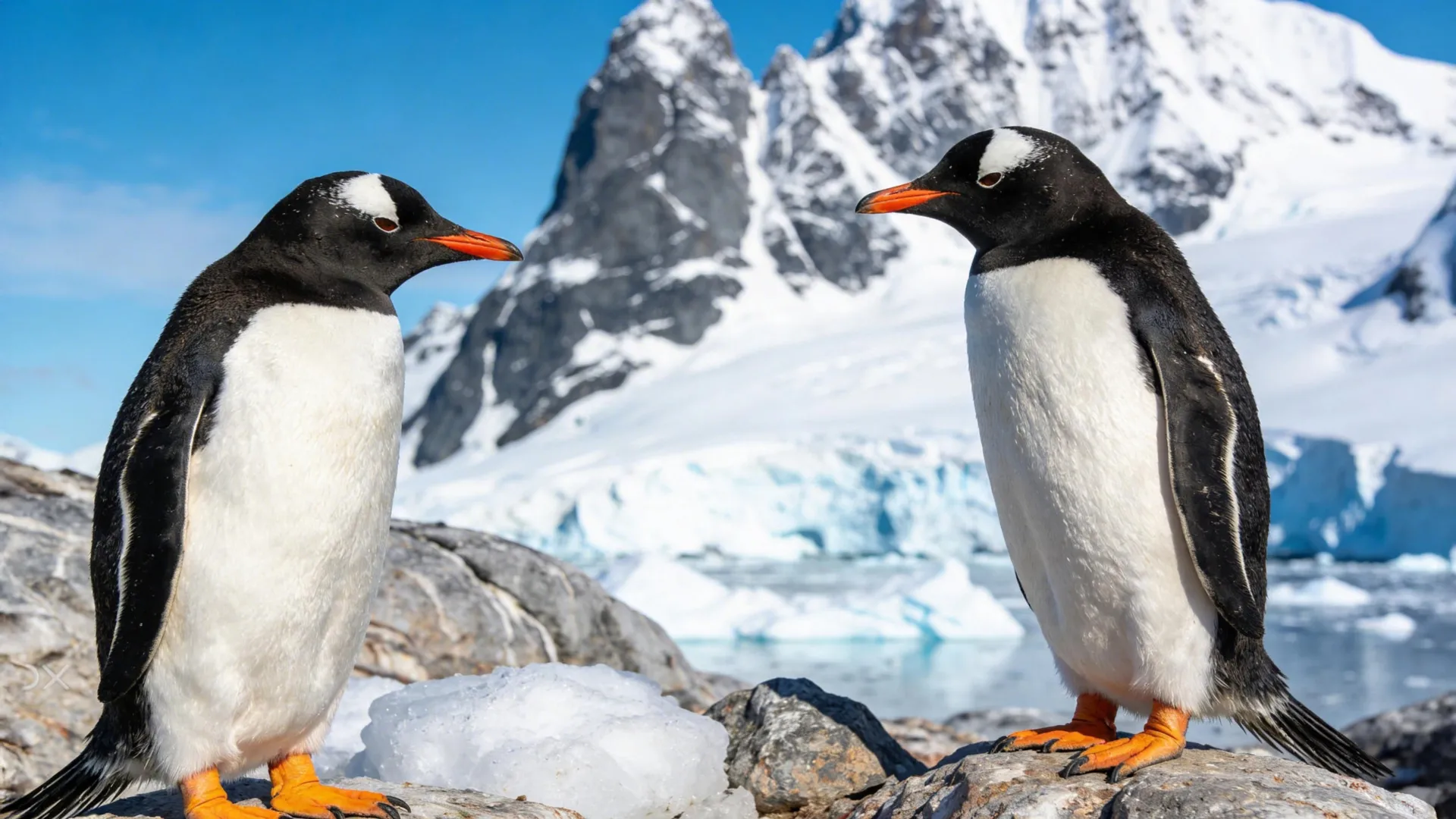
For over a century, the gentoo penguin has stood as a familiar icon of the sub-Antarctic and Antarctic landscapes, recognized by its striking white underbelly, jet-black back, and signature bright orange-red bill. Yet, beneath this uniform facade lies a profound evolutionary secret. Following a comprehensive international genomic study published in the journal Communications Biology, scientists have revealed that the widely distributed gentoo penguin is not a single species at all, but rather a complex of four distinct species. This landmark finding marks the first time a new penguin species has been officially named and recognized in more than 100 years.
The discovery centers on a previously unrecognized population inhabiting the Kerguelen Islands—territories colloquially known in French as the Desolation Islands, situated nearly 2,000 miles away from any permanently inhabited landmass. Led by an international team of researchers from Chile and the University of California, Berkeley, the study deployed whole-genome sequencing to resolve a taxonomic debate that has persisted in the ornithological community for over a century. By analyzing the genetic architecture, physical characteristics, and behavioral patterns of gentoo populations across their entire geographic range, the research collective has fundamentally rewritten our understanding of Southern Hemisphere avian biodiversity.
A Century of Taxonomic Controversy
The classification of gentoo penguins has long vexed biologists. Over the decades, various researchers proposed anywhere from a unified species to as many as six distinct subspecies, but a universal consensus remained elusive due to the logistical challenges of sampling isolated island colonies. To settle these long-running disagreements, Juliana Vianna, a professor of ecosystems and environment at Andrés Bello National University in Santiago, Chile, joined forces with co-senior authors Rauri Bowie, a professor of integrative biology at UC Berkeley, and Elie Poulin, a professor at the University of Chile.
The team coordinated a massive global effort, bringing together penguin specialists from Australia, Spain, Venezuela, South Africa, the United Kingdom, France, Argentina, Monaco, and Brazil. Daly Noll, a graduate student at the University of Chile, led the genomic analysis as the paper’s first author. The researchers gathered whole-genome sequences from 64 individual penguins across 10 distinct breeding colonies, achieving for the first time a sampling breadth that covered nearly the entire geographic range of the gentoo lineage.
In addition to genomic sequencing, the team conducted rigorous comparative analyses of physical and behavioral traits. This multifaceted approach evaluated coloration, vocalizations, breeding schedules, diets, and foraging behaviors. The resulting data provided the empirical weight needed to elevate three previously designated subspecies to full species status, while formally identifying a fourth, entirely new species.
The Four Pillars of the Gentoo Lineage
The genetic evidence demonstrates that geographic isolation and environmental pressures have driven the divergence of four distinct gentoo species over the past 300,000 to 500,000 years.
- The Southern Gentoo (Pygoscelis ellsworthi): Inhabiting the Antarctic Peninsula, coastal Antarctica, and South Georgia Island, this is the most numerous lineage and the only one of the four to reside truly within the Antarctic zone.
- The Eastern Gentoo (Pygoscelis taeniata): Found north of the Antarctic Polar Front on the Crozet, Marion, and Macquarie Islands, this lineage thrives in warmer, saltier waters.
- The Northern Gentoo (Pygoscelis papua): Restricted primarily to the Falkland/Malvinas Islands and Martillo Islands in South America.
- The Southeastern Gentoo (Pygoscelis kerguelensis): The newly described cryptic species, native to the remote Kerguelen Islands and likely nearby Heard Island, which looks virtually identical to other gentoos aside from subtle variations in body size and vocalizations.
The primary architectural barrier driving this speciation is the Antarctic Polar Front—a major oceanographic boundary where water temperatures and salinity shift sharply, acting as a filter that restricts the movement of many marine species. Furthermore, unlike specialized feeders such as Emperor and Adélie penguins, gentoos possess a flexible diet that includes fish, krill, squid, and cuttlefish. Because they can forage on a wide variety of prey near their breeding colonies, they do not need to undertake massive migrations, anchoring them to isolated island habitats where natural selection gradually shaped their genomes over millennia.
Genomic Adaptations to Extreme Environments
The high-resolution genomic data, which analyzed thousands of single nucleotide polymorphisms (SNPs), exposed distinct evolutionary adaptations tailored to each species’ specific geographic niche.
For the southern gentoo (Pygoscelis ellsworthi), thriving in the extreme conditions of Antarctica required genetic enhancements associated with heat production, lipid storage, and light perception. The latter adaptation is particularly critical for coping with dramatic seasonal shifts in daylight and the intense glare of sunlight reflecting off vast expanses of ice.
Conversely, the eastern gentoo (Pygoscelis taeniata) evolved genetic pathways focused on efficient carbohydrate metabolism and enhanced diving performance. Genomic markers linked to oxygen transport, blood vessel formation, mitochondrial activity, and lung development suggest these birds are uniquely equipped to remain submerged longer while foraging in sub-Antarctic waters characterized by lower biological productivity. Meanwhile, the northern gentoo of South America exhibits genomic enrichment in regions controlling digestion, heart contraction, and muscle excitation, supporting the sustained physical activity required for prolonged underwater hunting.
Climate Change and Conservation Implications
While the southern gentoo is currently expanding its range and benefiting from shifting conditions along the Antarctic Peninsula, the newly defined island-dwelling species face a precarious future. Climate models projecting conditions out to the year 2050 under a moderate warming scenario indicate that sub-Antarctic gentoo species could lose suitable habitat across their current island ranges, with few alternative landmasses available for colonization.
"In Antarctica, of course, other species, not the gentoo, are threatened by climate change," explained Juliana Vianna. "But the gentoo is of most concern in the sub-Antarctic region," noting that these isolated territories are governed by a patchwork of international jurisdictions, including Chile, South Africa, France, the Netherlands, Australia, and New Zealand. "It’s very important that conservation institutions in all the different countries involved recognize and take appropriate action to save these three gentoo penguin species."
Beyond climate disruption, these island populations face anthropogenic pressures including warming oceans, habitat destruction, introduced predators such as rats and dogs, competition with commercial fisheries, and accidental entanglement in fishing gear. Because these species are endemic to isolated island ecosystems, they cannot easily relocate when environmental baselines shift.
The Broader Value of Avian Genomics
The implications of this comprehensive genomic dataset extend far beyond basic taxonomy. Rauri Bowie, a curator in UC Berkeley’s Museum of Vertebrate Zoology, emphasizes that whole-genome sequencing has fundamentally altered the toolkit available to conservation biologists.
As global wildlife populations contend with emerging threats—most notably avian influenza, which has impacted bird and mammal colonies worldwide—researchers like Vianna are already scanning penguin genomes to identify genetic markers associated with disease resistance and vulnerability. By pinpointing which populations possess adaptive resilience and which remain critically exposed, conservationists can better direct limited resources to protect vulnerable lineages before they pass a tipping point.
Ultimately, the formal recognition of Pygoscelis kerguelensis and the elevation of its sister lineages underscore how much remains undiscovered within remote marine ecosystems. As modern genomic tools continue to illuminate the hidden diversity of the Southern Hemisphere, they provide both a clearer picture of evolutionary history and an urgent roadmap for safeguarding the future of the world’s most isolated seabirds.
