
The high-voltage power lines crisscrossing the lush canopies of Costa Rica present an invisible, lethal hazard to the country’s diverse arboreal wildlife. Unlike humans, who can be taught to recognize the structural dangers of electricity transmission, native species navigate fragmented forests relying entirely on instinct. For sloths, which are uniquely adapted for slow, deliberate tree-to-tree travel, urban expansion and rural electrification have created a deadly maze. Unable to comprehend the difference between a sturdy liana and a live power cable, these gentle mammals face a daily existential threat from severe electrical trauma and catastrophic falls.
According to data compiled by Costa Rica’s Ministry of Environment and Energy (MINAE), electricity distribution companies reported 6,703 wildlife electrocution incidents along power lines in 2024 alone. This staggering figure averages out to more than 18 animals killed or severely injured every single day. While these official numbers capture a fraction of the ecological damage, wildlife rescue organizations note that for every animal that successfully reaches a rehabilitation facility, hundreds more perish silently in the rainforest canopy, their bodies never recovered or documented.
The disproportionate impact of this infrastructure on sloths has become an alarming trend for conservationists. At the Toucan Rescue Ranch, historical intake data reveals that sloths account for an overwhelming majority of electrocution-related admissions—representing more than eight out of every ten patients treated for high-voltage trauma over the past two operational years. The physiological profile of sloths, combined with their slow locomotion and tendency to bridge gaps between uninsulated utility poles, makes them exceptionally vulnerable to grounding circuits and high-voltage transmission lines.
The Anatomy of High-Voltage Trauma and Rehabilitation
Experiencing a power line electrocution is among the most catastrophic physiological events a wild animal can endure. The electrical current travels through the body, causing severe internal and external burns, tissue necrosis, neurological damage, and secondary trauma resulting from falls that frequently exceed 10 meters in height. Recovery is an intensive, multi-month process that requires specialized veterinary intervention, prolonged wound management, and significant financial resources.
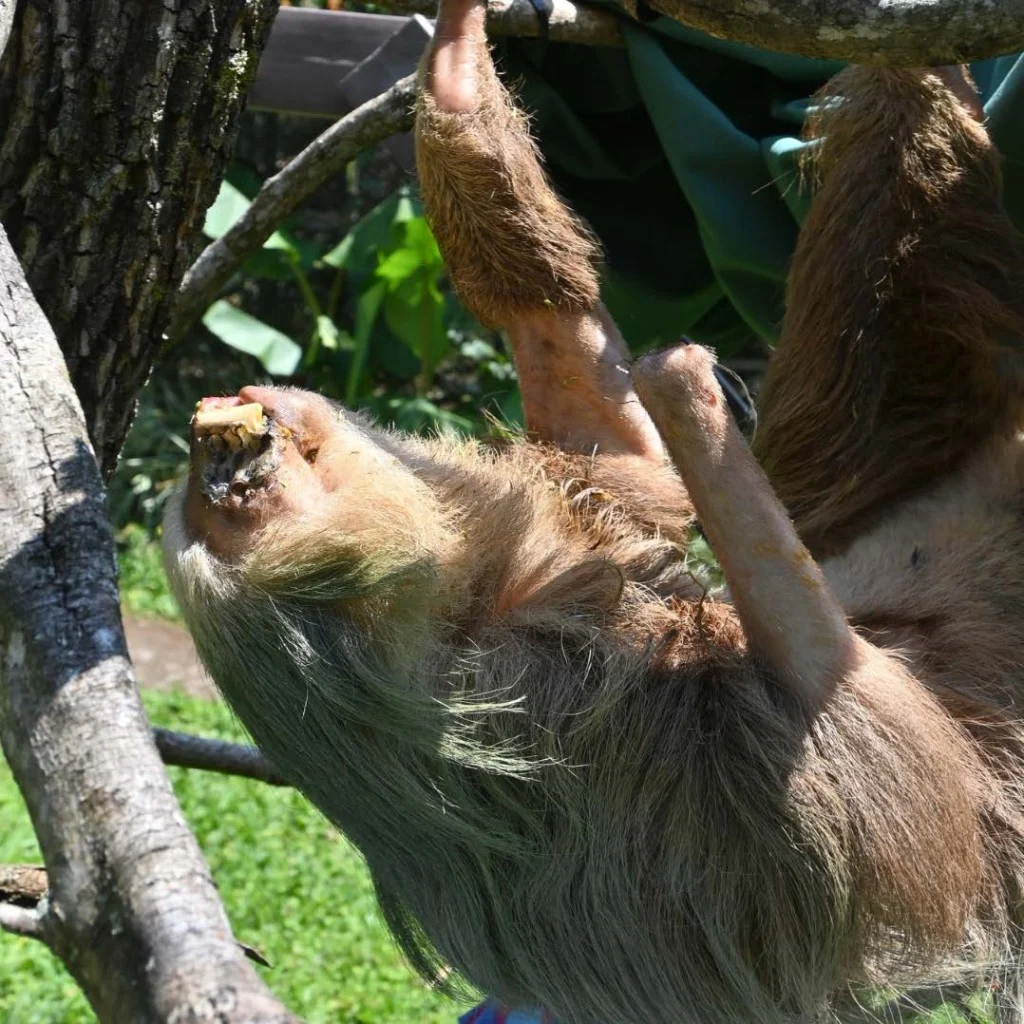
A prominent example of this ongoing crisis is Champ, a two-fingered sloth rescued in the province of Limón after coming into contact with an uninsulated transformer. Found by a local police officer in Guácimo, Champ suffered extensive burns to his face, torso, and limbs, alongside severe ocular trauma. Donors mobilized to raise $1,380 to fund his emergency stabilization and subsequent surgeries. At the Toucan Rescue Ranch’s specialized release-site clinic, veterinarians determined that the electrical damage to one of Champ’s hands was irreversible, necessitating a partial amputation. Despite the permanent physical handicap, intensive rehabilitation allowed Champ to regain his strength, offering a rare success story of adaptation and eventual return to a modified life in the wild.
The financial burden of these rescues is substantial. Facilities rely heavily on public donations, international grants, and corporate partnerships to cover the costs of surgeries, burn treatments, specialized diets, and long-term enclosures required for animals recovering from severe trauma.
A Chronology of Legislative and Industrial Reform
For decades, wildlife conservationists, rescue centers, and local communities have lobbied for systemic changes to Costa Rica’s electrical grid to mitigate wildlife mortality. The timeline of reform has been characterized by incremental cooperation between regulatory bodies, utility companies, and non-governmental organizations.
In the early 2010s, public awareness campaigns began highlighting the alarming frequency of coatis, monkeys, and sloths found dead or injured beneath utility poles. This grassroots pressure prompted initial discussions regarding the installation of wildlife bridges and insulated cabling. By the mid-2010s, regional distribution cooperatives began voluntary pilot programs to wrap high-risk transformer lines in insulating materials, though implementation remained sporadic and dependent on regional budgets.
The turning point for national accountability arrived in June 2026, when the Costa Rican government officially rolled out a comprehensive national strategy designed to eradicate wildlife electrocutions. This landmark policy mandates that state and private electricity providers systematically identify high-risk corridors, insulate dangerous lines, and collaborate directly with certified wildlife rescue centers and rehabilitation facilities. Under the strategy, organizations like the Toucan Rescue Ranch serve as critical data hubs, providing empirical insights into the efficacy of proposed mitigation tools, such as anti-climbing barriers and specialized cable guards.
Corporate Responsibility and Technological Collaboration
Mitigating the electrocution crisis requires a multi-pronged approach that extends far beyond emergency veterinary care. Modern conservation science emphasizes proactive environmental engineering to prevent wildlife from accessing hazardous infrastructure in the first place.
The Toucan Rescue Ranch maintains a long-standing collaborative framework with national energy companies to test and refine wildlife protection devices. These anti-climbing shields and physical barriers are installed on utility poles surrounding protected areas and biological corridors. By utilizing rescue facilities as testing grounds, engineers can evaluate real-world interactions between arboreal species and newly designed deterrents, ensuring that infrastructure updates translate into measurable drops in mortality rates.
Furthermore, conservation advocates are pushing for mandatory specialized training for utility field technicians and construction contractors. Personnel who routinely work on or near power lines in rural and semi-urban environments must be equipped with protocols for handling distressed wildlife safely, minimizing the time between incident discovery and veterinary intervention.
Broader Environmental Implications and Fragmentation
The high rate of wildlife electrocution is symptomatic of a broader ecological challenge: habitat fragmentation. As agricultural expansion, real estate development, and infrastructure projects carve up continuous rainforests, arboreal species are forced to cross human-dominated landscapes. When contiguous canopy cover is disrupted by roadways and electrical grids, power lines frequently represent the only continuous pathways available for animals traversing their home ranges.
Biologists emphasize that the loss of adult breeding-age animals—particularly sloths, which have low reproductive rates and typically give birth to a single offspring every year or two—has a disproportionate impact on local population stability. The removal of even a small number of individuals from a fragmented population can accelerate local extinction dynamics and reduce genetic diversity across regional corridors.
The Path Forward: Public Engagement and Systemic Prevention
Addressing a crisis of this magnitude demands sustained engagement from both civil society and industrial stakeholders. Conservation organizations stress that public awareness is the first line of defense. Citizens who encounter injured or electrocuted wildlife must be educated on proper reporting procedures, emphasizing the importance of contacting trained rescue networks rather than attempting amateur intervention, which can be dangerous for both the human and the animal.
While the national strategy introduced in mid-2026 marks a monumental step forward for Costa Rica’s environmental policy, the implementation phase remains a long-term endeavor. Thousands of kilometers of legacy infrastructure still lack basic insulation, and high-risk zones continue to claim the lives of native fauna daily.
The ultimate objective of conservationists, veterinarians, and policy makers is to build an infrastructure network where human development and biodiversity coexist safely. Through continued financial support from donors, stricter enforcement of corporate environmental accountability, and the expansion of insulated power grids, organizations like the Toucan Rescue Ranch strive to turn the tide against the silent crisis in the canopy, ensuring that fewer animals fall victim to the hazards of modern progress.
