
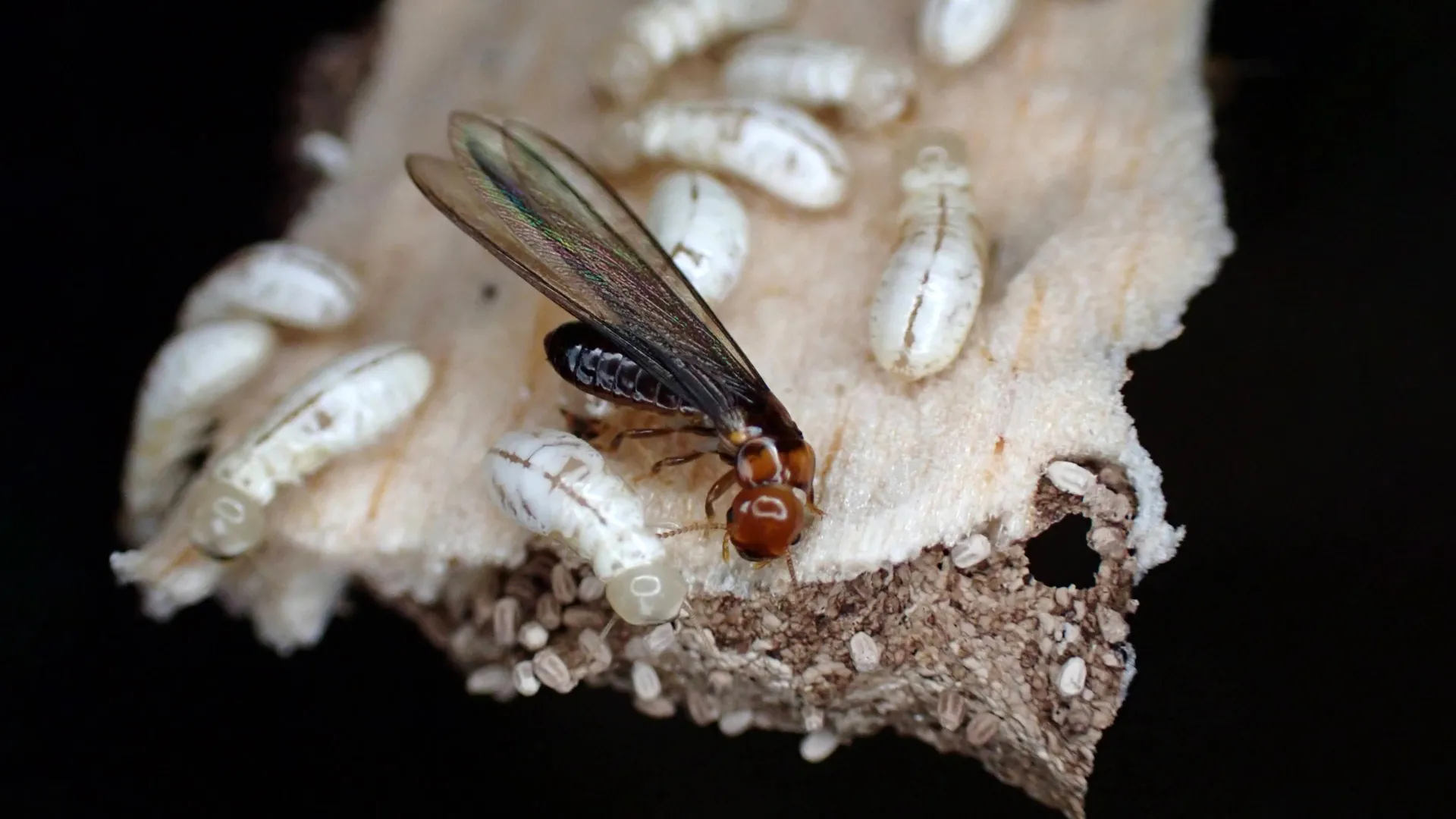
For decades, structural pest control has faced a formidable and silent adversary: the western drywood termite. Capable of spending their entire life cycles concealed deep within structural beams, subflooring, furniture, and framing timbers, these insects carve out intricate internal galleries while remaining virtually invisible to property owners. Traditional eradication methods, most notably whole-structure fumigation, have long served as the heavy-handed standard for tackling widespread infestations. However, fumigation is notoriously disruptive, requiring families to vacate their homes, mandating extensive food preparation and removal, and—critically—leaving behind no residual chemical protection against future invasions. Furthermore, these sweeping measures can be prohibitively expensive and environmentally taxing.
Now, a pioneering wave of research emerging from the Department of Entomology at the University of California, Riverside (UCR), is challenging the necessity of whole-house treatments. By leveraging the fundamental biology, social behaviors, and microbial signatures of western drywood termites, UCR scientists are designing targeted, low-impact alternatives. From chitin synthesis inhibitors that weaponize the molting process to tree-derived chemical lures and microbial clocks capable of identifying active infestations, this multi-pronged scientific pursuit aims to redefine how the pest control industry approaches one of its most elusive targets.
Weaponizing the Molting Cycle: The Power of Bistrifluron
The cornerstone of this new methodology centers on a biological inevitability that drywood termites cannot escape: they must molt. Unlike mammals, which possess internal skeletons, insects rely on a rigid external armor known as an exoskeleton. A primary component of this protective structure is chitin, a durable natural polysaccharide that also forms the structural walls of fungi, fish scales, and the anatomical beaks of cephalopods. For a growing termite, chitin provides both vital physical defense and sturdy attachment points for musculature.
However, because this biological armor cannot stretch indefinitely, drywood termites must shed their exoskeletons approximately seven times throughout their lifetimes, replacing them with larger versions. In a study published in 2025 in the Journal of Economic Entomology, UCR researchers identified a critical vulnerability in this necessary process. The team demonstrated that bistrifluron, an insect growth regulator functioning as a chitin synthesis inhibitor, can eliminate western drywood termites with striking efficiency.
Led by doctoral student and corresponding author Nicholas Poulos alongside senior author and entomology professor Dong-Hwan Choe, the laboratory experiments evaluated three distinct chitin synthesis inhibitors: bistrifluron, chlorfluazuron, and noviflumuron. Among these compounds, bistrifluron yielded the fastest and most decisive mortality rates. When test subjects were continuously exposed to treated wood, the chemical produced roughly 99 percent mortality within 60 days at a 0.1 percent concentration. Even when termites were given a choice between treated and untreated wood, the compound achieved a remarkable 95.7 percent mortality rate.
"This chemical is more environmentally friendly than ones traditionally used for drywood termite infestations," Nicholas Poulos noted, emphasizing that the compound targets insect-specific biological pathways and remains harmless to humans and other mammals.
Rather than acting as a conventional, fast-acting neurotoxin, bistrifluron operates with a delayed mechanism. When exposed termites reach a designated growth stage, they attempt to shed their old exoskeleton but lack a new, hardened replacement to protect them. Consequently, feeding activity decreases as the insects march inexorably toward a fatal, incomplete molt.
The Domino Effect: Social Behavior as a Vector for Elimination
One of the most profound discoveries in the UCR research is not merely that bistrifluron kills termites upon direct contact, but that it utilizes the insects’ own social structure to expand its lethality. Drywood termites live in highly cooperative colonies where resources, food, and gut microbes are routinely shared among nestmates.
To determine whether a localized application could scale up to eradicate an entire colony, the research team exposed a fraction of a test group to bistrifluron and introduced them to unexposed peers. Using colored food tracers to monitor the movement of organic material, the researchers observed that within 24 to 48 hours, substances from the exposed termites had successfully reached previously untouched nestmates.
The epidemiological results were striking. In experimental groups where only 5 percent of the population was initially exposed to bistrifluron, the colonies ultimately reached 100 percent mortality by day 90. Groups that began with a 50 percent exposure rate demonstrated a similarly devastating trajectory.
This social transmission is heavily facilitated by specialized behaviors. In 2026, the UCR research team released high-resolution imagery and video documenting western drywood termites engaging in proctodeal trophallaxis—a delicate feeding process wherein one termite receives essential nutrients and wood-digesting gut microbes directly from another’s hindgut. While this intense cooperation typically ensures a colony’s survival in the wild, the UCR findings reveal that pest controllers can subvert this exact behavior. A small cadre of contaminated termites effectively acts as a Trojan horse, carrying lethal doses deep into concealed galleries that would otherwise remain untouched by traditional spot treatments.
Attracting Termites to Their Own Demise
Bistrifluron represents only one pillar of UCR’s comprehensive strategy. Recognizing that finding and treating every localized pocket of an infestation remains an obstacle for pest management professionals, the same laboratory has explored ways to actively draw termites toward treatment zones.
In previous work published in 2024, the team investigated pinene, a naturally occurring fragrant chemical released by numerous tree species. To a western drywood termite burrowed inside timber, the scent of pinene acts as an environmental beacon, signaling attractive foraging terrain. When researchers paired pinene with aqueous fipronil treatments, the mortality rate surged from approximately 70 percent with the insecticide alone to over 95 percent when the lure was added.
This innovation progressed toward commercial feasibility with a University of California patent application filed in April 2025 and published later that October. The patent outlines the incorporation of alpha-pinene or beta-pinene into localized insecticide injections for western drywood termites. By drawing insects toward specific treated points, pest control technicians could theoretically space treatment drilling holes farther apart, substantially reducing labor costs and minimizing the overall volume of chemical required. While these applications remain under development rather than serving as immediate replacements for established protocols, they highlight a shift toward precision-guided pest management.
Solving the Diagnostic Dilemma: The Microbial Clock
Even the most effective localized insecticide is useless if a technician cannot accurately determine where an active colony resides. For homeowners, the primary indicator of a drywood termite infestation is often the appearance of frass—tiny, hard fecal pellets ejected from wooden galleries. However, identifying frass presents a deceptive diagnostic challenge: old pellets can persist inside wall voids and attics long after a colony has naturally died out or been previously eradicated. Finding frass has never definitively proven that termites are currently present.
To resolve this ambiguity, Poulos and his colleagues investigated the biological composition of termite droppings, discovering that the microbes inhabiting the pellets degrade over time, effectively functioning as a biological clock.
The researchers analyzed fresh western drywood termite pellets alongside samples aged for three months, six months, and one year. Their findings revealed that bacterial DNA within the frass declines precipitously as the material ages. In pellets produced by termites feeding on natural hardwood, the estimated bacterial load dropped as much as 190-fold over a twelve-month period. A similarly dramatic reduction was documented in pellets derived from Douglas fir, a standard material utilized in residential framing.
Furthermore, specific bacterial families identified in fresh Douglas fir pellets vanished entirely as the samples aged. By establishing these distinct microbial signatures, the UCR team hopes to develop a rapid diagnostic tool. Such a tool would allow pest professionals to test frass samples on-site, determining with scientific precision whether an infestation is active and warranting immediate intervention.
Overcoming Practical Obstacles and Future Implications
Despite the promising laboratory metrics, transitioning bistrifluron and associated treatments from controlled academic settings to residential homes requires overcoming practical engineering hurdles. In their foundational experiments, researchers dissolved bistrifluron in acetone, allowing the solvent to evaporate before introducing the insects. While acetone is an ideal laboratory medium, its high flammability and potent chemical odor render it entirely unsuitable for routine residential applications.
"We are working to make it more feasible for practical application in real-life scenarios," Poulos stated, noting that developing a safe, commercially viable carrier formulation remains a primary objective.
Furthermore, the economic and geographical implications of western drywood termite management continue to expand. Native to the southwestern United States and northwestern Mexico, Incisitermes minor has established itself as an aggressive structural pest throughout California. Driven by global commerce and the constant transport of timber, furniture, and wooden packaging materials, the species has steadily expanded its footprint far beyond its native range. Established populations have been documented in Hawaii, Florida, New York, parts of Canada, China, Japan, Korea, and Australia.
As global climate patterns shift and localized weather conditions become increasingly hospitable to introduced populations, entomologists warn that drywood termites will likely establish colonies in new geographic territories.
"As we move lumber around the world, the termites are constantly transported to new locations. If they find the climate there acceptable, the problem will spread," Dong-Hwan Choe observed. "In areas where these termites are common, it’s just a matter of time before homes are infested, so this study is a good initial step toward alternative strategies for controlling them."
The broader implications of UCR’s ongoing research point toward an industry-wide evolution. By looking past brute-force chemical applications and instead mapping the subtle intersections of insect endocrinology, social trophallaxis, olfactory attraction, and microbial ecology, scientists are dismantling the cloak of invisibility that has protected drywood termites for centuries. For property owners facing the prospect of disruptive fumigations, these biological insights promise a future where pest control is localized, environmentally prudent, and definitively guided by science.
