
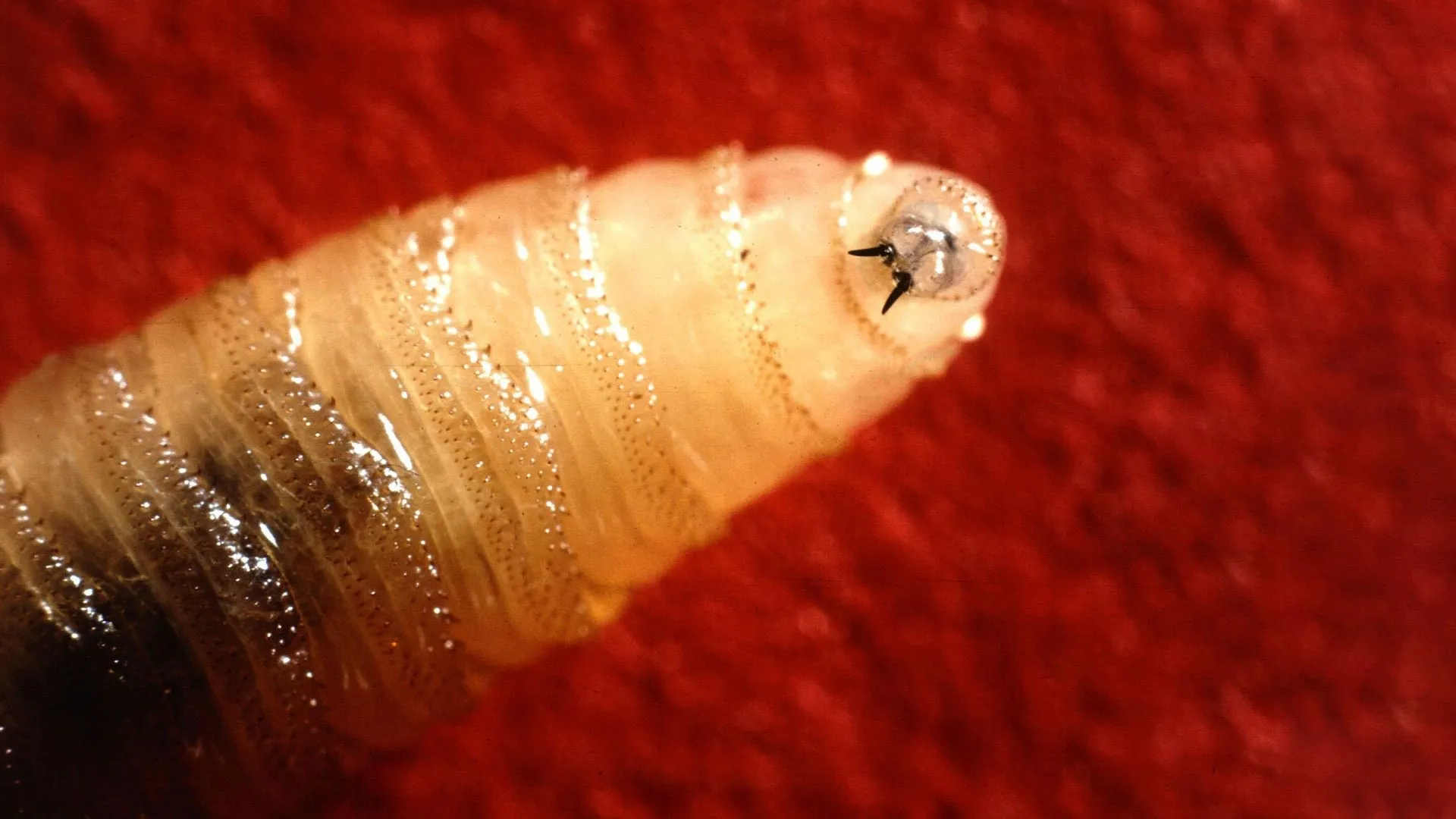
Decades after a monumental eradication campaign pushed the dreaded New World screwworm out of the United States and far south to the Darién Gap in Panama, the flesh-eating parasitic fly has quietly crossed back into American territory. Reaching parts of Texas and New Mexico, the return of Cochliomyia hominivorax has sparked urgent alarms among agricultural officials, livestock producers, veterinarians, and public health agencies. Unlike common blowflies whose maggots feed exclusively on necrotic, decaying matter, female New World screwworm flies target living tissue, laying their eggs in open wounds or mucous membranes of warm-blooded mammals. Once hatched, the larvae burrow into the host, consuming live tissue and causing deep, agonizing lesions that can rapidly prove fatal if left untreated.
To combat this creeping biological threat before it spirals into a nationwide agricultural crisis, researchers at the University of California San Diego (UC San Diego), in close collaboration with the County of San Diego Health and Human Services Agency (HHSA) Public Health Services, have engineered a sophisticated geospatial and data-driven tracking dashboard. Operating under the umbrella of "Resilient Shield"—a Centers for Disease Control and Prevention (CDC)-funded center within the newly established Insight Net network—this technological intervention represents a modern paradigm shift in how academic institutions and public health departments confront sudden biological hazards.
Historical Context and the 20th-Century Eradication Campaign
To understand the gravity of the current resurgence, one must look back to the mid-20th century. During the 1950s, New World screwworm infestations were an economic nightmare for American ranchers and livestock producers. In the southwestern United States alone, the parasite inflicted catastrophic losses, causing an estimated $50 million to $100 million annually—an astronomical sum at the time—by devastating cattle, sheep, and other agricultural assets.
The crisis prompted the United States Department of Agriculture (USDA) to pioneer one of the most successful biological control operations in human history: the sterile insect technique (SIT). Developed by USDA entomologists Edward F. Knipling and Raymond C. Bushland, the method involved mass-rearing millions of male screwworm flies, sterilizing them using gamma radiation, and systematically releasing them over infested regions from airplanes. When the sterile males mated with wild-native females, the unions produced no viable offspring. Over successive generations, wild populations collapsed.
Through relentless deployment of SIT, combined with strict quarantines on livestock transport and the use of chemical treatments, federal and state authorities systematically rolled back the pest’s geographic range. By the late 20th century, the screwworm had been eradicated from the United States, Mexico, and Central America, establishing a biological barrier zone in Panama to prevent northern migrations from South America. For decades, this victory held firm, rendering the screwworm a historical footnote in American veterinary medicine.
The Unexpected Return: Chronology of the Modern Threat
The historical line of defense, however, has begun to fracture. In 2023, veterinary epidemiologists tracking animal health trends in Central America and northern South America noted worrying northward movements of the parasite. While initial epidemiological models anticipated a gradual shift, the actual velocity of the spread caught many federal officials off guard.
By late 2023 and into 2024, confirmed detections of New World screwworm emerged within the borders of Texas and New Mexico.
"We knew in 2023 that New World screwworm was going to move northward, but I wasn’t expecting it to move as fast as it has," stated Dr. Mark Beatty, assistant medical director for the County of San Diego’s Epidemiology and Immunization Services Branch. "Although the source of the infections in the U.S. is still under investigation, the fact that it’s in the U.S. is 100% clear. Once it entered Texas, we quickly saw an increase in detections. It’s in a place where it used to live, so it’s not surprising it’s taking a hold again."
The modern vector landscape differs significantly from the 1950s. While adult screwworm flies are robust fliers capable of traversing multiple miles in search of hosts, modern globalized trade, rapid transportation networks, and the movement of domestic pets, exotic birds, and wildlife have accelerated the potential for long-distance dissemination. As the parasite reclaims its historical ecological niches in the American Southwest, state and federal authorities have had to mobilize rapidly.
Pathology: Why the New World Screwworm Terrifies Veterinarians
The biological mechanism of the New World screwworm explains why its return evokes such immediate dread among animal health professionals. The life cycle begins when an adult female fly is attracted to the scent of living tissue exposed by minor cuts, tick bites, castration wounds, branding scars, or even the navels of newborn livestock.
A single female can deposit hundreds of eggs in a single batch. Within 12 to 24 hours, the eggs hatch into larvae (maggots) equipped with sharp mouthparts and flesh-boring hooks. Unlike benign fly larvae that clean dead tissue, screwworm larvae actively burrow downward into healthy, vascularized muscle and tissue. As they feed cooperatively, they enlarge the initial wound, creating deep, crater-like pockets that emit a distinct, foul odor. This deterioration attracts more female flies, leading to compounding infestations known as myiasis.
Without prompt mechanical removal of the larvae and the application of larvicides, severe secondary bacterial infections set in, leading to systemic toxicity, shock, and death. While livestock remain the primary economic target, the parasite is entirely indiscriminate regarding warm-blooded hosts. Wildlife populations—including deer, elk, and javelinas—as well as domestic dogs, cats, and horses, are equally vulnerable.
Crucially, human cases, though exceedingly rare, do occur. The parasite does not transmit directly from person to person through respiratory droplets or casual contact like viral respiratory pathogens. Instead, human myiasis occurs when an adult fly deposits eggs directly into an untreated wound, or occasionally near the mucous membranes of the eyes, nose, or ears. Once established, human infections require immediate surgical extraction of the larvae to prevent permanent disfigurement or systemic complications.
Cutting-Edge Surveillance: The Resilient Shield Screwworm Dashboard
Recognizing that traditional public health reporting structures—relying on laboratory confirmations that often take days or weeks—are too sluggish to counter a fast-moving biological vector, local and academic partners stepped in to bridge the intelligence gap.
At UC San Diego, researchers partnered with the County of San Diego HHSA Public Health Services to design a specialized real-time tracking tool. The project is an operational output of Resilient Shield, a CDC-funded center within Insight Net, which unites academic research capabilities with the urgent, real-world demands of municipal and state public health agencies.
"Our County public health partners alerted us to the need for better situational awareness of New World screwworm," explained Dr. Eliah Aronoff-Spencer, professor of medicine at UC San Diego School of Medicine and affiliate member of the UC San Diego Design Lab and Qualcomm Institute. "We built a dashboard to generate regional risk profiles. This is just one example of how we are responding to County needs with a focus on real-world issues. It’s a model that has brought us great success, like the Tijuana River Crisis Environmental Dashboard."
The newly developed screwworm dashboard integrates a diverse array of data streams to evaluate regional risk profiles for individual counties across the United States. Key data inputs include:
- Confirmed Veterinary and Laboratory Detections: Official reports from state and federal agricultural departments.
- Environmental and Meteorological Variables: Temperature, humidity, and rainfall data that favor the biological lifecycle and active flight seasons of the fly.
- Aggregated Media Reports and Social Listening: Real-time news coverage and public reporting monitored to capture early signals before official bureaucratic confirmation pipelines process the data.
Dr. Seema Shah, medical director of the Epidemiology and Immunization Services Branch for San Diego County’s Public Health Services Department, emphasized the strategic value of incorporating media intelligence. "Traditional reporting mechanisms for public health are often delayed," Dr. Shah noted. "Lab confirmation can take days or weeks. By incorporating media reports, we can identify potential threats sooner and stay one step ahead."
Dr. Beatty added context regarding tactical preparedness: "The tool gives you a sense of where you might expect to see cases next. That’s helpful in determining how we should be preparing. Is the threat imminent, or do we have six months? We’re in a very concerning phase right now, and the tool backs that up."
Presently, access to the dashboard is strictly restricted to authorized public health officials, municipal partners, and participating veterinary networks. However, the development team intends to release a public-facing variant once system scalability and data privacy parameters are fully optimized.
Inter-Institutional Collaboration and the Insight Net Model
The creation of the screwworm tracker highlights a structural evolution in public health response mechanisms. Historically, academic research institutions often pursued projects based on theoretical interest or grant availability, while frontline public health agencies struggled with resource deficits and technological constraints.
Resilient Shield was explicitly designed to invert this dynamic. Functioning as one of 13 core facilities within the CDC’s Insight Net national modeling network, the center operates on a demand-driven framework: public health organizations submit urgent, high-priority operational challenges, and academic engineers, data scientists, and medical researchers rapidly build the required technological solutions.
"In public health, we always know our most urgent priorities, but too often we don’t have the immediate resources or in-house technical solutions to achieve them," Dr. Shah observed. "The screwworm is a perfect example. It is a critical threat, but it is an issue our academic partners might never have prioritized without our direct ticket. This partnership solves our immediate problem while providing shareable, open reference designs that demonstrate exactly how public health, academia, and industry can successfully work together."
The flexibility of the platform stems from its modular, open architecture. Developed in cooperation with technology heavyweights such as Google and MITRE, Resilient Shield maintains a shared resource hub containing reusable components—ranging from secure computing environments and automated AI agent builders to advanced simulation engines and public-facing data portals. When a crisis arises, such as the influenza tracking initiative previously led alongside Los Alamos National Laboratory, or the current screwworm emergency managed in tandem with mathematical epidemiologist Dr. Natasha Martin, researchers can rapidly assemble custom toolkits.
"Our central innovation is the true convergence of partner priorities with scalable engineering," Dr. Aronoff-Spencer remarked. "We do not build in a vacuum. Our infrastructure is built directly on the priorities dictated by our partners. In addition, because our platform is built on an open, modular architecture, every solution we develop strengthens the system and makes it more adaptable for the next public health challenge."
Federal Response and Modern Eradication Strategies
While state and local health agencies build advanced situational awareness tools, federal authorities are mounting an aggressive biological and regulatory counteroffensive. The USDA is spearheading the national eradication campaign, relying on a multi-pronged strategy that revives the foundational principles of the 1950s campaign while incorporating modern biotechnological innovations.
The primary operational response involves wide-scale deployment of the sterile insect technique. Specially equipped aircraft are utilized to drop millions of sterile male flies over designated buffer zones and infested border regions, saturating the environment and suppressing reproductive success in wild populations. This biological control is reinforced by rigorous animal movement quarantines, mandatory veterinary inspections, and targeted applications of approved pesticides to treat active livestock wounds.
Concurrently, regulatory agencies are evaluating advanced genetic methodologies. The USDA is seeking authorization from the U.S. Environmental Protection Agency (EPA) to test and deploy a genetically modified, all-male strain of screwworm fly in field trials. This next-generation strain is engineered to streamline the sterilization and mass-rearing process, offering higher efficacy than traditional gamma-irradiation methods. Simultaneously, UC San Diego researchers are laying the groundwork for future genetic control technologies that could permanently safeguard North American livestock from future resurgences.
At the regional level, veterinary networks are mobilizing to ensure that frontline animal caretakers are adequately equipped for surveillance. Dr. Emily Trumbull, a veterinarian and lead for the Epidemiology Unit’s One Health Program at the California Department of Public Health, stressed the necessity of cross-sector cooperation.
"We are working closely with the California Department of Food and Agriculture to connect local veterinarians with screwworm resources for surveillance in our region," Dr. Trumbull said. "The flies can affect any warm-blooded animal, so working together with veterinarians serving livestock, pets and wildlife is critical for identifying suspect cases and preventing cases in people. The dashboard takes into account environmental factors that can help us understand how the risk to our local region is changing before the fly arrives. That’s why the dashboard is valuable."
Broader Implications and Future Outlook
The resurgence of the New World screwworm in the American Southwest serves as a sobering reminder of the volatility of biological security. Climate change, shifting weather patterns, and the intensification of global trade routes continually alter the geographic boundaries of vector-borne diseases and parasitic threats. Pests once successfully vanquished through decades of coordinated international effort can re-emerge if vigilance lapses or ecological barriers weaken.
Nevertheless, the crisis has catalyzed a remarkable display of institutional resilience. By forging direct, demand-driven partnerships between municipal public health departments, academic powerhouses like UC San Diego, federal agencies like the CDC and USDA, and major technology industry partners, the public health sector is demonstrating a new agility.
As the USDA executes its sterilization and quarantine protocols across Texas and New Mexico, and as public health officials monitor real-time threat levels via the newly deployed Resilient Shield dashboard, the United States stands better prepared than ever before to confront the flesh-eating parasite. Whether this integrated deployment of advanced data analytics, biological control, and inter-agency cooperation will succeed in pushing the New World screwworm back across the southern border remains an unfolding narrative, but the tools now in place ensure that authorities will not be caught blind in the fight.
