
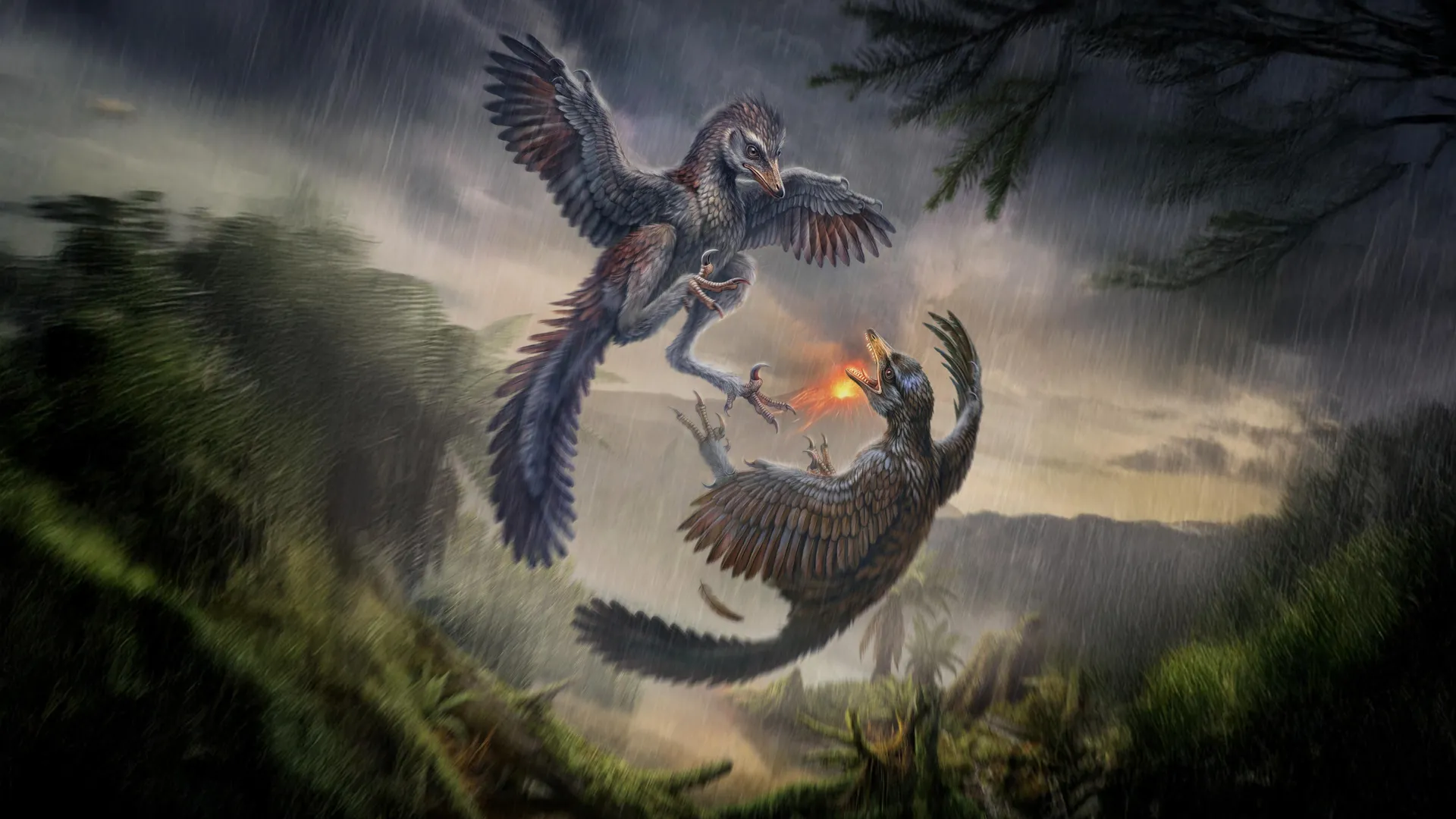
Deep in the rugged terrain of southeastern China, paleontologists have unearthly evidence that challenges the foundational dogma of how prehistoric dinosaurs transitioned into the birds we see today. The discovery of a remarkably preserved, crow-sized fossil dating back 150 million years reveals that the early chapters of avian history were not a straightforward march toward the skies. Instead, this prehistoric creature abandoned the heavens entirely, trading the ability of flight for a terrestrial existence long before the Jurassic period drew to a close.
Described in a landmark study published in the prestigious journal Nature, the newly identified species—named Yuezhuornis yangyuanensis—lived during the Late Jurassic, roughly between 150 and 148 million years ago. Unearthed in the newly recognized Zhenghe Fauna of Fujian Province, the specimen provides a rare window into an era of radical biological experimentation. Rather than evolving continuously toward more sophisticated flight dynamics, certain archaic bird lineages abruptly reversed course, shedding their airborne capabilities to conquer the forest floor.
Anatomical Paradox: The Fusion of Bird and Beast
To the untrained eye, the fossilized remains of Yuezhuornis present an arresting biological contradiction. The creature displays a mosaic of skeletal features that bridge the evolutionary gap between primitive avian species and small, hyper-carnivorous theropod dinosaurs. While its pelvis and hindlimbs exhibit definitive hallmarks of early avialans, its skull and forelimbs retain primitive traits that would have been entirely at home among agile, predatory dinosaurs.
Most striking among these archaic retentions is the creature’s dentition. Unlike modern birds, which are entirely toothless, Yuezhuornis possessed jaws lined with closely spaced, serrated teeth. These dental structures closely mirror those of deinonychosaurs, a specialized group of carnivorous dinosaurs that included swift, sickle-clawed hunters closely related to the ancestral lineage of birds.
The parallels to deinonychosaurs do not end at the jawline. A closer examination of the creature’s hindlimbs reveals a heavily modified second toe. Capable of bending backward to an extraordinary degree, this digit terminated in a curved, sickle-shaped claw. In traditional paleontology, this anatomical adaptation is heavily associated with dromaeosaurids and troodontids—predatory dinosaurs built for slashing and restraining struggling prey.
"When we examined Yuezhuornis and its remarkably preserved skeletal elements, we were immediately struck by its extraordinary mix of features," noted Dr. Min Wang, corresponding author of the study and a prominent researcher at the Institute of Vertebrate Paleontology and Paleoanthropology (IVPP) of the Chinese Academy of Sciences (CAS). "It possesses bird-like pelvic and hindlimb structures yet retains the specialized predatory foot and teeth of a small meat-eating dinosaur. It shows us that early bird evolution was far more complicated than we previously realized."
Placing Yuezhuornis on the Evolutionary Tree
To decipher where this enigmatic creature fit within the grand tapestry of prehistoric life, the research team—a collaborative effort between the IVPP and the Fujian Institute of Geological Sciences—subjected the fossil to rigorous phylogenetic analyses. The scientists deployed two distinct computational methodologies: maximum parsimony and Bayesian tip-dating.
Maximum parsimony operates by identifying evolutionary trees that require the fewest number of evolutionary changes to account for observed physical traits. Bayesian tip-dating, a more sophisticated statistical technique, integrates both morphological data and geological age constraints to estimate the temporal and ancestral relationships of fossil organisms.
To the surprise of the analytical team, both independent methodologies yielded identical and highly robust results. The algorithms firmly positioned Yuezhuornis within Avialae, the broader evolutionary clade that encompasses all modern birds alongside their closest extinct, feathered relatives. Specifically, the phylogenetic placement situates the species just crownward of the legendary Archaeopteryx and identifies it as a sister taxon to Zhengheornis.
"The results consistently placed Yuezhuornis firmly within Avialae, just crownward of Archaeopteryx and as a sister taxon to Zhengheornis," stated Dr. Zhonghe Zhou, a co-author of the study.
This precise positioning carries profound scientific weight. Archaeopteryx, which inhabited European ecosystems approximately 150 million years ago, has long served as the benchmark for transitional avian forms. By demonstrating that Yuezhuornis belongs to an early branch of the avialan tree rather than representing a non-avian dinosaur mimicking bird traits, the discovery confirms that true birds were already diversifying into radical ecological niches during the Late Jurassic.
A Groundbound Lifestyle: Unraveling Flightlessness
The most revolutionary aspect of the Yuezhuornis discovery lies not in its ancestry, but in its biomechanics. To reconstruct the creature’s behavioral ecology, the research team conducted quantitative analyses of its skeletal proportions, comparing limb measurements against a vast database of living and extinct tetrapods.
The statistical models evaluated whether the relative lengths of the forelimbs, hindlimbs, and foot bones were optimized for aerial propulsion, arboreal perching, or terrestrial locomotion. The results were unambiguous. The limb proportions of Yuezhuornis showed a striking affinity with modern ground-dwelling birds—such as modern ratites and gallinaceous ground-foragers—as well as specialized terrestrial theropod dinosaurs.
These biomechanical indicators strongly suggest that Yuezhuornis spent the entirety of its life bound to the earth. Its wings and upper body structures lacked the surface area and muscular attachment points necessary to sustain powered flight. Instead, this ancient avialan had forfeited its airborne heritage, adapting instead to a ground-dwelling, predatory lifestyle.
This finding directly challenges the long-held assumption that the evolution of flight was an irreversible, progressive escalator. For decades, the dominant paradigm held that once an animal achieved powered flight, natural selection would relentlessly refine that capability. Yuezhuornis proves that evolutionary regression was entirely possible; early birds were willing and able to surrender the sky if local environmental pressures or terrestrial food sources favored life on the ground.
Broader Impacts and the Significance of the Zhenghe Fauna
The unearthing of Yuezhuornis yangyuanensis serves as a watershed moment for paleoornithology. It paints a picture of a Late Jurassic world defined by intense evolutionary experimentation, where the boundary between bird and dinosaur was blurred, and ecological roles were fiercely contested across multiple strata of the environment.
Furthermore, the discovery highlights the rising prominence of the Zhenghe Fauna in Fujian Province. As paleontologists continue to unearth exceptionally preserved specimens from this newly explored fossil assemblage, the region is rapidly transforming into one of the world’s premier windows into Mesozoic terrestrial ecosystems. The combination of fine-grained sedimentary deposition and exceptional fossilization conditions in Fujian has allowed researchers to recover delicate structures that are typically lost to the fossil record.
As additional field seasons commence and analytical technologies advance, scientists anticipate uncovering more transitional species that will help clarify the erratic, branching pathways of early avian history. The story of bird evolution is no longer viewed as a simple linear ascent from scaly theropod to soaring falcon. Instead, it is recognized as a complex, multifaceted mosaic of trial, error, adaptation, and, in the case of Yuezhuornis, a permanent return to the ground.
