
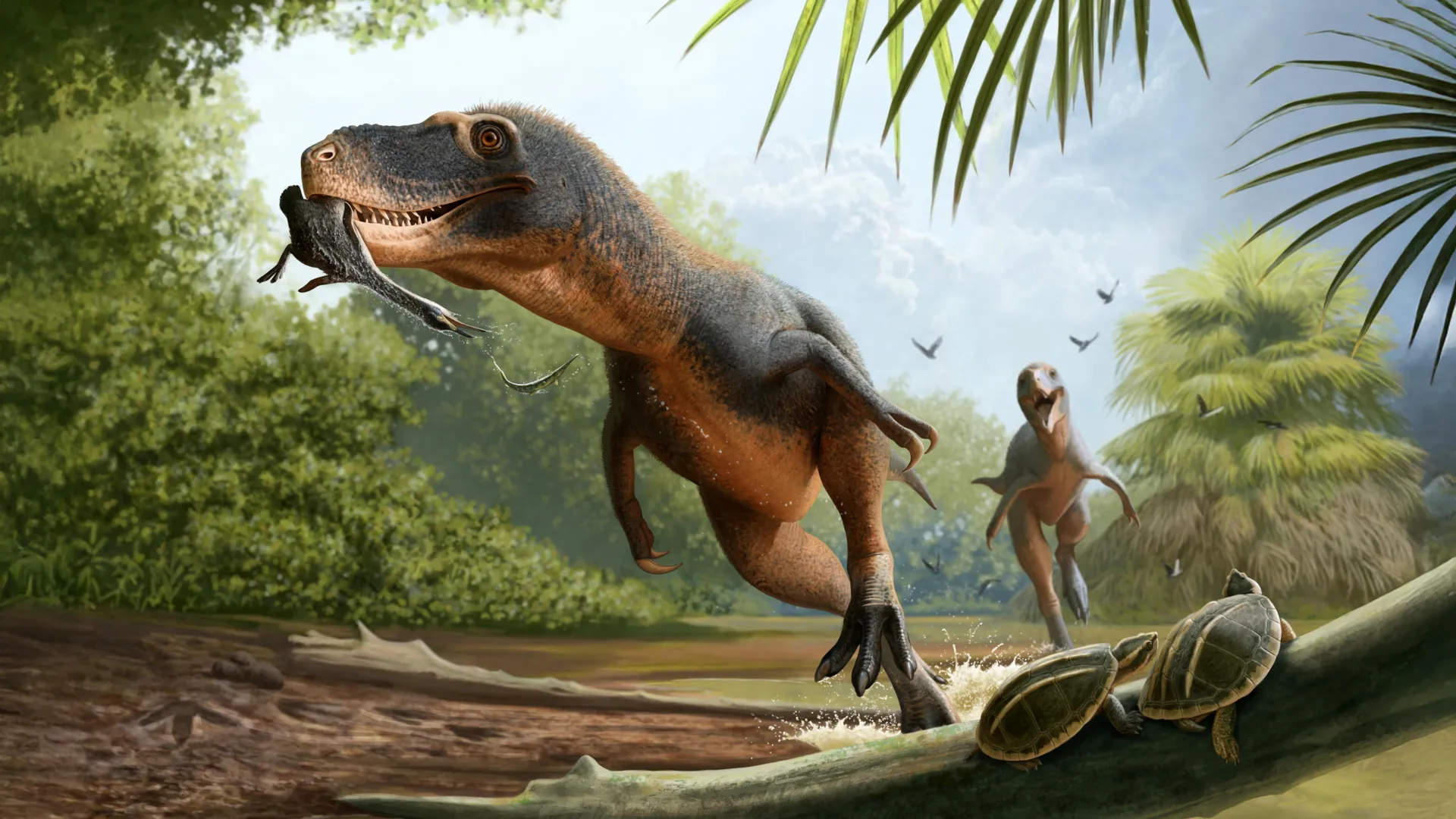
A tiny, remarkably preserved fossil feather discovered inside a 66-million-year-old piece of fossilized dinosaur feces—known as a coprolite—has provided scientists with unprecedented insight into the twilight of the dinosaur era. The exceptional specimen, recovered from the rugged badlands of northeastern Montana, was consumed by a large apex predator, likely a Tyrannosaurus rex or a closely related Nanotyrannus, shortly before a cataclysmic asteroid impact wiped out non-avian dinosaurs. Published in the journal Current Biology, the collaborative study bridges a critical knowledge gap in evolutionary paleontology, offering a tangible hypothesis as to why one specific lineage of birds endured the global mass extinction while all others perished.
Main Facts of the Discovery
The extraordinary find centers on a reddish-brown, golf-ball-sized nodule collected during routine paleontological fieldwork in the Hell Creek Formation. Initial visual inspections through hand lenses revealed an unexpected feature: the delicate barbules of a fossilized feather protruding from the matrix. Subsequent laboratory analyses, including high-resolution micro-computed tomography (micro-CT) scans performed at the University of Southern California, revealed a three-dimensional tapestry of microscopic anatomical details.
Inside the coprolite, researchers identified not only pristine feathers but also minute scales from a gar fish and skeletal leg elements belonging to a hesperornithiform, an extinct lineage of Cretaceous aquatic diving birds. The close spatial association of the feathers and the skeletal remains confirmed that the predator ingested the bird, providing a rare, highly detailed snapshot of an Upper Cretaceous food web. The specimen marks the first time that feathers have been formally identified and studied within a coprolite, establishing an entirely new methodological frontier for paleobiological research.
Chronology and Discovery Timeline
The sequence of events leading to this breakthrough spans millions of years of geological preservation and a decade of modern laboratory investigation:
- Approximately 66 Million Years Ago: A large theropod dinosaur, potentially a T. rex, preys upon or scavenges an aquatic hesperornithiform bird in a wetland environment within the Hell Creek ecosystem. The bird’s feathers, bones, and associated fish scales pass through the predator’s digestive tract, becoming fossilized within the resulting coprolite.
- 2016: Paleontologist David DeMar, Jr., serving as research scientist and collections manager for the Hell Creek Project at the University of Washington Burke Museum, discovers the unassuming dark nodule while prospecting for fish fossils along a rocky outcrop in Montana.
- Post-2016 Laboratory Phase: The specimen undergoes non-destructive micro-CT scanning. Researchers led by Nate Carroll at the Carter County Museum and lead author Jingmai O’Connor of the Field Museum analyze the digital 3D renderings, uncovering the hidden structural morphology of the feathers.
- Current Publication: The multidisciplinary research team publishes their findings in Current Biology, detailing the implications of the find for understanding feather evolution and the end-Cretaceous mass extinction.
Supporting Data and Anatomical Analysis
The biological data extracted from the coprolite challenge previous assumptions regarding prehistoric plumage. Hesperornithiforms were ecologically comparable to modern loons or grebes—flightless, heavily specialized diving birds that propelled themselves through aquatic environments using powerful, lobed feet. The newly analyzed feathers exhibited structural adaptations tailored for an underwater existence, confirming specialized waterproofing mechanisms.
However, a closer examination of the micro-structure revealed a transitional morphology. While some sections of the plumage displayed modern, waterproof characteristics, other regions retained primitive, fuzzy, and plumaceous body feathers traditionally associated with non-avian theropod dinosaurs and enantiornithines, the most dominant group of Cretaceous birds.
This hybrid feather architecture places hesperornithiforms outside the evolutionary lineage of modern birds (Neornithes) and apart from enantiornithines. Because hesperornithiforms possessed insulation strategies that bridged ancestral dinosaurian fuzz and modern avian contour feathers, their ultimate extinction provides a comparative baseline against which the survival of Neornithes can be measured.
Official Responses and Expert Perspectives
The interdisciplinary research team has emphasized the serendipitous nature of the discovery and its potential to reshape how museums curate and analyze existing fossil collections.
Jingmai O’Connor, associate curator of fossil reptiles at the Field Museum and lead author of the study, highlighted the methodological departure from traditional fossil analysis. "It’s such a beautiful, well-preserved feather, from such an unexpected source, and it’s exciting that it could help us answer this huge question in paleontology," O’Connor stated. Reflecting on the investigative process, she noted that studying coprolites offers a detective-like approach distinct from evaluating complete skeletons preserved in stone slabs. "No one has ever thought to look for feathers or to study feathers in coprolites, so this project was really exciting."
David DeMar, Jr., who field-collected the specimen, expressed initial skepticism regarding its provenance. "I was cautiously optimistic about its discovery, because feathers had not yet been found in the Hell Creek Formation, even after more than 150 years of prospecting," DeMar remarked, recalling the moment he scanned the nodule’s surface.
Nate Carroll emphasized the technological leap afforded by modern scanning equipment. "As someone who had been relying on far-flung amber mines as my main source of 3D feather data, realizing that fossil poop from my home state could yield such exceptional specimens was a game changer," Carroll said.
Gregory Wilson Mantilla, professor at the University of Washington and curator of vertebrate paleozoology at the Burke Museum, underscored the dual value of the fossil. "We rarely find fossils of birds and even more rarely their feathers, giving us such important insight into the evolution of this key aspect of their biology," Wilson Mantilla observed. "On top of that, these bird feathers found within a large fossilized dinosaur dung give us an incredible window into predator-prey interactions 66 million years ago."
Broader Impact and Implications for the End-Cretaceous Extinction
The extinction of non-avian dinosaurs and nearly all contemporary bird lineages at the close of the Mesozoic Era remains a central focus of evolutionary biology. A longstanding hypothesis posits that ancestral modern birds (Neornithes) survived the devastation primarily because they inhabited aquatic or semi-aquatic niches that buffered them from the immediate effects of the Chicxulub asteroid impact.
However, the presence of hesperornithiform fossils within the same aquatic ecosystems complicates this simple habitat-based survival model. Hesperornithiforms were fully aquatic, yet their lineage was completely eradicated during the mass extinction event. This contradiction suggests that habitat preference alone is insufficient to explain why Neornithes endured while other avian groups vanished.
The newly analyzed feathers suggest that the underlying mechanism of selectivity may lie in the evolutionary efficiency of thermal insulation and molt strategies. The asteroid impact is widely understood to have launched massive volumes of pulverized rock, aerosols, and soot into the stratosphere, plunging the planet into a protracted "impact winter" characterized by drastic global cooling and a severe reduction in sunlight.
Birds equipped with advanced, highly efficient plumaceous insulation—characteristic of modern Neornithes—would have been significantly better positioned to regulate their body temperatures during the prolonged cold snap. Conversely, hesperornithiforms and enantiornithines retained more primitive, less efficient feather types that may have failed to provide adequate thermal protection under extreme environmental stress.
Future Directions in Paleontological Research
Beyond addressing evolutionary theory, the study opens a promising new avenue for taphonomic and paleontological investigation. By demonstrating that delicate integumentary structures can survive the digestive processes of large carnivores and millions of years of fossilization inside coprolites, the research encourages institutions worldwide to re-examine existing coprolite collections using non-destructive micro-CT imaging.
As researchers begin to systematically scan fossilized feces previously overlooked as mundane geological detritus, the scientific community anticipates the discovery of additional microscopic soft-tissue remnants. This methodological shift promises to illuminate intricate details of ancient trophic networks, dietary preferences, and the complex evolutionary pathways that allowed modern birds to inherit the earth.
