
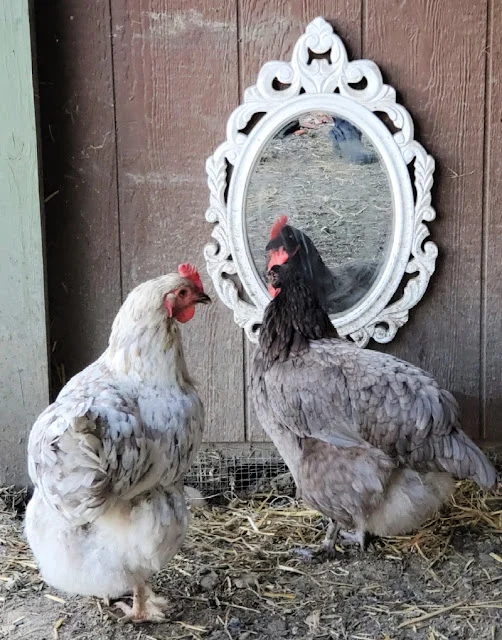
The traditional perception of chickens as simple-minded livestock is being fundamentally challenged by a series of cognitive studies suggesting that these birds possess a level of self-awareness previously thought to be reserved for a select group of highly intelligent mammals and a few bird species. For decades, the "Mirror Self-Recognition" (MSR) test has served as the gold standard for determining whether an animal possesses a sense of "self." While primates, dolphins, and elephants have long been the stars of these behavioral experiments, recent research into the alarm-calling behavior of roosters suggests that the domestic chicken (Gallus gallus domesticus) may have been unfairly overlooked in the hierarchy of animal intelligence.

The Evolution of the Mirror Self-Recognition Test
To understand the significance of recent avian findings, one must look back to 1970, when psychologist Gordon Gallup Jr. developed the first mirror test. The premise was straightforward: an animal is anesthetized and marked with an odorless dye or sticker on a part of its body it cannot see without the help of a reflection, such as the forehead or ear. If the animal, upon seeing its reflection, investigates the mark on its own body rather than attempting to interact with the "other" animal in the glass, it is considered to have passed the test.
For over half a century, the list of animals that passed the MSR test remained remarkably short. Chimpanzees, orangutans, and bottlenose dolphins were the first to join the "self-awareness club." Later, Asian elephants and Eurasian magpies were added. However, many species—including dogs, cats, and most birds—notoriously failed or produced ambiguous results. Critics of the MSR test argue that it is heavily biased toward species that rely on vision and possess the dexterity (like hands or trunks) to touch a mark. For species like chickens, which rely on a complex array of social cues and lack the physical anatomy to "groom" a specific mark on their head in a human-like fashion, the traditional test may be an inadequate measure of their true cognitive depth.

Methodology: The "Audience Effect" and Rooster Alarm Calls
Recognizing the limitations of the traditional mark test, researchers at the University of Bonn and Ruhr University Bochum in Germany, led by Sonja Hillemacher and Inga Tiemann, designed a more ecologically relevant experiment. Their study, published in the journal PLOS ONE, pivoted away from the visual mark and focused instead on a fundamental social behavior: the alarm call.
In the wild and on the farm, roosters serve as the primary sentinels for their flocks. When a rooster spots a predator, such as a hawk or a fox, it emits a specific vocalization to warn other chickens to seek cover. Crucially, this behavior is governed by what biologists call the "audience effect." A rooster will sound the alarm if other chickens are present, but it will typically remain silent if it is alone. There is no evolutionary benefit to alerting a predator to one’s location if there are no kin or mates to save.

The research team utilized this "audience effect" to test whether a rooster perceives its reflection as another bird or as itself. The experiment involved a controlled environment where a rooster was exposed to the silhouette of a bird of prey (a hawk) flying overhead. The researchers tested the roosters under three distinct conditions:
- Alone: The rooster was in the enclosure by himself.
- With a Companion: Another rooster was visible in an adjacent enclosure.
- With a Mirror: A mirror was placed in the enclosure, reflecting the rooster’s own image.
Chronology of the Experiment and Key Findings
The results of the study provided a clear statistical deviation from what would be expected of a "mindless" bird. When a second rooster was visible, the test subjects emitted a total of 133 alarm calls across the trials. However, when the roosters were alone, the number of calls dropped significantly to only 24.

The pivotal moment came during the mirror trials. If the roosters had perceived their reflection as a rival or a companion, they should have sounded the alarm at a rate similar to the "with companion" phase. Instead, when faced with their own reflection, the roosters remained almost entirely silent, emitting only 25 alarm calls—a figure nearly identical to the "alone" condition.
This behavior suggests that the roosters did not interpret the reflection as another bird. Even though the reflection mimicked every movement and displayed the physical traits of a fellow rooster, the test subjects recognized—at some cognitive level—that no other bird was actually present. This indicates a sophisticated integration of visual information and social logic that challenges the historical "bird brain" stereotype.

Visual Perception and the Sensory World of Chickens
To analyze why chickens might pass a behavioral mirror test but struggle with a mark test, one must consider the unique physiology of avian vision. Chickens possess a highly sophisticated visual system; they have five types of light receptors in their retinas (compared to three in humans), allowing them to see ultraviolet light and a broader spectrum of colors. Their eyes are located on the sides of their heads, providing a nearly 300-degree field of vision.
However, despite this visual acuity, chickens do not interact with their environment in the same way primates do. A mark on a chicken’s feathers may not trigger a "grooming" response because chickens do not use their feet or wings to investigate small discolorations in the same way a chimpanzee uses its fingers. By shifting the test to vocalizations—a primary social tool for the species—researchers were able to "ask" the chicken about its self-perception in a language the bird actually uses.

Supporting Data and Comparative Analysis
The implications of this research are bolstered by data from other "non-traditional" mirror tests. For instance, the cleaner wrasse, a small fish, passed a modified mirror test by scraping its body against surfaces to remove a mark it could only see in a reflection. Similarly, ants have been observed attempting to clean blue dots off their heads when looking in a mirror.
In the context of the rooster study, the data showed that the birds were not simply "scared" of the mirror. When a real companion was placed behind a transparent pane of glass, the roosters called out. When that companion was hidden behind a mirror, the calling stopped. This reinforces the idea that the visual presence of "another" is the trigger, and the mirror image is successfully filtered out as "self" or at least "not-other."

Broader Impact and Ethical Implications
The recognition of self-awareness in poultry has profound implications for animal welfare and the agricultural industry. Globally, billions of chickens are raised for meat and eggs, often in high-density industrial environments. If chickens are indeed self-aware, the ethical considerations regarding their confinement, mental stimulation, and social structures become significantly more complex.
In the backyard poultry community, these findings validate the observations of long-time keepers who have advocated for environmental enrichment. Mirrors have frequently been used in coops as "boredom busters," along with swings, perches, and treat dispensers. While some social media reports suggest that roosters may occasionally attack their reflections, behavioral experts suggest this may be a result of hormonal surges or high-stress environments where the bird’s "logic" is overridden by territorial aggression. In a stable, enriched environment, many keepers report that hens and roosters use mirrors for preening—a self-directed grooming behavior that further supports the idea of self-recognition.

Scientific Reactions and Future Research
The scientific community remains cautiously optimistic but divided. Some researchers argue that the "alarm call" test proves "self-recognition," while others suggest it might only prove that the birds recognize the reflection as "not a threat" or "not a social partner" without necessarily having a concept of "I."
"The study is a significant step forward because it moves away from the human-centric mark test," says one cognitive ethologist. "It forces us to redefine what intelligence looks like in non-mammalian species."

Future research is expected to focus on whether this self-recognition extends to female chickens (hens) and whether it changes with age or social status. There is also growing interest in studying other domestic fowl, such as ducks and geese. Preliminary observations suggest that ducks may use mirrors for social comfort, though they have not yet been subjected to the same rigorous alarm-call testing as roosters.
Conclusion: Redefining Avian Intelligence
The study of roosters and mirrors serves as a reminder that the absence of evidence is not evidence of absence. For decades, the perceived lack of self-awareness in chickens was based on a test designed for humans and apes. By meeting the birds on their own evolutionary terms, scientists have uncovered a window into the avian mind that reveals a surprising level of sophistication.

As our understanding of animal cognition continues to evolve, the line between "higher" and "lower" animals continues to blur. The humble chicken, once viewed merely as a commodity, is now emerging as a subject of great scientific interest, proving that there is much more going on behind those golden eyes than previously imagined. Whether it is through the silence of a rooster in front of a mirror or the complex social hierarchies of the coop, the domestic chicken is demanding a seat at the table of sentient beings.
