
As the annual phenomenon of bird migration reaches its crescendo this May, the arduous journeys undertaken by the world’s avian populations are casting a stark spotlight on the profound and escalating strain impacting the natural systems indispensable to all life on Earth. Far from being merely a spectacle of natural wonder, the changing patterns and alarming declines observed in migratory birds serve as critical bio-indicators, signalling a pervasive crisis in planetary health that demands urgent international attention and concerted action.
World Migratory Bird Day (WMBD), observed twice annually in May and October to coincide with the peaks of migration across hemispheres, stands as a global call to action. Instituted by the Convention on Migratory Species (CMS) and the African-Eurasian Waterbird Agreement (AEWA), in collaboration with Environment for the Americas (EFTA), WMBD aims to raise awareness about migratory birds and the necessity for their conservation. This year, conservationists are urging the public to move beyond the sheer marvel of these epic journeys and actively heed the silent warnings these birds are broadcasting about the state of our shared planet. The theme often implicitly, if not explicitly, reinforces the interconnectedness of ecosystems and the shared responsibility of nations.
Migratory birds are not just symbols of freedom or beauty; they are vital architects of healthy ecosystems. Their long-distance movements facilitate a myriad of indispensable ecological services that underpin environmental stability and human well-being. They traverse vast oceans and continents, acting as natural conduits for nutrients, depositing essential minerals and organic matter across diverse landscapes. Furthermore, these avian travellers are crucial pollinators, ensuring the reproduction of countless plant species, including many that are vital for human food security. Their role as seed dispersers is equally critical, aiding in forest regeneration and maintaining plant diversity by carrying seeds to new territories, often far beyond the reach of other dispersal mechanisms. Beyond these functions, many migratory bird species are natural pest controllers, consuming vast quantities of insects and other invertebrates that could otherwise decimate crops and spread diseases, thereby reducing the reliance on chemical pesticides and promoting healthier agricultural practices.
Despite their ecological indispensability, the signals emanating from the world’s great migratory routes are deeply concerning. Globally, a staggering more than 40% of bird species are now experiencing declines, a figure that underscores the scale of the environmental crisis. Martin Harper, CEO of BirdLife International, the only global partnership dedicated to conserving birds and all life on our planet, articulated the gravity of the situation: "Migratory birds connect us across countries, continents and ocean currents. Protecting the major migratory highways of the world is how we reverse those declines. And when we do, people gain too: cleaner water, food security, flood protection, and more resilience to a changing climate." Harper’s statement highlights not just the ecological imperative but also the direct, tangible benefits for human societies that arise from robust conservation efforts.
The Intricate Network of Global Flyways: Highways of the Sky

Central to the understanding of migratory bird conservation are the global flyways – the ancient, invisible highways birds use as they travel between their breeding grounds, crucial feeding areas, and seasonal refuges. Scientists and conservationists have meticulously mapped these routes, identifying four major terrestrial flyways: the African-Eurasian, East Asian-Australasian, Americas, and Central Asian. In addition to these, six critical marine flyways guide seabirds across vast oceanic expanses. These pathways are transnational by nature, stretching across borders and oceans, linking habitats that lie thousands of kilometres apart. They represent a complex ecological infrastructure, where the health of one link directly impacts the viability of the entire chain.
The integrity of these flyways is paramount. When a critical link is severed – a vital wetland drained for agriculture, a coastline degraded by development, or a stopover site polluted – the ripple effects can be catastrophic, leading to precipitous declines in entire species. The recent, tragic extinction of the Slender-billed Curlew ( Numenius tenuirostris ) serves as a stark and painful reminder of this vulnerability. Once found across Eurasia and Africa, this elusive wading bird faced relentless habitat loss, particularly in its wintering grounds and along its migration route, coupled with hunting pressures. Its last confirmed sighting was in 1995, and its official reclassification as extinct in 2024 by BirdLife International (on behalf of the IUCN Red List) underscores the irreversible consequences of neglecting these vital avian arteries.
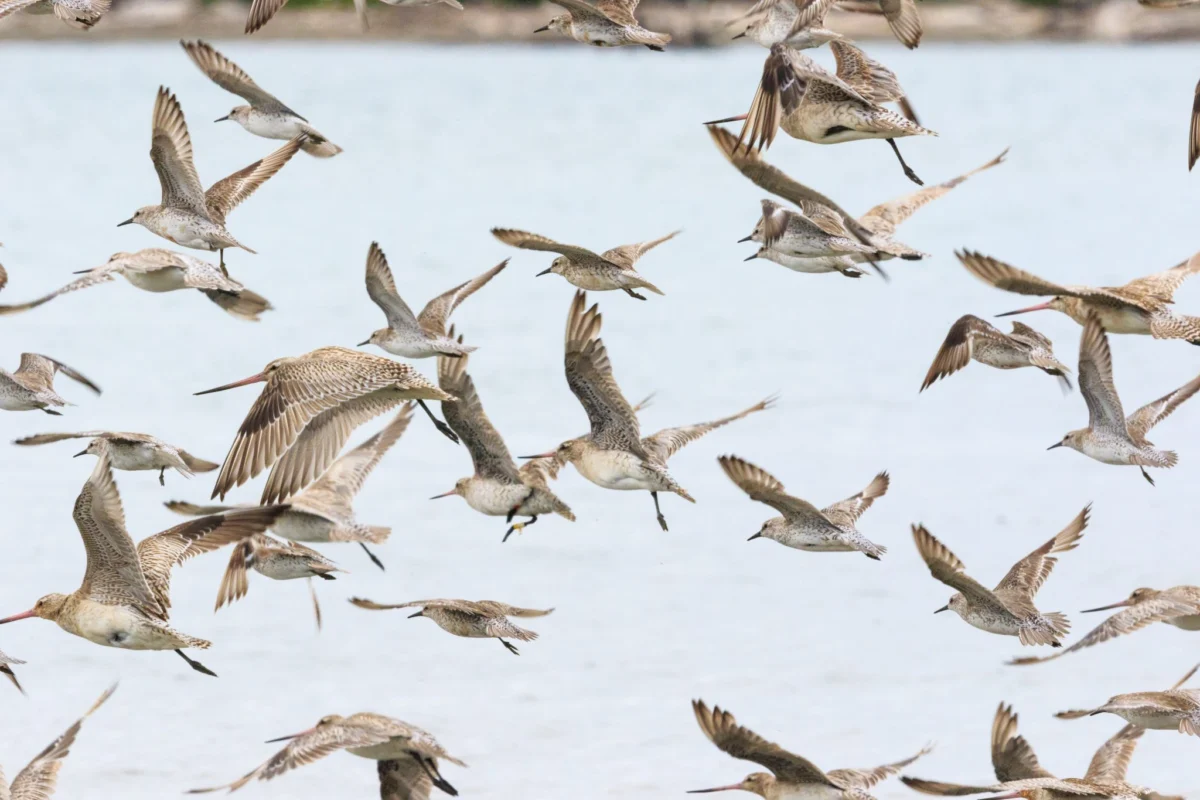
The Slender-billed Curlew’s demise is not an isolated incident. Many other migratory species teeter on the brink. The Spoon-billed Sandpiper (Calidris pygmaea), for instance, utilizes the East Asian-Australasian Flyway and is critically endangered due to the destruction of intertidal mudflats along its migration route, particularly in the Yellow Sea region. Similarly, numerous raptor species navigating the African-Eurasian Flyway face threats from illegal killing, electrocution on power lines, and habitat fragmentation. The Bar-tailed Godwit (Limosa lapponica), an iconic long-distance migrant featured in the header image, undertakes one of the longest non-stop migrations of any bird, flying from Alaska to New Zealand. While not critically endangered, its populations are susceptible to changes in climate and habitat degradation at its crucial stopover and breeding sites. The Lesser Flamingo (Phoeniconaias minor) and Andean Flamingo (Phoenicoparrus andinus), also depicted in the article, exemplify species whose movements across the African-Eurasian and Americas flyways respectively are intricately tied to the health of specific wetland ecosystems, which are increasingly threatened by water abstraction, pollution, and climate change.
International Cooperation: The Cornerstone of Flyway Protection
Recognizing that international challenges demand international cooperation, BirdLife International emphasizes that protecting flyways brings birds back and yields substantial benefits for people. Healthier wetlands, for instance, are not only crucial bird habitats but also provide natural water purification, flood protection, and support local fisheries. More reliable food security can be achieved through healthy ecosystems that support pollinators and natural pest control. Furthermore, intact ecosystems bolster resilience against the escalating impacts of climate change, such as extreme weather events and altered rainfall patterns.
The legal framework for flyway protection is primarily anchored in international treaties such as the Convention on Migratory Species (CMS), also known as the Bonn Convention, established in 1979. CMS provides a global framework and intergovernmental platform for the conservation and sustainable use of migratory animals and their habitats. Under CMS, various agreements, such as the African-Eurasian Waterbird Agreement (AEWA), focus on specific flyways and species groups, outlining concrete conservation measures. These agreements foster collaboration among signatory nations, recognizing that no single country can effectively protect species that traverse multiple jurisdictions. The scientific understanding of flyways has evolved significantly since the early 20th century, moving from anecdotal observations to sophisticated tracking technologies (satellite tags, geolocators) that provide unprecedented insights into migration routes, timings, and critical habitats. This data is fundamental for targeted conservation strategies.

Africa: At the Heart of a Global Migration Story
One of the world’s most critical migration systems, the African-Eurasian Flyway, vividly illustrates the interconnectedness of global ecosystems. Along this vast route, billions of birds journey from the Arctic tundras and European forests to the warm embrace of southern Africa and back again, a cycle essential for their survival and the ecological balance of both continents.
Dr. Paul Matiku, Executive Director of Nature Kenya, BirdLife International’s Partner in Kenya, underscored Africa’s pivotal role in sustaining these shared routes. "Africa is at the heart of some of the world’s great flyways," Matiku stated. "The health of our wetlands, rangelands and coastlines matters far beyond our borders. When we protect these habitats, we protect birds, biodiversity and the communities that live alongside them." His comments highlight the multi-faceted benefits of conservation, extending from the protection of endangered species to the enhancement of livelihoods for local communities.
Significantly, the upcoming Global Flyways Summit, scheduled for Nairobi this September, marks a historic milestone. It will be the first time this crucial summit is hosted on the African continent, a recognition of Africa’s central role in global avian migration and its growing leadership in conservation. Co-hosted by BirdLife International and Nature Kenya, the summit is poised to be a landmark event, bringing together a diverse array of leaders from science, policy-making, finance, business, and civil society. The primary objective is to forge consensus and agree on concrete, actionable strategies required to safeguard migratory birds and the intricate ecosystems upon which their survival, and indeed ours, depends.
A key highlight of the Nairobi summit will be the launch of the new edition of the "State of the World’s Birds" report by BirdLife International scientists. This seminal report, with a special focus on flyways, will present the latest, most comprehensive picture of global bird populations, detailing trends, threats, and conservation successes. It serves as an authoritative scientific assessment, providing critical data that informs policy decisions and galvanizes conservation action worldwide. The report’s findings are expected to reinforce the urgent need for cross-sectoral collaboration and investment in nature-based solutions.
The Broader Implications: Ecosystem Collapse and Climate Resilience

The decline of migratory birds has far-reaching implications that extend beyond avian biodiversity. Environmentally, it signifies a broader ecosystem collapse, indicating a loss of habitat integrity, increased pollution, and climate disruption. The degradation of wetlands, for instance, not only removes critical stopover sites for birds but also diminishes natural flood defenses, purifies less water, and reduces carbon sequestration capacity. Economically, the loss of these birds can impact industries such as ecotourism, where birdwatching is a significant draw, and agriculture, due to decreased natural pest control and pollination services. Socially, it represents a loss of cultural heritage, as many indigenous communities hold deep connections to migratory patterns and specific bird species, and can affect food security in regions reliant on healthy ecosystems.
Furthermore, the connection to climate change is undeniable. Altered migration timings due to warmer temperatures, extreme weather events disrupting journeys, and habitat shifts forcing birds into unsuitable areas are all direct consequences of a changing climate. Protecting flyways and their associated habitats, such as coastal wetlands and forests, actually enhances climate resilience. These ecosystems act as natural buffers against rising sea levels, absorb carbon dioxide, and help regulate local climates, providing benefits that extend far beyond bird conservation.
Citizen Science and Collective Action: A Call to Get Involved
On World Migratory Bird Day, individuals are invited to step into this worldwide celebration of nature through birdwatching and citizen science. Participating is straightforward: head outdoors, observe the birds in your local environment, and record what you see. Platforms like eBird, Merlin Bird ID, and local conservation initiatives provide easy ways for anyone, regardless of expertise, to contribute valuable data. Every observation, no matter how small, adds to the vast dataset that scientists and conservationists use to track population trends, identify critical habitats, and inform conservation strategies. This collective effort empowers individuals to become active participants in global conservation.
As Martin Harper concluded, "You don’t need to be an expert to care about birds. When we notice the wildlife around us, we start to understand the condition of the places we all rely on. Birds give us both a warning and an opportunity. They show us where nature needs urgent action, and where there is still hope." This sentiment encapsulates the essence of World Migratory Bird Day: a blend of scientific urgency and profound personal connection to the natural world.
The joy derived from observing birds in their natural habitats is inextricably linked to the responsibility to protect them. It is this dual commitment that underpins BirdLife International’s "Race to Save Birds Challenge" on May 9th. This initiative is not about physical prowess but about fostering care and engagement. By participating, individuals contribute to vital data collection through observation, simultaneously raising crucial funds that fuel ongoing conservation efforts. These funds support BirdLife’s extensive network of local partners and projects across the globe, ensuring that conservation actions are sustained, targeted, and effective in helping migratory birds and the broader natural world to thrive. Through such collective action, the warnings whispered by migratory birds can be transformed into a powerful chorus of hope and decisive change.
