
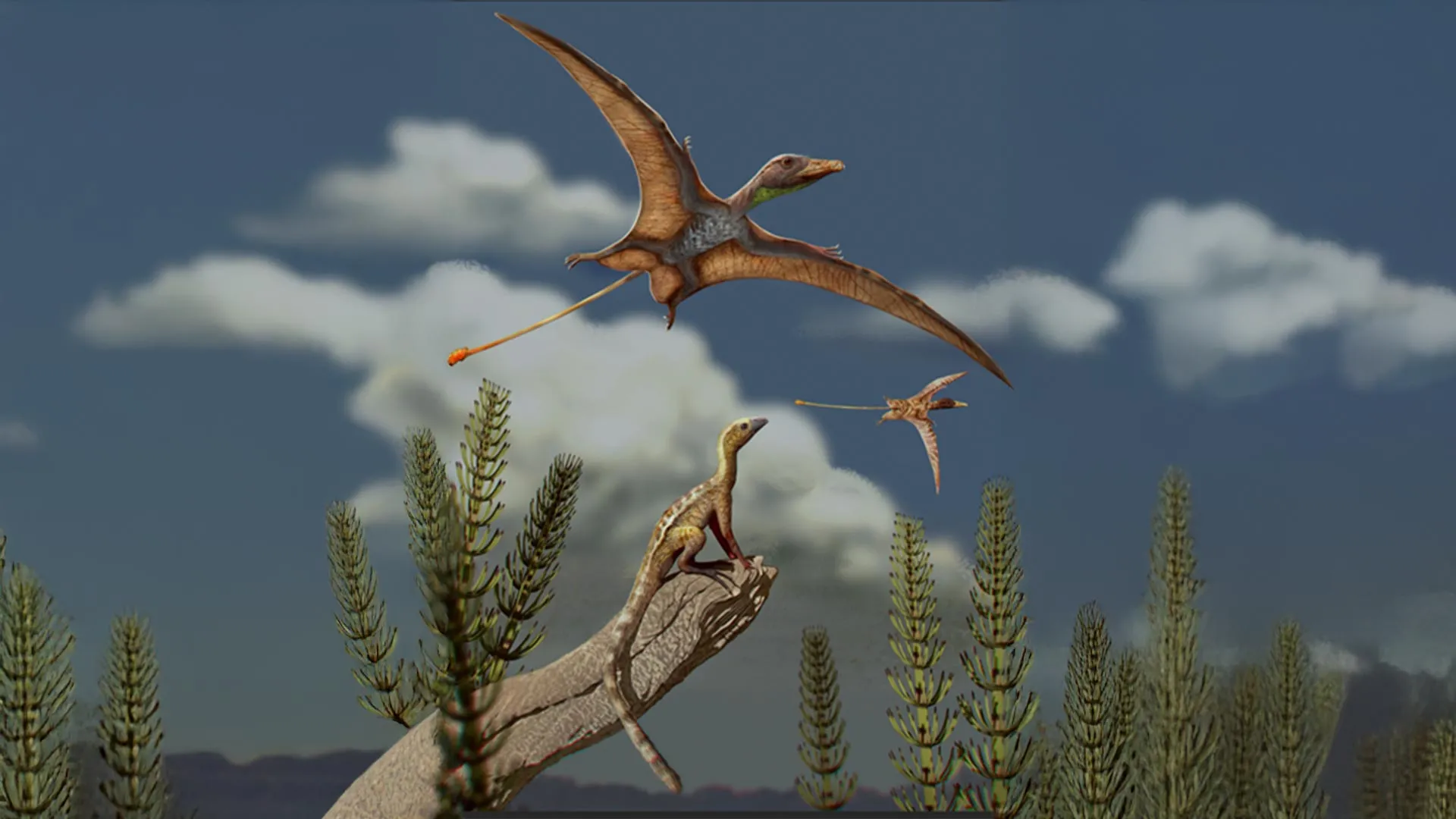
A groundbreaking study led by an evolutionary biologist at Johns Hopkins Medicine has unveiled a fascinating divergence in the evolutionary paths to powered flight among vertebrates. The research indicates that giant reptiles known as pterosaurs, which soared through prehistoric skies as far back as 220 million years ago, may have developed the complex ability to fly remarkably early and rapidly in their evolutionary history, doing so with comparatively smaller, less complex brains than previously assumed. This discovery stands in stark contrast to the widely accepted model for the ancestors of modern birds, which are thought to have achieved powered flight through a more gradual process, underpinned by the concurrent development of larger, more intricate brain structures. The detailed findings of this investigation, which leveraged advanced imaging techniques to scrutinize the internal brain cavities of pterosaur fossils and received crucial partial support from the National Science Foundation, were published on November 26 in the prestigious scientific journal Current Biology.
A Revolutionary Look at the Dawn of Flight
The origins of powered flight in vertebrates represent one of the most compelling and enduring mysteries in evolutionary biology. Three distinct lineages independently conquered the skies: pterosaurs, birds, and bats. Each achieved this monumental feat through unique anatomical and physiological adaptations. This latest research from Johns Hopkins Medicine offers a significant recalibration of our understanding, particularly regarding the neurological underpinnings of pterosaur flight. According to Dr. Matteo Fabbri, an assistant professor of functional anatomy and evolution at the Johns Hopkins University School of Medicine and a lead author on the study, the results strongly suggest that the enlarged brains observed in modern birds and their immediate ancestors were not a prerequisite, nor were they responsible, for enabling pterosaurs to become airborne.
"Our study shows that pterosaurs evolved flight early on in their existence and that they did so with a smaller brain similar to true non-flying dinosaurs," Fabbri explained, emphasizing the speed and neurological simplicity of this evolutionary leap. This revelation challenges long-held assumptions about the relationship between brain size, complexity, and the emergence of sophisticated motor skills like powered flight, offering a fresh perspective on the diverse strategies life has employed to adapt to new ecological niches.
Unveiling Ancient Neural Pathways Through Advanced Imaging
The scientific endeavor behind this discovery relied heavily on cutting-edge paleontological methodologies. Researchers employed sophisticated computed tomography (CT) imaging and specialized software to reconstruct and examine the internal brain cavities of fossilized pterosaurs. These internal casts, known as endocasts, provide invaluable proxies for the size, shape, and even certain structural features of the brains of extinct animals, offering a rare glimpse into their neuroanatomy. Unlike traditional methods that might involve destructive physical sectioning of precious fossils, CT scanning allows for non-invasive, high-resolution three-dimensional reconstructions, preserving the integrity of the specimens while revealing intricate details previously inaccessible.
This technique is transformative in paleoneurology, enabling scientists to digitally model the nervous system structures that once filled these cranial spaces. By analyzing these digital endocasts, the team could infer the relative sizes of different brain regions, providing clues about the sensory capabilities and motor control centers that were crucial for these ancient flyers. The precision offered by such advanced imaging was fundamental to distinguishing the subtle differences in brain morphology between pterosaurs, their flightless relatives, and early avian ancestors.
The Enigma of Pterosaur Origins
Pterosaurs were truly remarkable creatures, dominating the skies for over 150 million years, from the late Triassic to the end of the Cretaceous period. They were the first vertebrates to achieve powered flight, predating birds by some 70 million years. Described by Fabbri as powerful airborne predators of the dinosaur era, some species were formidable giants, reaching weights of up to 500 pounds and boasting wingspans that could stretch an astonishing 30 feet across, comparable to a small aircraft. Their wings were unique, consisting of a membrane of skin and muscle extending from the body to an elongated fourth finger. This distinctive anatomical structure, along with their lightweight, hollow bones, allowed them to exploit a vast array of ecological roles, from fish-eaters to terrestrial stalkers.
Despite their widespread success and diverse forms, the precise mechanisms and evolutionary pressures that drove the initial development of flight in pterosaurs have long been a subject of intense scientific debate. Previous hypotheses often posited a more gradual development of neurological sophistication alongside the evolution of flight-enabling skeletal and muscular structures. This new research directly addresses these questions by looking not just at the bones, but at the very "command center" that orchestrated their aerial prowess.
Tracing the Evolutionary Leap: From Lagerpetids to Pterosaurs
A crucial aspect of the investigation involved examining the closest known relatives of pterosaurs: the lagerpetids. These flightless, tree-climbing reptiles lived during the Triassic period, approximately 242 to 212 million years ago. Lagerpetids were first identified by scientists in 2016, and their close evolutionary connection to pterosaurs was subsequently confirmed by another research team in 2020. Studying these ancient relatives provided a vital baseline, allowing researchers to trace shifts in brain morphology that preceded the emergence of powered flight.
Using the same CT imaging and specialized software, the team analyzed the brain cavities of lagerpetid fossils. What they found was highly illuminating: the lagerpetid brain already displayed features linked to improved vision, notably an enlarged optic lobe. As corresponding author Mario Bronzati, a researcher at the University of Tübingen, Germany, explains, this adaptation "may have later helped their pterosaur relatives take to the skies." The optic lobe is a brain region critically involved in processing visual information, and an enhanced visual system would undoubtedly be a significant advantage for any creature navigating a complex three-dimensional environment, whether climbing trees or soaring through the air.
While pterosaurs also possessed enlarged optic lobes, Fabbri notes that beyond this shared trait, their overall brain shape and size differed considerably from those of the lagerpetid. This distinction is key to the study’s central hypothesis. "The few similarities suggest that flying pterosaurs, which appeared very soon after the lagerpetid, likely acquired flight in a burst at their origin," Fabbri elaborated. "Essentially, pterosaur brains quickly transformed, acquiring all they needed to take flight from the beginning." This "burst" model suggests a rapid evolutionary acquisition of complex traits, rather than a slow, incremental accumulation over vast stretches of geological time, marking a significant departure from many prevailing evolutionary narratives.
Brains Built for Flight: A Comparative Analysis
The study’s profound implications are best understood by comparing the pterosaur model with the established understanding of avian flight evolution. Modern birds are believed to have evolved flight through a far more gradual process, inheriting and successively refining several key neurological traits from their theropod dinosaur ancestors. This includes the expansion of the cerebrum (involved in higher cognitive functions), the cerebellum (crucial for muscle coordination, balance, and motor learning), and the optic lobes. These regions underwent further adaptation specifically for the demands of flight, culminating in the highly complex and efficient avian brain we observe today.
Support for this gradual model comes from ongoing research, including a 2024 study from the laboratory of Dr. Amy Balanoff, an assistant professor of functional anatomy and evolution at Johns Hopkins Medicine. Balanoff’s work specifically highlights the critical importance of cerebellum expansion in the origins of bird flight. The cerebellum, located at the back of the brain, is a vital control center, meticulously regulating muscle coordination, balance, and fine motor skills—all indispensable for the intricate maneuvers of powered flight. The larger and more complex a cerebellum, the greater the capacity for sophisticated aerial control.
In contrast to this avian trajectory, the Johns Hopkins team’s analysis showed that pterosaurs had only moderately enlarged brain hemispheres, a feature comparable to other dinosaur groups, including some non-flying lineages. For instance, their brain structures were similar to those of two-legged, bird-like troodontids, which existed between the Late Jurassic and Late Cretaceous periods (163 to 66 million years ago). Even Archaeopteryx lithographica, often considered the oldest-known bird, living between 150.8 and 125.45 million years ago, exhibited brain structures that differed strongly from modern birds, which possess significantly larger and more convoluted brain cavities. This comparative analysis reinforces the idea of distinct evolutionary strategies: pterosaurs achieved flight with a brain optimized for rapid visual processing and basic motor control, while birds evolved a more comprehensive neural architecture for sustained, highly coordinated aerial locomotion.
A Timeline of Vertebrate Flight Evolution
To fully appreciate the scope of these findings, it is useful to place them within a broader evolutionary timeline of vertebrate flight:
- Triassic Period (252 to 201 million years ago): This era witnessed the emergence of the first pterosaurs around 220 million years ago, very shortly after the appearance of their close relatives, the lagerpetids (242-212 million years ago). The study suggests that the evolutionary "burst" for pterosaur flight occurred in this period, leveraging pre-adaptations like an enlarged optic lobe from their lagerpetid ancestors.
- Jurassic Period (201 to 145 million years ago): By the Late Jurassic, we see the appearance of early avian forms such as Archaeopteryx lithographica (150.8-125.45 million years ago). These creatures, while capable of some form of flight, still possessed many reptilian features, and their brain structures were considerably less developed than those of modern birds, indicating a more nascent stage of avian flight evolution.
- Cretaceous Period (145 to 66 million years ago): Throughout the Cretaceous, bird lineages diversified significantly, accompanied by further expansion and specialization of their brain regions, particularly the cerebellum and cerebrum. Dinosaurs like the troodontids (163-66 million years ago), which were closely related to birds, also exhibited brain structures that provide further context for the gradual evolution of the avian brain.
- Modern Birds: Represent the culmination of this gradual evolutionary process, possessing highly complex brains adapted for sophisticated flight, navigation, and cognitive behaviors.
This chronology starkly highlights the independent evolutionary paths taken by pterosaurs and birds, emphasizing that there was no single, universal blueprint for the neurological development required for powered flight.
Reevaluating the Role of Brain Complexity in Evolution
The implications of this research extend far beyond the specific case of pterosaur flight. It challenges a long-standing paradigm in evolutionary biology that often correlates the emergence of complex behaviors with a gradual increase in brain size and complexity. The "burst" model proposed for pterosaurs suggests that highly complex motor skills, such as powered flight, can arise rapidly through focused adaptations in specific brain regions, rather than requiring a wholesale expansion of the entire brain.
This paradigm shift could lead scientists to re-evaluate how other complex behaviors, both ancient and modern, might have evolved. It suggests that natural selection might sometimes favor quick, efficient solutions by modifying existing neural structures or focusing development on key sensory and motor control centers, rather than necessitating a slow, energy-intensive growth of brain tissue. This insight is crucial for understanding the diverse evolutionary pathways organisms can take to conquer new environmental challenges and exploit novel ecological opportunities. It underscores the incredible adaptability of life and the various strategies employed to achieve evolutionary success.
Expert Perspectives and Broader Scientific Impact
The scientific community is likely to receive these findings with considerable interest and enthusiasm, as they offer a significant contribution to the fields of paleoneurology, evolutionary biology, and comparative anatomy. Dr. Fabbri’s assertion that pterosaurs achieved flight with a "smaller brain similar to true non-flying dinosaurs" provides a concise yet powerful summary of the study’s core message. It pushes back against the notion that neurological sophistication must always precede complex motor adaptations.
Dr. Amy Balanoff’s perspective further underscores the importance of this comparative work: "Any information that can fill in the gaps of what we don’t know about dinosaur and bird brains is important in understanding flight and neurosensory evolution within pterosaur and bird lineages." Her statement highlights the interconnectedness of these studies, emphasizing that insights into one lineage often illuminate the evolutionary processes in others. The study provides crucial pieces of the puzzle, enabling scientists to build a more complete and nuanced picture of how diverse forms of life independently evolved one of the most energetically demanding and mechanically complex behaviors in the animal kingdom.
Future Directions in Paleoneurology
Looking ahead, Dr. Fabbri indicates that future progress in this area will hinge on understanding not just the size and shape of the brain, but also its internal structure and connectivity. While endocasts provide valuable external morphology, truly unraveling how pterosaur brains enabled flight will require delving deeper into the inferred neural circuits and functional organization of different brain regions. This will be essential for uncovering the broader biological principles that govern the evolution of flight across all lineages.
Such investigations will likely involve further refinements in imaging technology, coupled with advanced computational modeling and comparative neurobiological studies of living flying animals. The interdisciplinary nature of this research, blending paleontology, neurobiology, biomechanics, and computer science, promises to unlock even more secrets about the intricate interplay between brain evolution and the acquisition of complex behaviors.
Collaborative Research Across Continents
The ambitious scope and profound findings of this study are a testament to extensive international collaboration and diverse funding support. The research team comprised a large group of scientists from numerous institutions across the globe, including Akinobu Watanabe from New York Institute of Technology, Roger Benson from the American Museum of Natural History, Rodrigo Müller from Federal University of Santa Maria, Brazil, Lawrence Witmer from the University of Ohio, and many others from prestigious universities and museums in Germany, Argentina, Spain, and Sweden.
Funding support was provided by a consortium of international organizations, including the Alexander von Humboldt Foundation, the Brazilian Federal Government, The Paleontological Society, Agencia Nacional de Promoción Científica y Técnica, Conselho Nacional de Desenvolvimento Científico e Tecnológico, the European Union NextGeneration EU/PRTR, the National Science Foundation (NSF DEB 1754596, NSF IOB-0517257, IOS-1050154, IOS-1456503), and the Swedish Research Council. This wide-ranging support and collaborative effort underscore the global significance of this research and its potential to reshape our understanding of vertebrate evolution and the extraordinary journey to the skies.
