
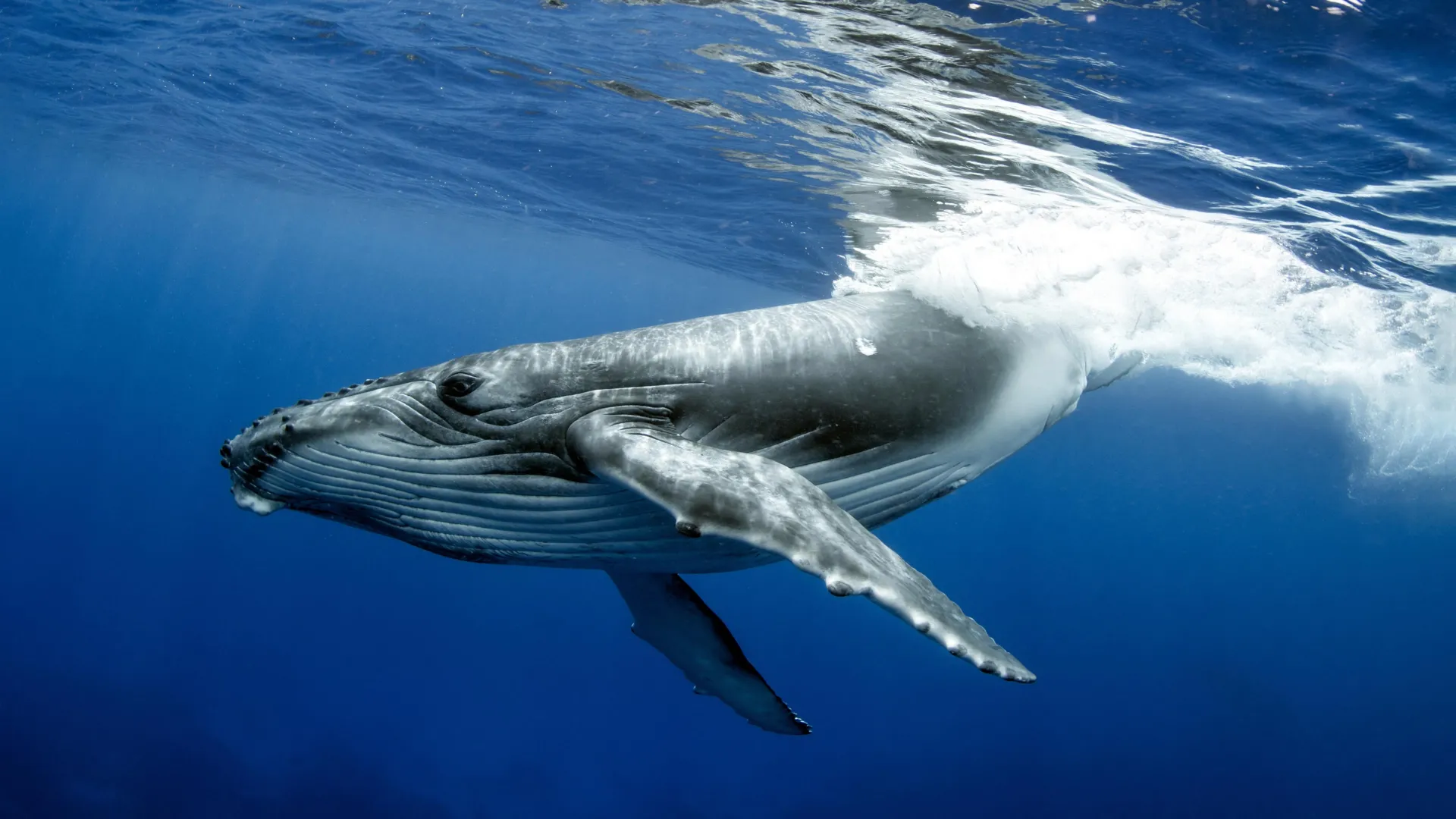
Scientists have documented an extraordinary feat of whale migration for the first time, confirming that humpback whales traveled between breeding grounds in eastern Australia and Brazil across more than 14,000 kilometers of open ocean. This groundbreaking discovery, detailed in a recent study, not only establishes a new record for the longest confirmed distance ever recorded between sightings of individual humpback whales anywhere in the world but also offers profound insights into the resilience, adaptability, and complex social dynamics of these magnificent marine mammals. The unprecedented voyages underscore the critical importance of long-term ecological research and international collaboration in unraveling the mysteries of the planet’s vast oceans.
The revelation stems from a meticulous comparison of tens of thousands of photographs of humpback whale tails, known as flukes. Each humpback whale possesses a unique pattern of pigmentation, scars, and serrations on its fluke, akin to a human fingerprint. These distinct markings allow scientists to identify and track individual whales over their lifetimes and across vast geographical distances. The ability to identify individual animals across decades and continents is a testament to sophisticated photo-identification techniques combined with advanced image recognition software and rigorous manual verification.
Unprecedented Journeys: Two Whales, Two Continents
The study meticulously tracked the movements of two specific humpback whales that defied conventional migration patterns, embarking on journeys previously thought improbable.
The first whale, an adult individual, was initially photographed in Hervey Bay, Queensland, Australia, in 2007. Hervey Bay is renowned as a crucial resting and calving ground for humpback whales along Australia’s eastern coast, a vital component of the East Australian Humpback whale population (E1). This whale was subsequently resighted in the same area in 2013, reinforcing its connection to the Australian breeding grounds. However, the most astonishing discovery came six years later when the very same whale was identified near São Paulo, Brazil, in 2019. This sighting marked a staggering minimum straight-line distance of approximately 14,200 kilometers between its last known location in Australia and its new presence in the South Atlantic. To put this into perspective, this distance is roughly equivalent to traversing from Sydney, Australia, to London, United Kingdom, highlighting the sheer scale of the journey undertaken. Researchers noted that the actual travel distance was undoubtedly far greater, as only the beginning and ending points of the journey were recorded, with the precise migratory route remaining unknown.
The second whale presented an even more remarkable narrative of endurance and exploration. This individual was first photographed in 2003 at Brazil’s Abrolhos Bank, a critical nursery area for humpback whales off the coast of Bahia. The Abrolhos Bank serves as the primary breeding ground for the Western South Atlantic humpback whale population (WSA), hosting thousands of whales annually for calving and mating. At the time of its initial sighting, the whale was observed actively swimming within a lively group of nine adult whales, indicative of typical breeding ground behavior. Twenty years later, in September 2023, the same whale was spotted alone in Hervey Bay, Australia. This documented transit between the Abrolhos Bank and Hervey Bay covered an astonishing minimum straight-line distance of 15,100 kilometers, establishing a new global record for the longest known movement of an individual humpback whale. This epic journey further solidified the extraordinary capacity of these marine giants for trans-oceanic navigation.
Decades of Dedicated Research and International Collaboration
Such monumental discoveries are not the result of fleeting observations but emerge from decades of sustained, multi-decadal research programs and an unwavering commitment to international scientific collaboration. As Stephanie Stack, a PhD Candidate at Griffith University and co-author of the study, emphasized, "Discoveries like this are only possible because of investment into long-term multi-decadal research programs and international collaboration. These whales were photographed decades apart, by different people, in opposite parts of the world, separated by two different oceans, and yet we can connect their journey."
The study leveraged an extensive dataset comprising 19,283 high-quality fluke photographs collected between 1984 and 2023 from eastern Australia and Latin America. This impressive archive represents an unparalleled visual record of humpback whale populations across two major ocean basins. The images were sourced from a diverse network, including professional researchers from various institutions and, crucially, a growing global community of citizen scientists.
The Indispensable Role of Citizen Science
A significant portion of the photographic data was contributed by citizen scientists through the global whale tracking platform, Happywhale. Happywhale is an innovative online platform that enables researchers and the public alike to upload photographs of whale flukes. Its sophisticated automated image recognition software then compares these submissions against a vast database, identifying individual whales and tracking their movements over time. This collaborative model has revolutionized whale research, greatly expanding the geographical and temporal scope of data collection.
Once the automated software identified potential matches, a team of expert researchers meticulously manually checked every possible match to confirm the findings, ensuring the highest level of accuracy and scientific rigor. Dr. Cristina Castro from the Pacific Whale Foundation, the lead researcher for the study, lauded the pivotal role of public participation: "This kind of research highlights the value of citizen science. Every photo contributes to our understanding of whale biology and, in this case, helped uncover one of the most extreme movements ever recorded." The success of platforms like Happywhale underscores the immense potential of harnessing public enthusiasm and technological advancements for large-scale ecological monitoring and conservation efforts.
The Broader Context of Humpback Whale Migration
Humpback whales (Megaptera novaeangliae) are renowned for their epic annual migrations. Typically, these baleen whales undertake long-distance journeys between cold, nutrient-rich feeding grounds in polar regions (such as the Antarctic) during the summer months and warm, sheltered breeding and calving grounds in tropical and subtropical waters during the winter. These migrations are essential for their life cycle, allowing them to feed heavily and build up energy reserves in productive polar waters before traveling to warmer climes for mating and raising their young, where food is scarcer but predator risk for calves is lower.
While typical humpback migrations can span 5,000 to 8,000 kilometers one-way, the cross-oceanic journeys documented in this study represent an entirely different scale of movement. The East Australian population (E1) typically migrates along Australia’s eastern coast from Antarctic feeding grounds to breeding areas like Hervey Bay and the Great Barrier Reef. Similarly, the Western South Atlantic population (WSA) travels from the Antarctic to breeding grounds off Brazil, such as the Abrolhos Bank. The discovery of individuals moving between these two distinct breeding populations across the vast expanse of the Pacific and Atlantic Oceans is unprecedented and challenges long-held assumptions about population fidelity to specific breeding grounds.
Rarity with Profound Significance: Why These Crossings Matter
Despite the stunning distances involved, researchers emphasized the extreme rarity of these trans-oceanic migrations. Across more than four decades of data, encompassing nearly 20,000 individually identified humpback whales, only these two individuals were found to have traveled between the eastern Australian and Brazilian breeding regions. This represents an astonishingly low figure of just 0.01 percent of the whales included in the records.
However, the infrequency of these events does not diminish their profound ecological and evolutionary significance. Scientists contend that even these rare movements play a crucial role in the long-term survival and genetic health of whale populations. Ms. Stack elaborated on this critical point: "Despite their rarity, these exchanges matter for the long-term health of whale populations. Occasional individuals moving between distant breeding grounds can help maintain genetic diversity across populations and may even carry new song styles from one region to another – humpback whale songs are known to spread culturally across ocean basins, much like music trends in human populations."
Genetic Exchange and Cultural Transmission
The concept of genetic diversity is fundamental to a population’s resilience. When populations become isolated, they are susceptible to inbreeding, which can lead to a reduction in genetic variation, making them more vulnerable to diseases, environmental changes, and other stressors. The occasional "outlier" individual migrating between distant populations acts as a genetic bridge, introducing new genetic material and preventing genetic bottlenecks. This genetic exchange is vital for maintaining the long-term viability and adaptive capacity of the species as a whole.
Beyond genetics, humpback whales are celebrated for their complex and evolving songs. These intricate vocalizations, primarily performed by males, are culturally transmitted, meaning they are learned and spread through social interaction rather than being genetically inherited. Studies have shown that specific song styles can propagate across entire ocean basins, evolving over time. The movement of individuals between breeding grounds offers a direct mechanism for the introduction and spread of new song styles, enriching the cultural tapestry of humpback whale populations across the globe. This phenomenon provides a fascinating parallel to the spread of cultural trends in human societies, highlighting the sophisticated social learning capabilities of these marine mammals.
The Southern Ocean Exchange Hypothesis
The findings also lend strong support to what researchers refer to as the "Southern Ocean Exchange" hypothesis. This compelling idea posits that humpback whales from different breeding populations, typically separated by vast ocean expanses during the breeding season, may occasionally converge and interact in shared feeding grounds within the highly productive waters of the Antarctic. During these intense feeding periods, individuals from the East Australian population might encounter those from the Western South Atlantic population. Following this intermingling, some whales may then deviate from their original migratory routes, returning along a different path and eventually settling in a completely new breeding region. This hypothesis provides a plausible explanation for the observed trans-oceanic movements, suggesting that the Antarctic serves not only as a crucial food source but also as a melting pot for genetic and cultural exchange.
Climate Change: A New Variable in Whale Migration
Looking to the future, researchers believe that climate change could potentially render these rare crossings more common. The rapidly changing environmental conditions in the Antarctic, particularly shifts in sea ice distribution and alterations in the abundance and distribution of Antarctic krill – the whales’ primary food source – are likely to impact whale migration patterns. As krill populations respond to warming waters and ocean acidification, whales may be forced to explore new feeding grounds or extend their foraging ranges, increasing the likelihood of encountering and intermingling with individuals from different populations. These environmental pressures could inadvertently accelerate the processes of genetic and cultural exchange, fundamentally altering the dynamics of humpback whale populations on a global scale. Understanding these potential shifts is crucial for effective conservation planning in an era of rapid climate change.
A Testament to Conservation and Future Research
The extraordinary journeys of these two humpback whales are a testament to the remarkable recovery of the species from the brink of extinction due to commercial whaling in the 20th century. Decades of international conservation efforts, including the global moratorium on whaling, have allowed humpback populations to rebound in many regions. However, new threats, primarily climate change, ocean noise, and entanglement in fishing gear, continue to pose significant challenges.
This study, titled "First evidence of bidirectional exchange between distant humpback whale breeding populations in eastern Australia and Brazil," published in the prestigious journal Royal Society Open Science, not only expands our understanding of humpback whale biology and behavior but also underscores the critical need for continued investment in long-term ecological research, advanced tracking technologies, and robust international collaborations. Such efforts are indispensable for monitoring population health, predicting responses to environmental change, and ensuring the long-term survival of these iconic ocean travelers in an increasingly dynamic marine environment. The ability to connect individuals across continents and decades offers a powerful tool for conservation, painting a more complete picture of life in our shared oceans.
