
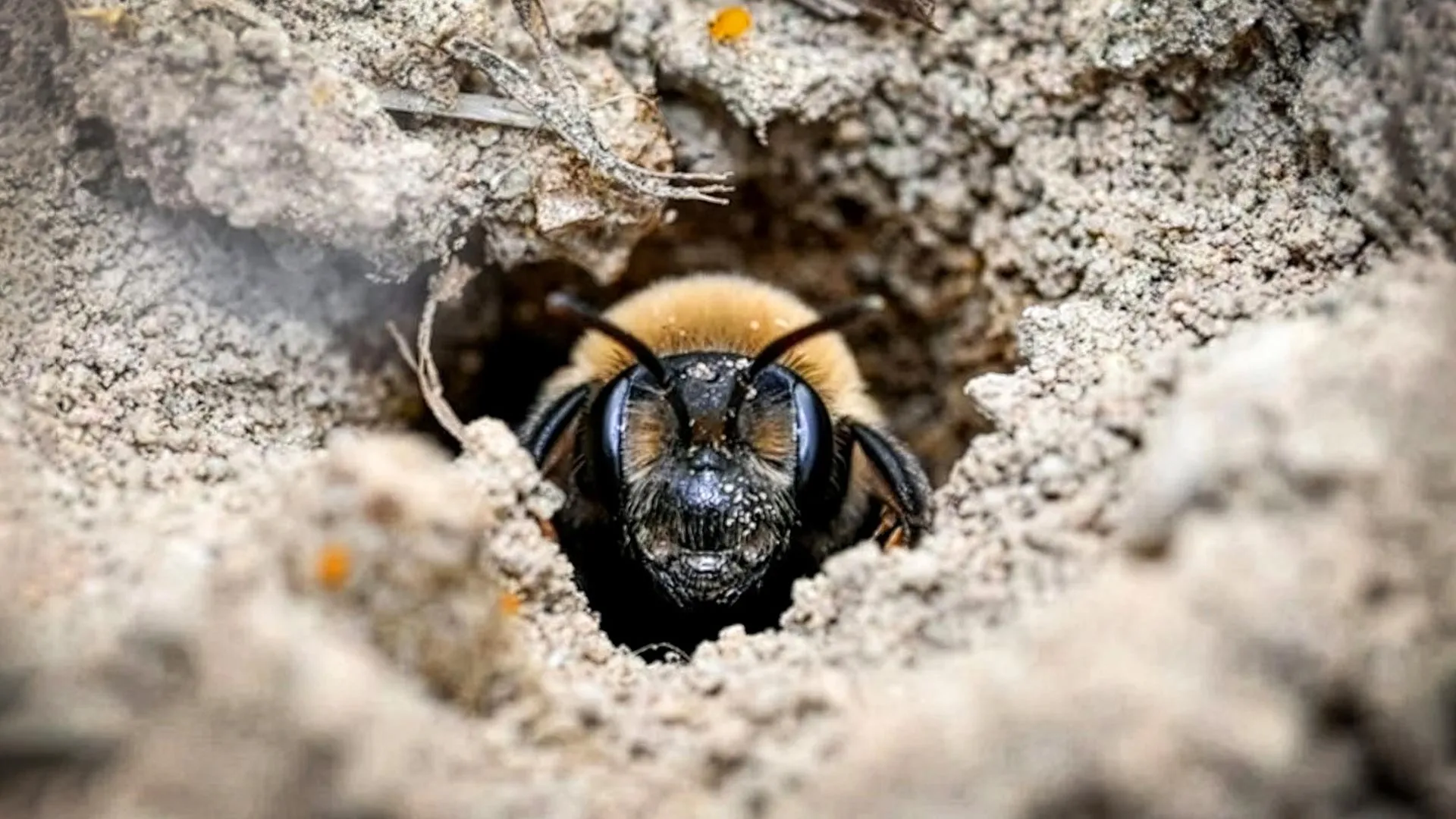
What began as a casual shortcut through East Lawn Cemetery in Ithaca, New York, evolved into one of the most significant entomological discoveries in recent history. In the spring of 2022, Rachel Fordyce, a lab technician at a Cornell University entomology lab, observed an extraordinary number of bees during her routine walk to work from East Hill Plaza. This initial, serendipitous sighting led to the identification of an immense, ancient aggregation of ground-nesting bees, providing critical insights into biodiversity conservation and the vital role of often-overlooked native pollinators.
The Genesis of a Groundbreaking Discovery
Fordyce’s path through the serene landscape of East Lawn Cemetery typically offered a quiet start to her day. However, in April 2022, the usual tranquility was punctuated by an unusual buzz. Bees, in numbers she had never witnessed, were emerging from the ground, creating a vibrant, living tapestry across specific sections of the cemetery. Intrigued, she collected several specimens in a jar and brought them to her supervisor, Bryan Danforth, a distinguished professor of entomology in Cornell’s College of Agriculture and Life Sciences. "These are all over the cemetery," she reported, her observation setting in motion a research endeavor that would redefine understanding of native bee populations.
The insects were quickly identified as Andrena regularis, commonly known as the "regular mining bee." This solitary wild bee species is a crucial component of local ecosystems, nesting underground and playing an indispensable role in pollinating a wide array of crops and wild plants. Unlike the more celebrated honeybee, A. regularis operates independently, each female constructing her own nest and provisioning for her offspring.
What followed the initial identification was an intensive study that unveiled a truly extraordinary phenomenon. Researchers concluded that East Lawn Cemetery harbors one of the largest and oldest known aggregations of ground-nesting bees ever scientifically documented. The sheer scale of the discovery is staggering: scientists estimate the site is home to approximately 5.5 million individual bees, concentrated within a remarkably small 1.5-acre area. To put this into perspective, this single aggregation is comparable to the pollinating power of more than 200 commercial honeybee hives and exceeds the human population of Manhattan by more than threefold.
Steve Hoge ’24, the lead author of the study published on April 13 in the esteemed journal Apidologie, emphasized the magnitude of the find. "I’m sure there are other large bee aggregations that exist around the world that we just haven’t identified, but in terms of what is in the literature, this is one of the largest," Hoge stated. His pivotal work on the study was conducted as an undergraduate researcher in Professor Danforth’s lab, highlighting the significant contributions emerging scientists can make.
Unraveling the Biology of Andrena regularis
The research delved deeply into the biology of these poorly understood wild bees, simultaneously underscoring their critical importance as pollinators for valuable agricultural crops, particularly apples, a signature commodity of New York State. The economic value of apples to New York’s agricultural sector is substantial, contributing hundreds of millions of dollars annually, making the role of efficient pollinators like A. regularis indispensable.
Professor Danforth articulated the broader implications of the findings: "The research elevates the value of solitary ground-nesting bees and shows just how abundant these bees are, how important they are as crop pollinators, and that we need to be aware of these nest sites and preserve them." This statement underscores a growing recognition within the scientific community that while honeybees garner significant public attention, native wild bees are often the unsung heroes of pollination, supporting both natural ecosystems and agricultural productivity.
A significant aspect of the study involved piecing together the life cycle and habitat preferences of A. regularis. Historical records revealed that this species has maintained a continuous presence at East Lawn Cemetery since at least the early 1900s, suggesting a remarkably stable and long-standing population. The cemetery itself dates back to 1878, providing a century and a half of relative peace and stability for its inhabitants.
One of the unique biological traits of A. regularis is its overwintering strategy. Unlike many other bee species that overwinter as larvae or pupae, A. regularis spends the colder months as adults. This characteristic is relatively rare among bees and explains their early emergence in spring, perfectly timed with the bloom of apple trees. As Hoge explained, "This species overwinters as adults, which is relatively rare, and that’s part of the reason why they come up out of the ground so early in the spring, timed to the apple bloom." The bees also visit other fruit trees and wildflowers that bloom early in the season, capitalizing on the first available nectar and pollen resources. In New York, their emergence typically occurs in April, when daytime temperatures consistently reach around 70 degrees Fahrenheit.
The proximity of Cornell Orchards, located approximately one-third of a mile from the cemetery, likely plays a crucial role in supporting this massive bee population by providing an abundant and reliable source of early spring flowers. Furthermore, Professor Danforth noted that A. regularis exhibits a strong preference for sandy soil, a characteristic that the East Lawn Cemetery possesses in large quantities, offering ideal nesting conditions.
Cemeteries: Unexpected Sanctuaries for Biodiversity
The discovery at East Lawn Cemetery strongly reinforces a burgeoning idea within conservation biology: that cemeteries can serve as critical refuges for biodiversity, particularly in increasingly urbanized landscapes. Older cemeteries, especially those situated within cities, have long been recognized for their ability to shelter uncommon plants, insects, birds, and even small mammals, often due to minimal disturbance and a lack of intensive chemical management.
Keven Morse, the superintendent of East Lawn Cemetery, whose family has managed the nonprofit cemetery for 46 years, attested to this ecological richness. He has routinely observed a diverse array of wildlife, including deer, geese, hawks, foxes, coyotes, and, of course, countless bees. Morse noted the bees have never stung him, a testament to their docile nature, particularly when undisturbed. His practical management approach reflects an innate understanding of their presence: "I just felt bad having to mow in certain areas," Morse admitted. "There’s probably three or four sections where they really migrate heavy, there’s a lot of them." This informal conservation practice, driven by observation and respect, has inadvertently fostered a thriving ecosystem.
Researchers explain that cemeteries offer an exceptionally good habitat for ground-nesting bees because the land is typically peaceful, rarely subjected to significant disturbance, and, crucially, largely free of harmful pesticides. These conditions create a stable environment where bee populations can flourish over decades, if not centuries, contrasting sharply with many agricultural and suburban areas that experience frequent tilling, development, and chemical applications. This highlights the potential of overlooked urban green spaces to act as vital ecological corridors and refugia.
The Unseen Majority: Ground-Nesting Bees
While honeybees (a social, introduced species) receive the lion’s share of public attention and conservation efforts, the vast majority of bee species – approximately 75% globally – are solitary ground-nesters, much like A. regularis. "It’s the most common lifestyle for bees," Professor Danforth clarified. This widespread but often invisible lifestyle means that most of the world’s bee diversity and pollinator services come from species that dig their homes beneath our feet.
When Steve Hoge embarked on his research into A. regularis, he encountered a surprising dearth of contemporary scientific information. One of the most detailed references he found dated back to 1978, underscoring the significant knowledge gap regarding many native bee species. This gap presented the Cornell team with a unique opportunity to meticulously document the bee’s biology, contributing substantially to a field often overshadowed by research on social bees.
Female A. regularis construct intricate underground nests, excavating individual tunnels that branch off into brood cells. Each cell is carefully provisioned with a mixture of pollen and nectar, forming a nutrient-rich "bee bread" that serves as the sole food source for the developing larva. After the egg hatches, the larva consumes this provision, undergoes several instars, pupates, and eventually emerges as an adult, completing its life cycle beneath the surface.
Counting Millions: The Scientific Method Behind the Estimate
Estimating a population of millions of tiny insects spread across several acres requires innovative and precise methodologies. To accurately gauge the bee population and study their emergence patterns, the Cornell researchers employed a novel monitoring method utilizing emergence traps. These specialized traps, consisting of small mesh tents covering less than a square meter of ground, are designed to funnel emerging insects into collection jars placed at their apex. "You capture a whole community of animals coming out of the ground with this approach," Professor Danforth explained, highlighting the method’s efficacy in capturing a broad spectrum of soil-dwelling invertebrates.
Between March 30 and May 16, 2023, the research team strategically placed 10 such traps throughout the cemetery. Over this period, they meticulously collected 3,251 insects, representing 16 distinct species of bees, beetles, and flies. Significantly, A. regularis overwhelmingly dominated these samples, confirming their numerical supremacy in the area.
Using the number of bees captured in each trap, researchers calculated the average bee density across the cemetery’s approximately 6,000 square meters. Based on these rigorous calculations, the estimated total population of A. regularis ranged from an impressive 3 million to an astonishing 8 million bees, with an average estimate settling at 5.5 million individuals. This meticulous approach provided a robust scientific basis for the unprecedented population estimate.
The traps also offered invaluable insights into the emergence timing of males and females. The data revealed a distinct protandry, with male bees appearing first during the warmer periods of April, several days before the females. This staggered emergence is a common reproductive strategy among many insect species. As Hoge elucidated, "The males come out first and wait for the females, so that they have the best opportunities to mate and pass on their genes." This competitive advantage ensures that males are present and ready to mate as soon as the females emerge, maximizing reproductive success.
Ecological Challenges and the Imperative for Conservation
The study also shed light on some of the ecological challenges faced by this massive bee aggregation, specifically documenting instances of brood parasitism by nomad (or "cuckoo") bees, Nomada imbricata. These parasitic bees do not build their own nests or collect pollen; instead, they stealthily enter the nests of A. regularis females. They wait until the host bee has meticulously prepared and provisioned a brood cell with pollen and nectar before laying their own eggs inside. Once the Nomada larvae hatch, they exhibit a grim form of kleptoparasitism, killing the host bee larvae and consuming the stored provisions intended for the mining bees. This interaction highlights the complex web of life within the soil ecosystem and the constant pressures even thriving populations face.
The discovery of such a vast and vital pollinator aggregation underscores an urgent conservation imperative. "These populations are huge, and they need protection," Professor Danforth stressed. "If we don’t preserve nest sites, and someone paves over them, we could lose in an instant 5.5 million bees that are important pollinators." This warning serves as a stark reminder of the fragility of even seemingly robust natural populations when confronted with human development and habitat destruction.
To proactively identify and protect similar critical nesting sites, Professor Danforth and his colleagues have launched a global citizen science initiative. This program encourages individuals worldwide to report any ground-nesting bee aggregations they encounter. By mobilizing the public, researchers aim to gather data on the distribution and size of these often-overlooked bee populations, creating a more comprehensive map of their habitats and facilitating targeted conservation efforts. Such initiatives are crucial in an era where biodiversity loss is accelerating, providing a powerful tool for community engagement and data collection that scientific teams alone cannot achieve.
The implications of this discovery extend beyond entomology. For urban planners, it offers a compelling argument for the ecological value of existing green spaces, even those with unconventional uses like cemeteries. It advocates for policies that protect these areas from development and ensure the avoidance of pesticides. For agricultural communities, it highlights the immense, often unquantified, ecosystem services provided by native wild pollinators, reinforcing the need for integrated pest management and habitat creation on farms. For the general public, it serves as a powerful reminder that significant biodiversity often thrives unseen, literally beneath our feet, and that careful observation and respect for nature, even in unexpected places, can lead to monumental discoveries that benefit us all.
The groundbreaking research was a collaborative effort, with co-authors including postdoctoral researchers Jordan Kueneman and Katherine Odanaka, undergraduate students Steve Hoge ’24 and Cassidy Dobler ’26, and lab technician Rachel Fordyce, whose initial keen observation ignited the entire project. Funding for this pivotal research was provided by the Cornell Atkinson Center for Sustainability, the National Science Foundation, and the Federal Capacity Funds program, underscoring the broad scientific and societal importance attributed to understanding and conserving our planet’s vital pollinators.
