
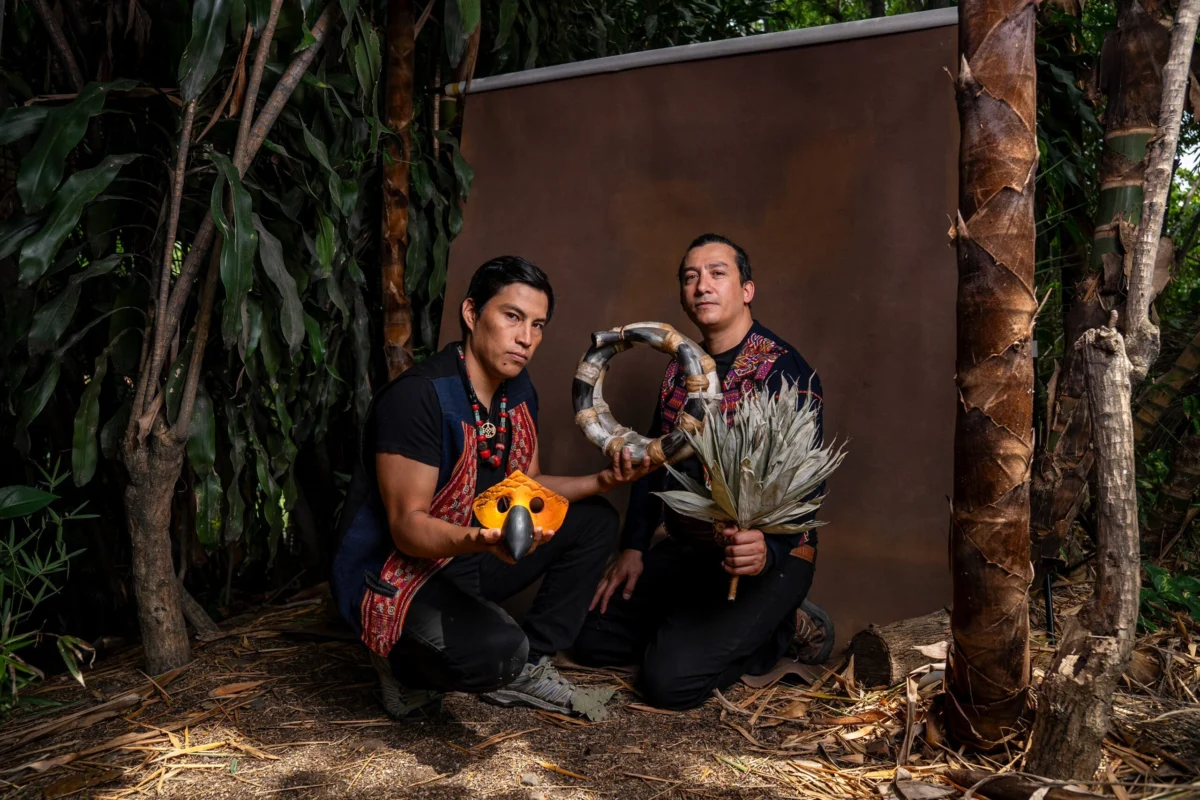
Cali, Colombia – At the heart of the 2026 Colombia Birdfair, an outdoor concert venue in Cali transformed into a vibrant nexus of ancient history and contemporary ornithology. Here, amidst the verdant landscapes of the world’s most bird-rich nation, Esteban Valdivia, a classically trained flautist and a scholar steeped in history and anthropology, embarked on a performance unlike any other. His stage was less a concert platform and more a living museum, featuring a curated collection of three dozen meticulously crafted replicas of ancient American instruments. From the resonant hollow of an Incan deer skull to the delicate Carchi syrinx, and a flute fashioned from condor quills, each artifact represented over two decades of Valdivia’s dedicated mastery and profound research into the sonic heritage of pre-Columbian civilizations. Yet, the instrument he chose to highlight, a seemingly unassuming two-chambered clay bottle, defied conventional musical classification. This was an object that, strictly speaking, played itself.
The Enigmatic Whistling Bottles: Echoes from Antiquity
Valdivia, holding up the intricately decorated clay bottle adorned with a bird perched on a tiny house, described it with reverence. “This is one of the most incredible objects,” he declared, his voice resonating with a blend of academic insight and artistic passion. It was a replica of an artifact originating from the Chorrera culture, a sophisticated pre-Columbian society that flourished along the Ecuadorean coast around 1500 BCE. “It’s a sound machine,” he explained to the captivated audience. “You activate it, and the sound it makes is the same as 3,000 or 4,000 years ago.”
With careful deliberation, Valdivia lifted the bottle to his headset microphone, tilting it gently as if pouring an unseen liquid. A magnified gurgle filled the air, followed by a sudden, ethereal high whistle. As water displaced air through an internal chamber within the birdhouse, the replica burst into a wavering, leaping song before settling back into silence. The effect was transportive, an auditory bridge across millennia, predating the advent of coins, glass, or written books.
These unique whistling bottles, unearthed across a vast geographical expanse stretching from Peru to Mexico, have long fascinated archaeologists and the public alike. Their otherworldly sounds have garnered them a cult following in modern times, appearing on souvenir tables, integrated into New Age ceremonies, and even credited with inducing out-of-body experiences. Despite their captivating allure, the original purpose and context of these instruments have remained an enduring archaeological enigma. A typical description, such as one from the Metropolitan Museum of Art in New York City, acknowledges this pervasive lack of knowledge: “Little is known of how they were used before Spanish invaders ravaged the native cultures.”
Valdivia’s Groundbreaking Theory: Ancient Ornithologists and Sonic Records
However, Esteban Valdivia is systematically challenging this long-standing academic silence. His theory, born from years of traversing the globe with a rotating team of collaborators—convincing museum curators and private collectors to grant access to study, replicate, and play their ancient instruments—posits a revolutionary interpretation. James Zeidler, an expert on the Jama-Coaque culture that succeeded the Chorrera, attests to the novelty of Valdivia’s approach. "The whole issue of sound—it’s one of the really unstudied things," Zeidler notes. "Esteban is the first person who has really gone at the issue systematically."
Valdivia contends that the bird depicted on the Chorrera whistling bottle is not merely decorative; its sound is a deliberate, precise imitation of the Gartered Violaceous Trogon’s distinctive call. He argues, through books, classes, concerts, and online videos, that this bottle is just one of dozens of artifacts that, both sonically and visually, evoke specific avian species. He sees these whistling bottles as sophisticated "recording devices" that have preserved the calls of birds like the Great Black Hawk and the Peruvian Screech-Owl for millennia, akin to an ancient, clay-based version of modern bird identification apps like Merlin. The artisans who crafted them, he suggests, were in essence the world’s first ornithologists.
This groundbreaking argument found a particularly receptive audience at the Colombia Birdfair, the largest annual gathering of bird enthusiasts in a nation boasting an unparalleled avian diversity. “The way that we are bird fanatics, they were too,” Valdivia asserted to the crowd, drawing a direct parallel between contemporary birdwatchers and ancient peoples. He invited his audience to consider that the simple act of searching for living things in the natural world, which often serves as a gateway to inhabiting the present moment more fully, could also be a profound gateway to understanding the past.
A History of Overlooking Sound: Challenging Academic Bias
The idea that human music originated from imitating natural sounds, particularly birdsong, is not new. Around the time the Chorrera potter crafted the first surviving whistling bottle, the Roman philosopher Lucretius posited that human music began with the imitation of "the liquid voices of birds." Across the continent, Lü Buwei, a prominent figure in ancient China, wrote that China’s 12-tone musical scale was copied from the birdsong of the mythical fêng huang. Yet, by the 20th century, such speculation was largely dismissed as unscientific. Cognitive biologist W. Tecumseh Fitch captured this skepticism, writing, “Did Australopithecines sing? Did Homo erectus drum? Did Neanderthals dance? These questions, however fascinating, will probably never be answered with certainty.”
The questions that drive Valdivia’s research face similar inherent challenges. Many of the ancient cultures he studies left behind no written records, making direct interpretation difficult. Furthermore, a significant portion of these artifacts were discovered by treasure hunters, individuals not known for meticulous record-keeping or scientific context preservation. Compounding this, Western academics who subsequently studied these artifacts often approached them with a pervasive "visual bias." As Ellen Hoobler, a specialist in ancient American art at William Paterson University, explains, “We’re looking for authenticity, for aesthetic qualities. But then that means that we often don’t even realize that there are sound qualities to the object.” This visual-centric approach has historically relegated the auditory dimensions of ancient artifacts to obscurity.
This limited perspective resulted in equally limited museum exhibit texts, which Valdivia encountered as a child. Flutes adorned with bird-like decorations were invariably labeled with the vague, catch-all adjective "zoomorphic," or "animal-shaped." More impactful to Valdivia, however, was the silence of these objects. “The instruments were always behind glass,” he recalls, a poignant barrier between his curiosity and the sounds they once made. “I always wondered: How would they sound?” In hindsight, his entire career has been a profound, systematic elaboration of this very question.
Esteban Valdivia’s Winding Path to Discovery
Valdivia’s journey to becoming a pioneering figure in archaeo-acoustics is as unique as his research. He describes his life as being shaped by "two currents." One stream encompasses his formal academic pursuits: undergraduate studies in musical composition, followed by master’s degrees in history and anthropology, providing him with a robust interdisciplinary foundation. The other current, which he terms "the esoteric," unfolded through an improbable series of serendipitous opportunities and bold choices.
As a teenager growing up on the coast of Argentina, Valdivia experienced a brief stint of fame as the drummer for a nu-metal band. He notes, with a touch of humor, that “Metalheads get into the ancestral stuff,” hinting at an early, unconventional connection to ancient themes. His transition to ancient instruments was catalyzed by an apprenticeship with Tito La Rosa, a Grammy Award-winning Peruvian sound healer, whose profound knowledge of indigenous musical traditions deeply influenced Valdivia. He subsequently met Pierre Hamon, a renowned French medieval music specialist, who invited him to Europe for flute duets, further broadening his musical horizons.
A pivotal moment arrived when a politician facilitated a gig for Valdivia, tasking him with preparing an exhibition for the prestigious Musée du Quai Branly in Paris. This unprecedented access granted him entry to museum collections across Ecuador, allowing him to study invaluable instruments firsthand. Even his father, a radiologist, played an unexpected role, assisting Valdivia by X-raying artifacts to reveal their hidden internal structures, crucial for understanding their sound production. Valdivia encapsulates his opportunistic spirit with a metaphor: “They say that after a train passes, there’s no way to get onboard. I’m the kind of person that, as soon as I see a train, I get on it. Later maybe I’ll jump off, but I always get on at first.”
Perhaps the most impactful "train" he boarded was YouTube. In 2010, he and filmmaker Carolina Segre launched one of the first channels dedicated to ancient American instruments. Its early popularity was remarkable. “To have 10,000 followers in 2010 is like having a million today,” Valdivia observed. Their channel became a rich repository of interviews with historians and musicians, short documentaries on subjects ranging from Mayan murals to the roots of Afro-Colombian music. Crucially, many videos featured Valdivia himself, explaining, crafting, and playing the very instruments he had dreamed of hearing as a child, previously locked away in silent museum displays.
The Birth of Archaeo-Ornithology: A Collaborative Revelation
Throughout his work, Valdivia had noticed a significant percentage of ancient flutes were shaped like birds, but this observation remained a peripheral detail. The catalyst for his deep dive into avian connections arrived in 2020. The global pandemic halted his extensive travel plans, and the birth of his son anchored him closer to home. During this period, he began leading online classes, teaching students worldwide how to replicate ancient instruments, transforming clay into resonance chambers and rectangular bevels.
Among his most diligent students was Darío Rocha, a young Ecuadorean ceramicist and astronomy museum tour guide. When travel restrictions eased, Valdivia visited Rocha in Ecuador. “It was like meeting a celebrity,” Rocha recounted, clearly star-struck. Soon, Rocha was not only playing bass drum at Valdivia’s concerts but also co-teaching his ceramics classes. Rocha’s sister, Diana Rocha, a budding ornithologist, introduced a critical question that had been simmering in her mind since seeing an exhibition in Quito featuring a sculpture of a man with a headdress made of birds: Could it be possible to identify the specific bird species depicted in ancient sculptures?
Valdivia was instantly onboard. Before long, he and the Rocha siblings were in the storeroom of the Museum of Anthropology and Contemporary Art in Guayaquil, embarking on a systematic hunt for bird-related objects. They initially expected to find a few dozen; to their astonishment, they encountered over 4,000. “I never imagined there was such an enormous collection of pieces with birds,” Diana exclaimed, the scale of the discovery overwhelming. Each find evoked the thrill of spotting a new species for the first time, a "lifer" for an archaeologist. The sheer volume of material compelled Valdivia to suggest they write a book, an endeavor that quickly blossomed into something far grander.
From Speculation to System: Publishing Ancient Avian Narratives
In the past three years, Valdivia and his collaborators have published an impressive eight books. These slim volumes, printed in both English and Spanish with large print, are designed for broad accessibility. Nearly every page features an artifact, a detailed drawing of a bird, or a QR code linking to a brief YouTube video of Valdivia or Darío Rocha demonstrating an instrument. While Valdivia expresses hope that these publications will garner respect from traditional archaeologists, their design, like all his work, aims to engage a wide audience.
Valdivia launched his latest work, Ancestral Birds: Archaeo-Ornithology of Colombian Ceramics, at the Colombia Birdfair. The cover, featuring a squat, smiling vase identified as a Crested Owl, epitomized his unique approach. The term "archaeo-ornithology" has recently been adopted by archaeologists, zoologists, and paleontologists to define a new academic subfield focused on ancient human-avian relations. However, Valdivia employs it to describe his more unorthodox methodology: “What is archaeo-ornithology? Basically, it’s going birding in museums.”
He first pioneered this approach in Ecuador with the Rochas, and then extended it to Colombia. His ambitious plans for the current year include expanding this research to Costa Rica and Peru. The process is meticulous: he photographs, X-rays, and records the sounds of various bird-related artifacts. He then collaborates with local ornithologists to identify the species. For the Colombian ceramics book, he partnered with biologist and scientific illustrator Fernando Ayerbe-Quiñones, author of An Illustrated Field Guide to the Birds of Colombia. By cross-referencing the provenance of the documented artifacts with historical vegetation cover and the known geographic distribution of birds, Ayerbe-Quiñones was able to match drawings and sculptures to specific birds of prey, parrots, and hummingbirds, and to link the sounds of wind instruments to owls and nightjars.
The Balance Between Certainty and Hypothesis
During Valdivia’s presentation, as he projected an image of a plate encircled by stylized line drawings identified as a Sparkling Violetear, murmurs arose from a pair of biologists in the audience, Verónica Valencia Montero and Natalia Vargas. As experienced birders, they understood the immense difficulty of identifying one of Colombia’s 163 hummingbird species, even when the living creature was directly in front of them. The question hung in the air: How could the authors accurately determine a species from merely a whistle or a line drawing on an ancient plate? “That was the one doubt I had about the presentation,” Montero admitted afterward. “How does one arrive at something so specific?” Vargas added.
Ayerbe-Quiñones acknowledged that his hummingbird identification was less definitive than some of the other identifications in the book. “I put the species that’s most logical,” he stated. While multiple hummingbird species inhabit the Andean montane region where the plate was found, the electric-pulse call of the social, aggressive Sparkling Violetear is particularly ubiquitous.
The debate extended to other identifications. Several experts consulted for this story debated specific attributions: a King Vulture on a Magdalena Medio funeral urn might be an Andean Condor; a Jama-Coaque statue of a Harpy Eagle could potentially be a bat; and the sound of a Chorrera whistling vessel was deemed slightly too low to be a Great Black Hawk. This inherent uncertainty is precisely why most traditional academics, when attempting to identify animals from ancient artifacts or even bones, tend to shy away from species-level identifications in their own work, preferring broader classifications.
Yet, remarkably, every expert interviewed also defended Valdivia’s overarching methodology. Peter Stahl, a neotropical zooarchaeologist, articulated this nuanced perspective: “If I go too far out on a limb, I increase my chances of being wrong, and I’d rather be right. But is it okay for him to go out on a limb? Yeah, definitely.” For one, speculation, carefully considered, is an intrinsic part of the scientific process. As Ecuadorean ornithologist Markus Tellkamp advises his students, “Just call speculation ‘hypothesis formation’ and continue.”
Tellkamp further emphasized that Valdivia’s work serves as a crucial corrective to a fundamental flaw in academic historical approaches. In regions with scant written records, the cautious, scientifically confident pronouncements about the past can inadvertently create a false impression of cultural simplicity or "meagerness." “We ought not to assume that people back then didn’t understand the natural world,” Tellkamp asserted. “They did. They lived from the natural world in a way that we don’t.” Ancient peoples awoke to birdsong, hunted birds for sustenance, and depicted them extensively in ceramics, stone, and gold. Tellkamp’s own research reveals an extensive bird trade network stretching from the Amazon to the Ecuadorean coast, underscoring the deep symbolic and practical significance of birds. “You don’t carry a bird for 1,000 kilometers because you don’t care about it,” he concluded, highlighting the profound meaning these creatures held.
A Legacy of Resonance: Bridging Past and Future
The true significance of Valdivia’s work, and that of his collaborators, transcends any single identification. It lies in its powerful act of elevating the knowledge systems of ancient Indigenous cultures to the same plane as Western science, and in making this profound understanding accessible to a public that may never step inside a museum’s locked vaults. Darío Rocha encapsulated this sentiment, stating, “I think we’re doing something transcendental, like the Indigenous cultures did thousands of years ago. We’re just helping that echo reach the new generation so that they can hear and feel and perceive a little bit. Because who knows when it could disappear, be lost, be broken, be damaged, and there could be no contact with what was.”
After the final performance at the festival, a palpable energy drew a crowd around a folding table, as the audience eagerly accepted Valdivia’s invitation to experience the instruments firsthand. “It’s important that you understand that this isn’t music for musicians,” Valdivia told them, his words echoing the inclusive spirit of his entire endeavor. “It’s for everyone.” Through his tireless dedication, innovative methodology, and collaborative spirit, Esteban Valdivia is not merely rediscovering ancient sounds; he is orchestrating a re-evaluation of history, allowing the sophisticated voices of ancient American civilizations to resonate once more, guiding us to a deeper appreciation of their profound connection to the natural world.
