
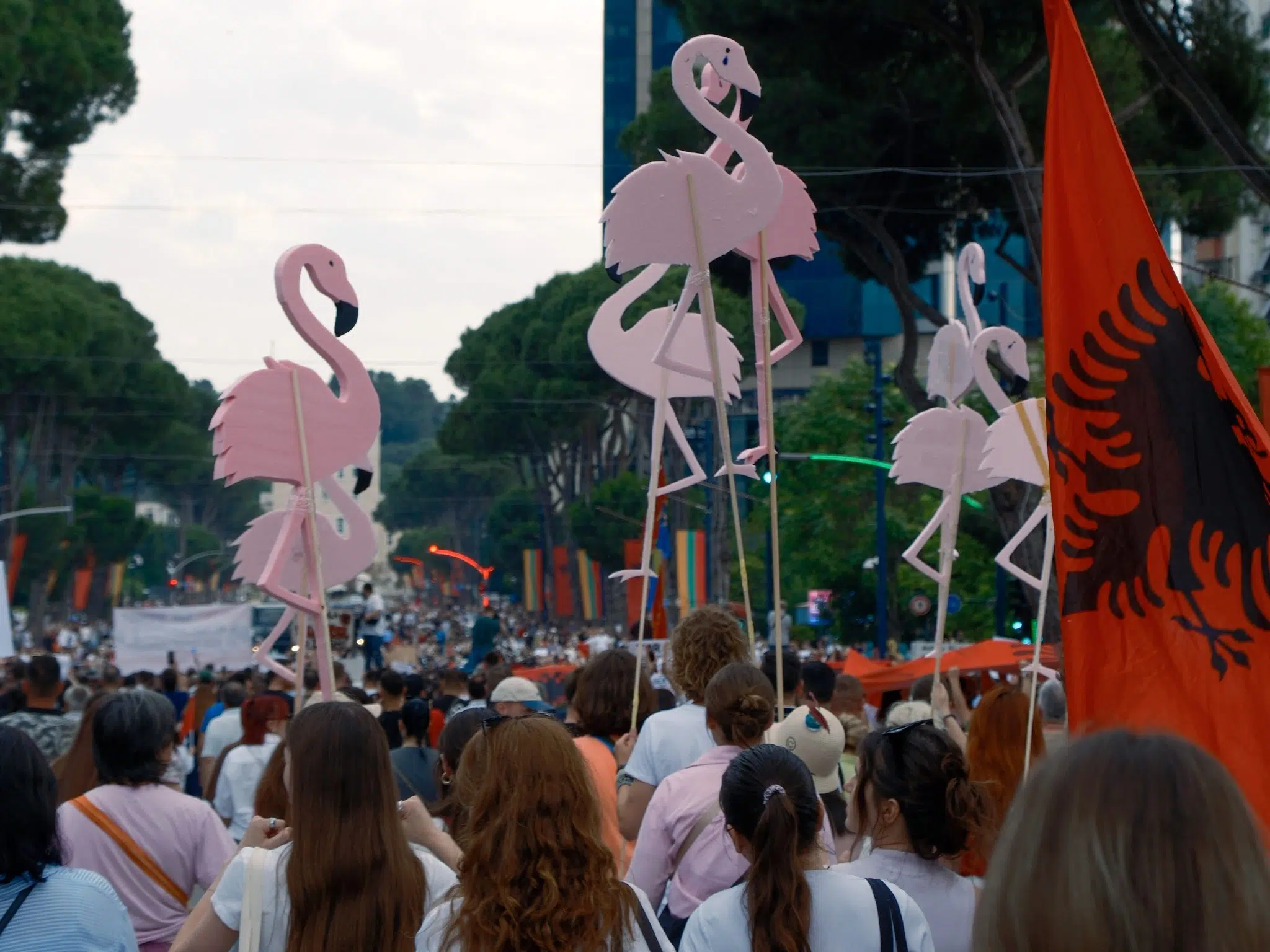
The European Parliament today adopted a resolute stance on Albania’s 2025 Commission Report, voicing profound concerns regarding the escalating developments within the critically important Vjosa-Narta Protected Area. In a clear message echoing the core principles of the European Union, the Parliament underscored that the rule of law and adherence to EU environmental standards are non-negotiable prerequisites for accession. The adopted resolution makes an explicit demand for the immediate repeal of Albania’s controversial 2024 amendments to the Law on Protected Areas, legislation widely condemned for facilitating the degradation of one of the Mediterranean’s most ecologically significant natural sites and sparking unprecedented public outcry, culminating in the largest street protests Albania has witnessed in a generation.
A Call for Immediate Action and Compliance
Beyond the legislative repeal, the European Parliament’s resolution calls for an "immediate moratorium on new permitting procedures, construction works, and development interventions within protected areas." This moratorium is intended to remain in effect until the incompatible provisions of Albania’s amended Law on Protected Areas are fully rescinded and complete compliance with robust EU nature protection standards can be demonstrably assured. This firm directive signals a critical juncture in Albania’s arduous path towards European Union membership, linking environmental stewardship directly to its geopolitical aspirations.
The "Flamingo Revolution": A Nation Mobilizes
The Parliament’s decision comes amidst a powerful wave of popular dissent, globally dubbed the "Flamingo Revolution." For the past 18 days, over 100,000 Albanian citizens have converged on the streets, demonstrating against what they describe as the illegal clearing of ancient forests, vital sand dunes, and protected habitats within the Vjosa-Narta Protected Landscape. This widespread popular uprising underscores a deep-seated public commitment to environmental preservation and a growing frustration with governmental policies perceived as undermining national natural heritage for the sake of unchecked development. The sheer scale and persistence of these protests highlight a burgeoning environmental consciousness within Albanian society, transforming local ecological concerns into a potent national movement.
Legislative Backslide and Eroding Oversight
Central to the European Parliament’s condemnation are the 2024 amendments to Albania’s Law on Protected Areas. These legislative changes are explicitly criticized for permitting the construction of large-scale tourism infrastructure within zones previously designated for strict protection, effectively dismantling crucial safeguards. Furthermore, the amendments are seen as stripping away key environmental oversight mechanisms, thereby weakening the regulatory framework designed to protect these invaluable ecosystems.
Adding to these concerns, MEPs also expressed deep apprehension regarding Albania’s Law on Strategic Investments. This particular piece of legislation, with its provisions for accelerated permitting procedures, raises alarms that it could be exploited to bypass essential environmental scrutiny, particularly in ecologically sensitive areas like Vjosa-Narta. Critics argue that such expedited processes create loopholes that can be exploited by developers, leading to irreversible environmental damage without adequate prior assessment or public consultation.
A Stark Contrast: Parliament vs. Commission
The decisive outcome of today’s vote in the European Parliament presents a stark contrast to the earlier reaction from the European Commission regarding these illegalities. On June 15, Commissioner Kos had indicated that the Commission had received assurances from the Albanian government that an environmental impact assessment (EIA) would eventually be carried out. This statement drew heavy criticism for seemingly overlooking a fundamental fact: illegal works had already commenced and were actively proceeding without the requisite permits, without transparency, and crucially, without any prior environmental impact assessment. The Parliament’s more assertive stance is widely interpreted as a stronger commitment to upholding the integrity of EU laws and principles, even in the face of governmental assurances that, critics argue, ring hollow given the ongoing destruction. This divergence highlights a potential tension within EU institutions on how best to address rule of law and environmental compliance issues in candidate countries.
The Vjosa-Narta: A Jewel of Mediterranean Biodiversity
The Vjosa-Narta Protected Landscape is not merely a local environmental concern; it represents a globally significant ecological treasure. It constitutes one of the last remaining intact delta systems across the entire Mediterranean basin, a region already heavily impacted by human activity and climate change. This unique ecosystem provides critical habitat for an extraordinary array of biodiversity, hosting over 200 bird species, many of which are migratory, and more than 70 endangered species.
Its strategic location on one of Europe’s most vital migratory corridors makes it an indispensable stopover for countless birds traveling between continents. Beyond avifauna, the area offers essential sanctuary for iconic and highly vulnerable marine species, including the Mediterranean monk seal and the Loggerhead sea turtle. These species are not only protected under international conventions but also by specific legal obligations of EU Member States such as Greece, Italy, and Croatia, emphasizing that the ecological fate of Vjosa-Narta extends far beyond Albania’s borders. The destruction within this area has direct implications for regional biodiversity and the conservation efforts of neighboring EU countries, reinforcing the Parliament’s assertion that "what happens here doesn’t stay in Albania."
A Timeline of Disregard for Environmental Law
The current crisis in Vjosa-Narta is not an isolated incident but rather the latest chapter in a series of concerning developments.
- November 2021: The controversial construction of Vlora International Airport commenced within the same protected area. This project has been a focal point of environmental criticism since its inception, raising serious questions about the government’s commitment to its own environmental protection laws and international obligations.
- 2024: Amendments to the Law on Protected Areas are passed, significantly weakening environmental protections and opening the door for large-scale tourism developments in previously safeguarded zones.
- May 2024 (Assumed): Large-scale construction activities begin inside the protected area. These operations have proceeded without any publicly available project plan, environmental impact assessment, public consultation, or valid permits. This direct violation of established legal procedures stands in stark contradiction to Albania’s explicit accession commitments under both the Environmental Acquis – the body of EU environmental law – and Cluster 1 on the Rule of Law, which forms the bedrock of EU membership negotiations.
- June 15: European Commissioner Kos issues a statement noting assurances from the Albanian government regarding future environmental impact assessments, a position seen by critics as insufficient given the ongoing illegal works.
- Past 18 Days (Leading up to the Vote): Over 100,000 Albanians participate in sustained street protests, demonstrating against the destruction and demanding accountability.
- Today: The European Parliament adopts its resolution, calling for a moratorium and repeal of the controversial laws.
Expert Voices and Activist Demands
Environmental organizations at the forefront of this battle have welcomed the European Parliament’s decisive intervention.
Joni Vorpsi, Head of Policy and Advocacy at PPNEA (Protection and Preservation of Natural Environment in Albania), articulated the significance of the resolution: "The European Parliament’s call for an immediate moratorium is exactly what is needed in our fight to protect Vjosa-Narta. It provides Albanian authorities with the necessary time and clarity to align with EU standards on nature protection and, crucially, to avoid irreversible mistakes that would undoubtedly set back Albania’s EU path. We unequivocally want Albania to join the European family, and it is precisely for this reason that we cannot afford to get this wrong." Vorpsi’s statement underscores the dual objective of environmental protection and European integration, arguing that one cannot be achieved without the other.
Anouk Puymartin, Head of Policy at BirdLife Europe, echoed this sentiment, emphasizing the solidarity shown by the European Parliament: "Today, the European Parliament has unequivocally stood with the thousands of Albanians on the streets of Tirana. This vote sends an unambiguous message: you simply cannot join the EU while simultaneously bulldozing protected wetlands and bypassing your own national laws. Protecting Vjosa-Narta, and respecting the Birds and Habitats Directives, are fundamental conditions of EU accession. The Albanians protesting in Tirana already understood that defending nature and defending democracy are, in essence, the same fight. Today, the European Parliament has affirmed this truth." Puymartin’s remarks highlight the intrinsic link between environmental governance, democratic principles, and the rule of law within the EU accession framework.
Broader Regional Implications: A Precedent for the Western Balkans
The implications of today’s vote extend beyond Albania. There are growing concerns among observers that other Western Balkan accession countries are closely monitoring these developments, potentially considering similar legislative approaches to facilitate rapid, large-scale development, even at the expense of environmental protection. The European Parliament’s firm stance serves as a potent warning. Today’s vote makes it explicitly clear that such a path, one that prioritizes short-term economic gains over long-term environmental sustainability and adherence to EU standards, is fundamentally incompatible with the aspirations of EU membership. This sends a critical signal across the region, reinforcing the message that environmental integrity and the rule of law are cornerstones of European integration, not optional add-ons.
The Path Forward: Challenges and Opportunities
The European Parliament’s resolution places significant pressure on the Albanian government to reconsider its current policies and legislative framework concerning protected areas. The demand for a moratorium and the repeal of the 2024 amendments signals that the international community, particularly the European Union, is watching closely and will not tolerate a disregard for environmental protection. For Albania, this presents both a challenge and an opportunity. The challenge lies in reversing controversial policies and confronting powerful development interests. The opportunity lies in demonstrating a genuine commitment to environmental stewardship and the rule of law, thereby strengthening its credibility as a prospective EU member. Failure to heed the Parliament’s call could significantly jeopardize Albania’s accession negotiations, signaling a lack of alignment with fundamental European values.
The "Flamingo Revolution" has demonstrated the power of civil society in Albania to mobilize against perceived injustices and advocate for their natural heritage. The sustained protests, coupled with the international pressure from the European Parliament, create a powerful impetus for change. The focus will now shift to how the Albanian government responds to these demands, whether it chooses to align with European standards and its own citizens’ aspirations for environmental protection, or risk further isolation on its path towards European integration. The future of Vjosa-Narta, and indeed Albania’s European future, hangs in the balance.
