
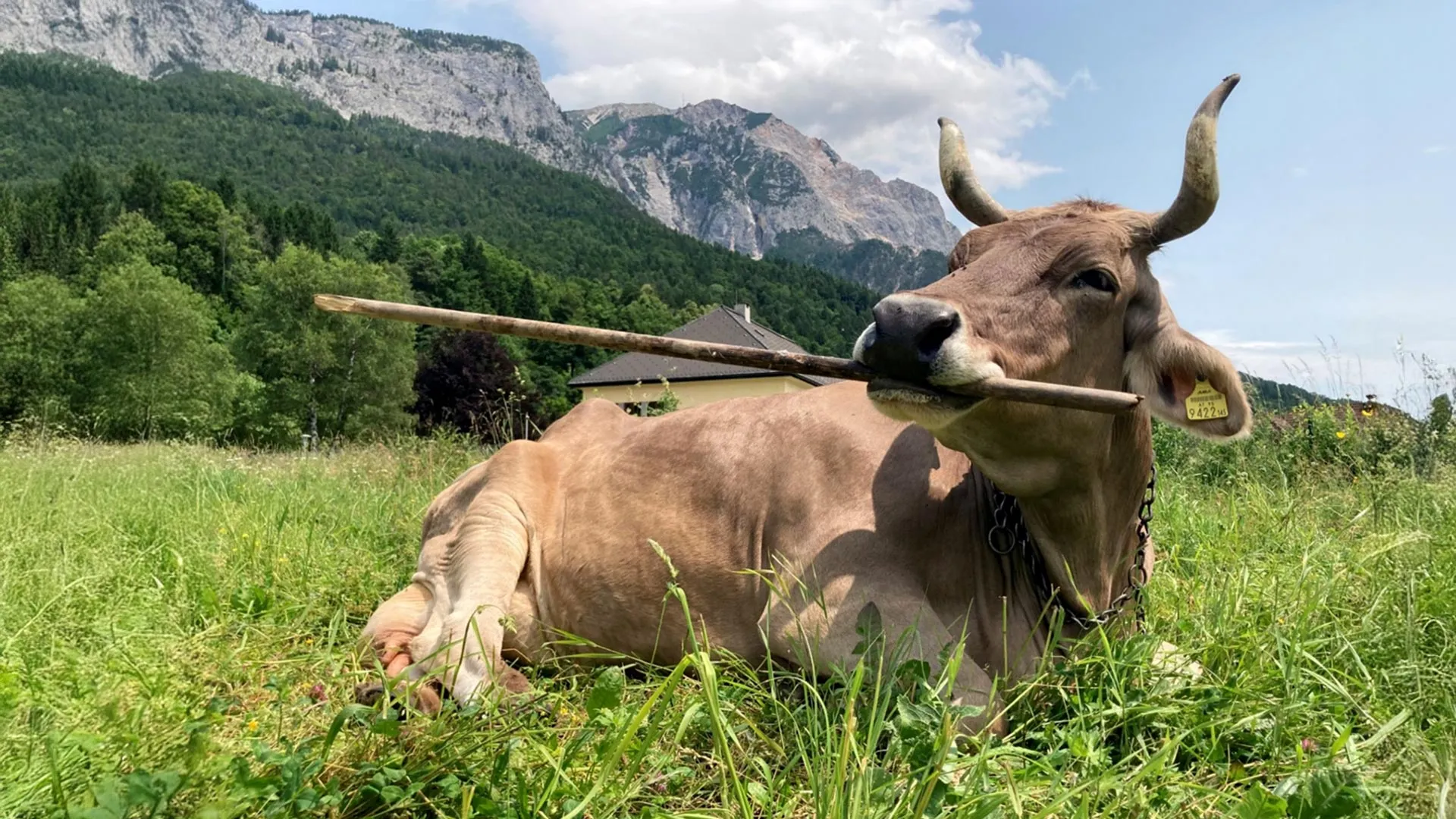
For decades, the popular imagination, heavily influenced by cartoonist Gary Larson’s iconic 1982 Far Side comic, Cow Tools, has depicted cattle as animals lacking the cognitive capacity for complex behaviors like tool use. The humor of Larson’s illustration—a cow standing proudly next to a bizarre, seemingly useless collection of objects labeled as "tools"—stemmed from a widely accepted, albeit largely untested, assumption that such intelligence was beyond bovine capabilities. This cultural touchstone cemented a perception of cows as docile, instinct-driven creatures, primarily valued for their agricultural output rather than their intellectual prowess. However, this long-standing notion is now being dramatically challenged by a real-life Swiss Brown cow named Veronika, whose extraordinary behavior has provided the first documented case of flexible, multi-purpose tool use in cattle, suggesting a much deeper cognitive landscape within the species than previously understood.
A groundbreaking study, recently published in the esteemed journal Current Biology, details Veronika’s remarkable ability to manipulate external objects to achieve a specific goal, thus overturning a significant scientific assumption. This revelation comes from a collaborative research effort involving the University of Veterinary Medicine, Vienna, and other institutions, marking a pivotal moment in the study of animal cognition. The findings not only highlight Veronika’s unique capabilities but also underscore how deeply ingrained preconceptions about livestock intelligence may have inadvertently created blind spots in scientific observation, rather than reflecting genuine cognitive limitations of the animals themselves.
"The findings highlight how assumptions about livestock intelligence may reflect gaps in observation rather than genuine cognitive limits," stated Alice Auersperg, a cognitive biologist at the University of Veterinary Medicine, Vienna, whose expertise lies in understanding animal intelligence and behavior. Her comments emphasize the need for a re-evaluation of how we perceive and study the cognitive abilities of species traditionally viewed through a purely utilitarian lens.
A Decade of Unnoticed Ingenuity: Veronika’s Journey to Scientific Spotlight
Veronika’s story began more than a decade ago on the organic farm of Witgar Wiegele, an organic farmer and baker who resides in a picturesque region. Unlike the vast majority of her bovine counterparts, Veronika was not raised for food production; instead, she lives as a cherished companion animal, considered an integral part of Wiegele’s family. This unique upbringing, characterized by a stimulating environment and close human interaction, is believed to be a crucial factor in the development and observation of her unusual behavior.
It was Wiegele who first noticed Veronika’s peculiar habit. Over time, he observed her regularly picking up sticks and, remarkably, using them to scratch otherwise inaccessible areas of her body. This consistent, purposeful action, initially dismissed as an anomaly or simple play by some, eventually captured Wiegele’s scientific curiosity. Recognizing the potential significance of what he was witnessing, he began to document Veronika’s actions, eventually capturing video footage that would prove instrumental. This footage, shared with researchers, became the catalyst for the formal scientific investigation that would ultimately redefine our understanding of bovine intelligence.
"When I saw the footage, it was immediately clear that this was not accidental," Auersperg recounted, describing her initial reaction to Wiegele’s recordings. "This was a meaningful example of tool use in a species that is rarely considered from a cognitive perspective." Her statement underscores the immediate recognition by experts that Veronika’s actions were not random but indicative of sophisticated cognitive processing.
Rigorous Scientific Scrutiny: Unpacking Veronika’s Flexible Tool Use
To transition from anecdotal observation to robust scientific evidence, researchers embarked on a series of structured tests designed to systematically evaluate Veronika’s tool-using behavior. In these controlled experiments, a common deck brush was strategically placed on the ground in various positions around Veronika. The researchers meticulously observed and recorded her interactions with the brush, looking for patterns, intentionality, and adaptability in her actions.
Across multiple trials, Veronika demonstrated remarkable consistency and precision. She consistently chose specific parts of the brush, depending on the particular area of her body she intended to scratch. Her selections were far from random; instead, they precisely matched the needs of different regions of her body, indicating a deliberate and adaptive approach to problem-solving. This level of discernment is a hallmark of sophisticated cognitive processing and sets her behavior apart from simple object manipulation.
Antonio Osuna-Mascaró, a key researcher involved in the study, elaborated on the depth of Veronika’s capabilities: "We show that a cow can engage in genuinely flexible tool use. Veronika is not just using an object to scratch herself. She uses different parts of the same tool for different purposes, and she applies different techniques depending on the function of the tool and the body region." This observation is critical, as it elevates Veronika’s actions beyond basic tool use to a more advanced form, demonstrating a nuanced understanding of an object’s properties and how to leverage them for varied outcomes.
Beyond Basic Manipulation: Flexible and Multi-Purpose Application
The research team identified clear and compelling patterns in how Veronika deployed the brush. For larger, firmer areas of her body, such as her back, she exhibited a distinct preference for the bristled side of the brush, applying firm pressure to achieve effective scratching. Conversely, when addressing more sensitive regions on her lower body or flanks, she would deliberately switch to the smoother, less abrasive handle, demonstrating an understanding of the differing tactile needs of her anatomy.
Her movements were equally adaptive. When targeting her upper body, Veronika employed broader, more vigorous motions, indicative of a desire to cover a larger area with greater force. In contrast, movements directed at lower or more sensitive areas were notably slower and more precise, suggesting careful control and an anticipation of the sensory feedback.
The scientific definition of tool use involves using an external object to achieve a goal through physical interaction. Veronika’s actions not only meet this fundamental definition but significantly expand upon it. Her behavior qualifies as "flexible, multi-purpose tool use," a more advanced category that denotes the ability to utilize different features of the same object for distinct outcomes. This sophisticated form of behavior is exceptionally rare in the animal kingdom. Prior to this study, it had been clearly documented primarily in chimpanzees among non-human species, underscoring the groundbreaking nature of Veronika’s abilities and placing her in an elite category of cognitively advanced animals.
Overcoming Physical Limitations: The Bovine Mouth as a Dexterous Tool
One of the most remarkable aspects of Veronika’s tool use is the physical challenge she overcomes. Unlike species with prehensile limbs such as primates, cows lack hands or paws capable of intricate manipulation. Consequently, Veronika must manipulate tools solely using her mouth. This anatomical limitation significantly increases the cognitive and motor demands of her actions. Despite this hurdle, she exhibits extraordinary control and apparent anticipation of the effects of her movements. She meticulously adjusts her grip, leveraging her tongue and lips with remarkable dexterity, and calibrates her movements to achieve the desired scratching effect with precision. This level of motor planning and execution, using an appendage primarily designed for grazing, speaks volumes about her cognitive flexibility and problem-solving skills.
Veronika’s tool use is directed at her own body, a behavior known as egocentric tool use. While this form is typically considered less complex than using tools on external objects to modify the environment or interact with other individuals, it nonetheless presents considerable cognitive and physical challenges, especially for an animal without hands. Her ability to skillfully manage these challenges further solidifies the case for her advanced cognitive abilities.
The Role of Environment: Why Veronika and Not Others?
The researchers hypothesize that Veronika’s unique living conditions have played a pivotal role in the development and manifestation of her tool-using behavior. Her life stands in stark contrast to that of most cattle globally. Instead of a short lifespan within a production-focused environment, Veronika has enjoyed a long life (over a decade, which is considerable for a cow) in a complex, stimulating, and enriched environment. Her daily interactions with humans, her status as a companion animal, and her access to a diverse array of objects within her surroundings likely fostered an environment conducive to exploration, learning, and behavioral innovation—opportunities that are largely absent for the vast majority of cows raised in conventional agricultural systems.
This perspective suggests that intelligence and complex behaviors might be more widespread in animal populations than currently observed, but often remain latent due to environmental constraints. "Veronika did not fashion tools like the cow in Gary Larson’s cartoon, but she selected, adjusted, and used one with notable dexterity and flexibility," the researchers meticulously detailed in their publication. They concluded with a thought-provoking statement that challenges our own anthropocentric biases: "Perhaps the real absurdity lies not in imagining a tool-using cow, but in assuming such a thing could never exist."
Broader Implications: Reshaping Our Understanding of Animal Cognition and Welfare
This unprecedented discovery represents the first confirmed case of tool use in cattle, significantly expanding the roster of species known to demonstrate this sophisticated ability. Beyond adding a new entry to the list, it profoundly challenges existing scientific paradigms regarding the cognitive capabilities of commonly domesticated animals and the evolutionary drivers behind tool use.
The implications for the scientific community are substantial. This research opens new avenues for investigating bovine intelligence, suggesting that many other cognitive abilities in cattle—and potentially other livestock species—might have gone unnoticed due to a lack of appropriate observation and experimental design. It prompts a critical re-evaluation of how we categorize and study animal minds, pushing the boundaries of what we consider possible for species traditionally deemed less intelligent.
Perhaps even more significant are the implications for animal welfare and agricultural practices. If cows possess a level of cognitive complexity that allows for flexible tool use, it raises profound ethical questions about their living conditions in industrial farming systems. A deeper understanding of their cognitive and emotional lives could lead to a demand for improved welfare standards, advocating for more enriched environments, longer lifespans, and opportunities for natural behaviors and problem-solving, moving beyond mere physical sustenance to address their psychological well-being. This study provides empirical support for arguments against the reductionist view of livestock as mere production units, instead advocating for their recognition as sentient, intelligent beings with complex needs.
The research team is actively pursuing further investigations to understand the specific environmental and social conditions that foster such complex behaviors. They are also encouraging a broader community of observers—farmers, veterinarians, and animal enthusiasts—to report similar observations. "Because we suspect this ability may be more widespread than currently documented," Osuna-Mascaró appealed, "we invite readers who have observed cows or bulls using sticks or other handheld objects for purposeful actions to contact us." This call to action aims to crowdsource further evidence, potentially uncovering more Veronikas and ultimately building a more comprehensive picture of animal intelligence across species.
The case of Veronika the tool-using cow serves as a powerful reminder of humanity’s often-limited perspective on the animal kingdom. It forces us to confront our anthropocentric biases and encourages a more open-minded, rigorous approach to understanding the rich, diverse tapestry of intelligence that exists on our planet, challenging us to rethink the very definition of "cow tools" and, indeed, of animal capability itself.
