

For decades, the narrative surrounding the planet’s coastal ecosystems has been defined by rapid decline and environmental loss. However, a historic shift is underway along tropical and subtropical coastlines across the globe. According to the newly released State of the World’s Mangroves 2026 report, published on October 1, 2026, the long-standing trend of global mangrove destruction has finally reversed. Backed by cutting-edge satellite mapping and rigorous scientific research published in Science Magazine, the comprehensive study reveals that the total extent of mangrove ecosystems worldwide is now increasing, marking a monumental victory for international conservation efforts, local communities, and global climate resilience.
Spanning roughly 15 million hectares globally, mangroves are among the most ecologically productive and economically vital habitats on Earth. These coastal wetlands function as irreplaceable carbon sinks, absorbing greenhouse gases at rates vastly superior to tropical rainforests. Beyond climate mitigation, mangroves serve as critical fish nurseries that sustain local fisheries, protect shorelines from severe storm surges, and act as natural sea defenses. According to environmental data, these coastal forests reduce flooding impacts for nearly half a million people and prevent approximately $2 billion in annual property and infrastructure damages. Despite these invaluable ecosystem services, centuries of human encroachment, industrial development, and pollution have taken a devastating toll on old-growth forests. The revelation that net coverage is expanding offers a renewed sense of optimism, even as conservationists emphasize that profound challenges remain.
The findings of the 2026 report are grounded in unprecedented collaborative research, drawing contributions from more than 190 government bodies, academic institutions, community organizations, and scientific experts across 30 countries. This united front is largely spearheaded by the Global Mangrove Alliance (GMA), a coalition of over 100 member organizations—including heavyweights such as The Nature Conservancy, Conservation International, the International Union for Conservation of Nature (IUCN), Wetlands International, and WWF. The GMA’s 17 National Chapters have proven particularly instrumental, bridging the gap between high-level international climate policy and ground-level execution. By fostering cross-sector knowledge exchange and empowering local leadership, these chapters are transforming international biodiversity targets into measurable, practical actions on the ground.
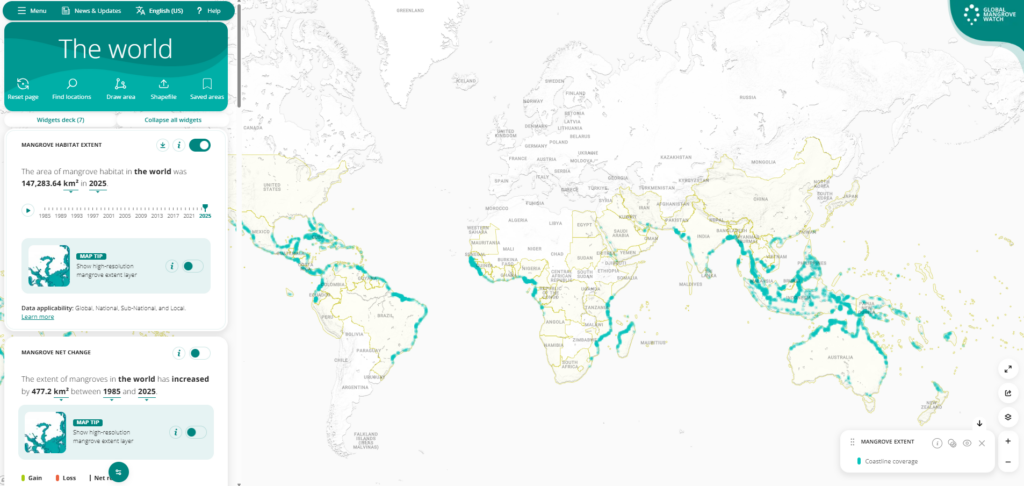
Underpinning this ecological renaissance is the evolution of advanced monitoring technology, most notably Global Mangrove Watch (GMW) version 4.1. This state-of-the-art mapping and monitoring platform has revolutionized humanity’s ability to track mangrove dynamics from space. By analyzing historical satellite data spanning four decades from 1985 to 2025, GMW v4.1 and corresponding studies in Science Magazine have mapped out a clear four-decade trajectory. The data illustrates a gradual deceleration in global mangrove loss that began in the late 20th century, followed by a definitive tipping point roughly a decade ago when net global coverage began to expand.
Lammert Hilarides, Global Mangrove Watch Programme Lead at Wetlands International, emphasized the transformative impact of these technological advancements. The unprecedented accuracy of the upgraded Global Mangrove Watch platform is reshaping how authorities and conservationists understand these ecosystems at both global and local levels, providing an unmatched alert system. This tool empowers stakeholders to plan restoration activities strategically and react to illegal clearing in real time, even within remote coastal regions previously beyond the reach of routine surveillance.

Despite the encouraging news of net territorial gains, environmental scientists urge caution against oversimplifying the data. A closer examination of the metrics reveals a nuanced reality: roughly 65% of recorded mangrove expansion is occurring in areas where mangroves have not traditionally grown. In many instances, these new forests are thriving on fresh sediment deposits washed down into coastal waters as a result of severe deforestation and soil erosion far inland. Furthermore, these nascent ecosystems cannot immediately replace the complex ecological functions of ancient, old-growth forests. It will take decades of undisturbed growth for new plantations to match the carbon sequestration capacities, complex biodiversity habitats, and robust flood-defense capabilities of the mature forests that continue to face degradation.
The 2026 report provides a clear-eyed assessment of where and why mangrove losses persist. While conservation successes are multiplying, destructive pressures remain active across multiple continents. Documented case studies within the report highlight direct environmental clearance driven by urban expansion in countries such as Guinea, India, Bahrain, and Bali. In Senegal, illegal timber cutting and commercial aquaculture continue to threaten local stands, while ill-planned mining operations in Mozambique have physically severed mangroves from their vital tidal connection to the ocean. In Nigeria, chronic oil pollution poisons fragile root systems. Meanwhile, insidious threats such as rising sea levels rarely act in isolation; their destructive impacts are severely magnified when combined with local land subsidence and upstream hydrological disturbances.
As the international community reaches the halfway point toward achieving the ambitious Global Mangrove Alliance 2030 Goals—which aim to halt further loss, double the protection of existing forests, and restore half of all degraded mangroves—the report turns its focus toward regional implementation. Through detailed case studies spanning Ghana, Brazil, Mexico, Qatar, Tanzania, and the Philippines, the document showcases how community-led restoration is driving tangible progress. Susanna Tol, Global Policy Officer for Deltas and Coasts at Wetlands International, noted that translating high-level climate commitments into effective national policies, sustained investment pathways, technical capacity, and robust local leadership is the ultimate key to success.
The implications of the State of the World’s Mangroves 2026 extend far beyond academic circles, offering a direct roadmap for global policymakers ahead of upcoming climate summits. Pieter van Eijk, Programme Head for Deltas and Coasts at Wetlands International, reflected on the decades of dedication required to reach this milestone, noting that a vast community of practitioners has worked tirelessly to turn the tide. As nations grapple with accelerating climate instability and catastrophic biodiversity loss, the protection, sustainable management, and active restoration of mangrove ecosystems emerge as immediate, cost-effective, and indispensable tools for securing a resilient future for both nature and humanity.
