
The global conservation community has issued a stark warning regarding the state of the planet’s inland waters and coastal ecosystems, emphasizing that current global strategies are failing to protect these critical habitats. Published ahead of the upcoming seventeenth meeting of the Conference of the Parties to the Convention on Biological Diversity (CBD COP17), a joint briefing paper from the six International Organization Partners (IOPs) of the Ramsar Convention on Wetlands—comprising BirdLife International, the International Water Management Institute (IWMI), the International Union for Conservation of Nature (IUCN), Wetlands International, the World Wide Fund for Nature (WWF), and the Wildfowl & Wetlands Trust (WWT)—outlines an urgent roadmap to prevent further ecological collapse.
The Global Review of the Kunming-Montreal Global Biodiversity Framework (KMGBF), which serves as the analytical foundation for the new briefing, highlights a troubling disparity between global ambitions and on-the-ground implementation. While various ecosystems have seen localized conservation gains, inland waters such as rivers, lakes, peatlands, and marshes, alongside coastal environments like mangroves, salt marshes, and seagrass beds, are lagging significantly behind. According to the conservation coalition, this deficit in ambition and targeted investment threatens not only the goals of the KMGBF but also global commitments to combat climate change and land degradation.
Main Facts and the Core Crisis Facing Global Wetlands
Wetlands cover a mere fraction of the Earth’s surface yet represent some of the most biologically diverse and functionally vital ecosystems on the planet. They act as natural infrastructure, providing essential services that sustain human populations and wildlife alike. These services include water purification, flood mitigation, coastal storm protection, and global carbon sequestration. Peatlands alone, for instance, store more carbon than all the world’s forests combined, making them indispensable in the fight against global warming.
Despite their irreplaceable value, wetlands have historically been subjected to severe degradation and conversion. Agricultural expansion, urban sprawl, industrial pollution, infrastructure development such as unsympathetic damming, and over-extraction of water resources have severely compromised the ecological integrity of these systems. The Global Review of the KMGBF indicates that without a dramatic pivot in policy and financial allocation, the international community will miss critical targets designed to halt and reverse biodiversity loss by the end of the decade.
The briefing paper produced by the Ramsar IOPs underscores that protecting and restoring wetlands is not merely an environmental option but a socioeconomic imperative. The coalition stresses that the fragmentation of environmental policy—where biodiversity, climate change, and desertification are addressed in isolation—has exacerbated the crisis. Consequently, the proposed framework calls for integrated governance that bridges the gaps between the Convention on Biological Diversity, the United Nations Framework Convention on Climate Change (UNFCCC), the United Nations Convention to Combat Desertification (UNCCD), and the Ramsar Convention itself.
Chronology and Context of the Kunming-Montreal Global Biodiversity Framework
To understand the urgency of the current intervention, it is necessary to examine the timeline of global biodiversity governance that led to CBD COP17.
The trajectory of modern biodiversity targets gained significant momentum in 2010 with the adoption of the Aichi Biodiversity Targets under the Convention on Biological Diversity in Nagoya, Japan. However, as the 2020 deadline for the Aichi Targets approached, a comprehensive global assessment revealed that virtually none of the targets had been fully met, largely due to insufficient financing, lack of political will, and weak accountability mechanisms.
Recognizing the escalating ecological emergency, negotiations commenced to forge a new, more robust global blueprint. This culminated in December 2022 at CBD COP15, held in Montreal, Canada, under the joint presidency of China and Canada. There, delegates adopted the historic Kunming-Montreal Global Biodiversity Framework. The KMGBF established four overarching goals for 2050 and 23 concrete targets for 2030, commonly referred to as the "30×30" target, which mandates the effective conservation and management of at least 30 percent of the world’s terrestrial, inland water, and coastal and marine areas by 2030.
Following COP15, the international community entered a critical implementation phase. Governments were tasked with updating their National Biodiversity Strategies and Action Plans (NBSAPs) to align with the KMGBF. However, initial reviews conducted ahead of subsequent meetings, including CBD COP16 and the preparations for CBD COP17, revealed systemic shortcomings. While terrestrial frameworks and protected areas received notable attention, inland waters and coastal zones remained critically underrepresented in revised national strategies. This oversight prompted the six Ramsar IOPs to draft their targeted briefing paper, aiming to refocus political attention on aquatic and coastal realms before the official proceedings of COP17 commence.
Supporting Data and Ecological Implications
The empirical evidence underpinning the IOP briefing underscores an escalating environmental emergency. According to assessments referenced by Wetlands International and the IUCN, the world has lost approximately 85 percent of its global wetlands since the pre-industrial era, with the rate of loss accelerating threefold compared to forests.

Furthermore, the Living Planet Report produced by WWF indicates an average decline of nearly 85 percent in monitored populations of freshwater vertebrate species since 1970—a rate of biodiversity loss far exceeding that of terrestrial or marine systems. This freshwater biodiversity crisis is symptomatic of widespread hydrological alteration. Over half of the world’s large rivers are now moderately to severely fragmented by dams and reservoirs, disrupting fish migrations, sediment transport, and the livelihoods of hundreds of millions of people who depend on river basins for food security and economic sustenance.
Economically, the degradation of coastal ecosystems such as mangroves and coral reefs exposes millions of coastal inhabitants to severe weather events and rising sea levels. The protective buffering capacity provided by these habitats represents billions of dollars in avoided damages from storm surges and erosion. When these ecosystems are degraded or destroyed, the economic toll on vulnerable coastal communities multiplies exponentially.
From a climate perspective, the continued drainage and degradation of peatlands release gigatons of greenhouse gases into the atmosphere annually, transforming vital carbon sinks into net carbon sources. This dynamic complicates national efforts to achieve net-zero emissions under the Paris Agreement. The data clearly demonstrates that failing to prioritize wetland restoration undermines climate mitigation and adaptation strategies, creating a feedback loop of ecological and economic vulnerability.
Official Responses and Strategic Recommendations
While formal state responses to the briefing paper will unfold during the negotiations at CBD COP17, environmental policymakers and international civil society organizations have welcomed the proactive stance of the Ramsar IOPs.
Representatives from BirdLife International and the WWT have emphasized that the seven core actions proposed in the briefing paper offer a pragmatic pathway for Contracting Parties to operationalize their commitments. The recommendations focus on several strategic imperatives:
First, governments are urged to explicitly integrate inland water and coastal ecosystem targets into their updated National Biodiversity Strategies and Action Plans. This requires breaking down institutional silos between water resource management and biodiversity conservation ministries.
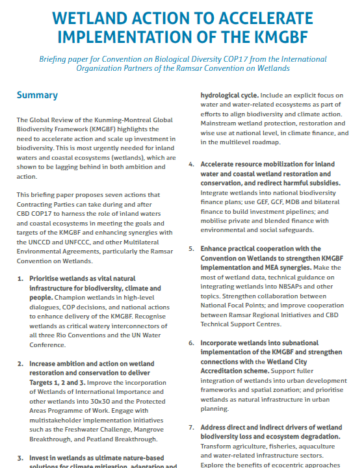
Second, the coalition calls for a massive scale-up of financial investments, directing domestic budgets and international climate and biodiversity finance toward wetland restoration. This includes redirecting environmentally harmful subsidies—such as those supporting unsustainable agricultural drainage and intensive water abstraction—toward incentive structures that reward conservation and sustainable management.
Third, the briefing stresses the importance of recognizing and integrating the rights and traditional knowledge of Indigenous Peoples and local communities. These groups often serve as the most effective stewards of wetland ecosystems, yet their tenure rights and customary management practices are frequently undermined by centralized development policies.
Fourth, the IOPs advocate for enhanced transboundary cooperation. Because major river systems and migratory flyways cross international borders, fragmented management often leads to over-exploitation and ecological decline. Strengthening transboundary river basin agreements is viewed as essential for maintaining ecological flows and sustaining shared resources.
Fifth, the paper highlights the necessity of robust monitoring frameworks. Contracting Parties must improve data collection and reporting mechanisms to track the ecological health of wetlands accurately, ensuring accountability and adaptive management over the course of the decade.
Sixth, the coalition calls for enhanced synergies between the Rio Conventions (CBD, UNFCCC, and UNCCD). By aligning national reporting and implementation strategies across these three treaties, governments can maximize resource efficiency and co-benefits for climate resilience, land restoration, and biodiversity conservation.
Finally, the IOPs urge parties to leverage the Ramsar Convention on Wetlands as the principal global mechanism and expert authority for guiding policy and action in these critical ecosystems.
Broader Impact and Long-Term Outlook
The release of the briefing paper by BirdLife International, IWMI, IUCN, Wetlands International, WWF, and WWT marks a critical juncture in global environmental diplomacy. As delegates prepare for CBD COP17, the international community faces a definitive test of its resolve to move from rhetorical commitments to measurable, transformative action.
The implications extend far beyond conservation circles. Water security, agricultural productivity, climate resilience, and economic stability are all inextricably linked to the health of the world’s inland waters and coastal zones. If governments fail to heed the warnings and recommendations outlined in the review of the Kunming-Montreal Global Biodiversity Framework, the degradation of these ecosystems will continue to erode the foundations of sustainable development.
Conversely, embracing the proposed seven-action framework offers a unique opportunity to address multiple global crises simultaneously. By restoring rivers, safeguarding peatlands, and revitalizing coastal mangroves, nations can simultaneously curb biodiversity loss, mitigate climate change, and secure the vital ecosystem services upon which human survival depends. The deliberations at CBD COP17 will ultimately determine whether the international community possesses the political will and financial capacity to reverse the decline of the planet’s most dynamic and threatened habitats before it is too late.
