
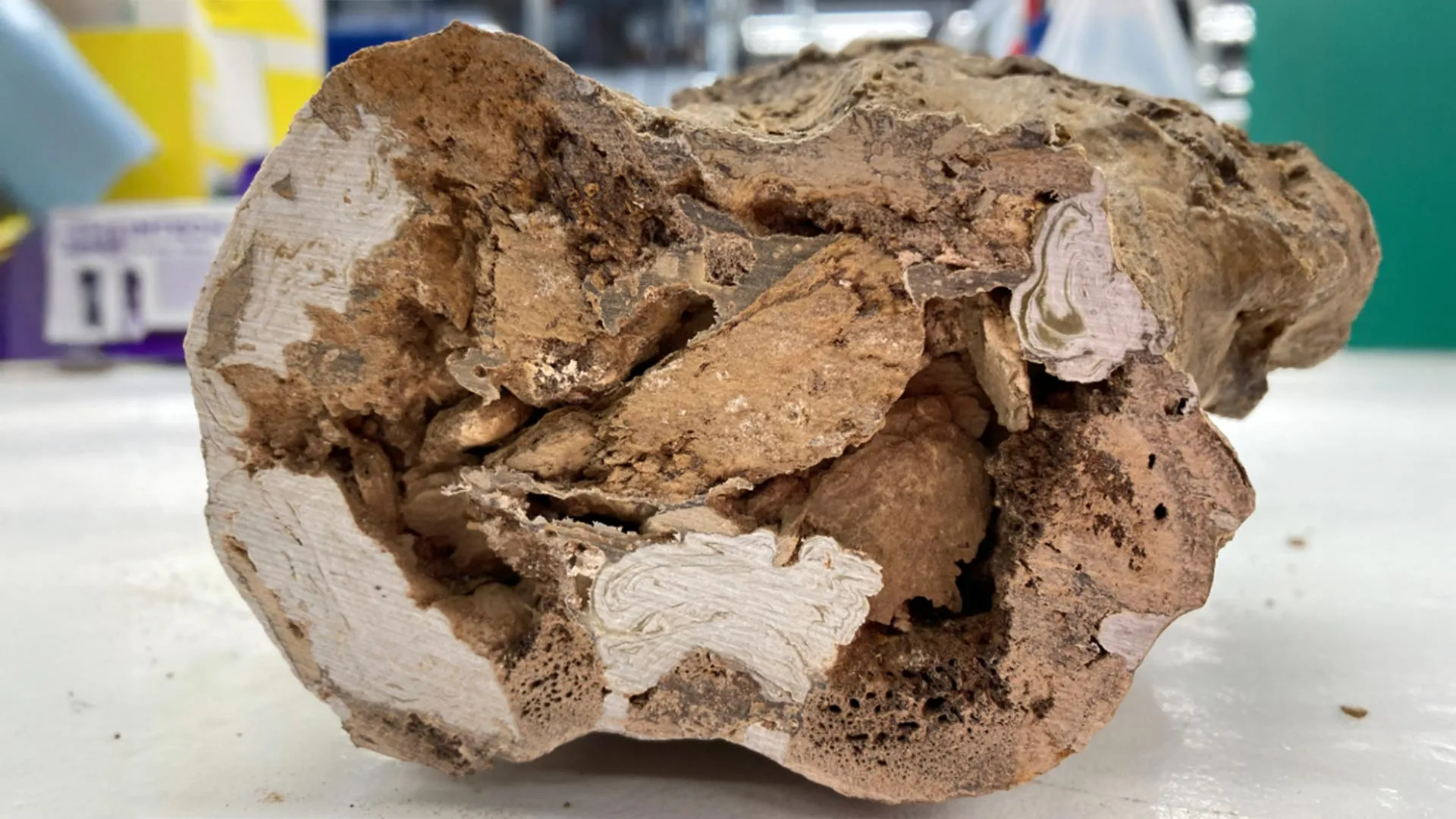
For decades, scientists believed dinosaur fossils were little more than mineralized rock, with any original biological material long since destroyed by the immense pressures and chemical processes of time. This long-held scientific consensus, a foundational pillar of paleontology, dictated that any soft tissues, proteins, or other complex organic molecules would have degraded completely over tens of millions of years. However, an extraordinary new study, centered on a remarkably preserved Edmontosaurus fossil, is profoundly challenging this assumption, providing robust evidence that traces of original organic molecules, including collagen, can indeed survive inside dinosaur bones for geological timescales. This discovery adds powerful and meticulously verified new support to a controversial idea that has divided paleontologists for more than 30 years, heralding a potential paradigm shift in how we understand and study extinct life.
Researchers, led by a collaborative team from the University of Liverpool and UCLA, have meticulously uncovered compelling evidence suggesting that endogenous organic molecules persist within dinosaur bones dating back approximately 66 million years. The findings, published in 2025 in the esteemed journal Analytical Chemistry under the title "Evidence for Endogenous Collagen in Edmontosaurus Fossil Bone," represent a significant leap forward in biomolecular paleontology. The implications are vast, suggesting that fossils, far from being mere mineralized casts, could serve as molecular time capsules, preserving invaluable biological information that could revolutionize our understanding of dinosaur physiology, evolution, and even their diseases.
A Paradigm Shift in Paleontology: Unveiling Ancient Biomolecules
The traditional view of fossilization has long been rooted in the understanding that organic materials, particularly complex proteins, are highly unstable and prone to rapid degradation. The extreme conditions of deep burial, coupled with geological time, were thought to ensure the complete replacement of original tissues by minerals, leaving behind only the mineralized blueprint of the organism. This conventional wisdom, while robust for many aspects of fossil preservation, left little room for the survival of intricate biomolecules like collagen. The idea that soft tissues or original proteins could persist for millions of years was often met with skepticism, sometimes even outright dismissal, within the scientific community.
The current study directly confronts this established dogma. By employing a suite of advanced analytical techniques, the research team has presented a multi-faceted line of evidence that makes a compelling case for the presence of authentic dinosaurian collagen. This isn’t just about finding any organic material, which could easily be attributed to microbial contamination or environmental residues. Instead, it’s about identifying specific, complex proteins characteristic of the original animal’s tissues, in a context that meticulously rules out alternative explanations.
The Edmontosaurus Sacrum: A Window into the Cretaceous
At the heart of this groundbreaking investigation lies a 22-kilogram Edmontosaurus sacrum, a critical part of the dinosaur’s hip region, meticulously recovered from South Dakota’s renowned Hell Creek Formation. The Hell Creek Formation is a geological treasure trove, famous globally for its exceptionally preserved fossils that offer a vivid snapshot of the very end of the Cretaceous Period, just before the catastrophic K-Pg extinction event. This formation has yielded countless specimens, including some of the most iconic dinosaurs like Tyrannosaurus rex and Triceratops, which coexisted with Edmontosaurus.
Edmontosaurus, a genus of large, duck-billed hadrosaur, was a prevalent herbivore of the Late Cretaceous of North America. These impressive plant-eaters, known for their distinctive dental batteries designed for grinding tough vegetation, could reach lengths of up to 13 meters and weigh several tons. Their fossils, particularly those from the Hell Creek Formation, have occasionally displayed remarkably detailed preservation, including skin impressions and other soft tissue features, earning some specimens the evocative nickname "dinosaur mummies." This existing reputation for exceptional preservation in Edmontosaurus specimens lends further credence to the possibility of biomolecular survival, as the conditions conducive to macroscopic soft tissue preservation might also favor microscopic molecular preservation.
Rigorous Science: Multi-Method Validation of Collagen’s Presence
The strength of this new research lies in its rigorous, multi-pronged approach to analysis. The scientists did not rely on a single technique but rather a combination of advanced laboratory methods to examine the same fossil, thereby building a robust case and systematically addressing potential sources of error or contamination.
- Advanced Spectrometry and Sequencing Confirmations: Key among these methods were protein sequencing and several forms of mass spectrometry. Mass spectrometry, a highly sensitive analytical technique, measures the mass-to-charge ratio of ions to identify the molecular composition and structure of a sample. By employing different variants of mass spectrometry, the researchers could detect and characterize peptide fragments—short chains of amino acids—that are diagnostic of collagen. Protein sequencing then allowed them to determine the precise order of amino acids within these fragments, offering a molecular fingerprint that could be compared against known collagen sequences. This high-resolution analysis provides specificity, distinguishing ancient collagen from general organic debris or microbial contamination.
- The Indispensable Role of Collagen and Hydroxyproline: Collagen is the most abundant structural protein in animals, forming the primary framework of connective tissues like bone, skin, tendons, and cartilage. Its ubiquitous presence and distinctive molecular structure make it an ideal target for investigating ancient protein survival. Crucially, the team from UCLA further identified hydroxyproline, an amino acid that is rarely found in significant quantities outside of collagen. Hydroxyproline is formed by the post-translational modification of proline residues within collagen and elastin, making its detection an exceptionally strong indicator of the presence of genuine collagen. According to the research team, this represented a vital confirmation that degraded collagen fragments were truly present inside the fossil, not merely a misidentification or contamination. The combination of protein sequencing and the detection of hydroxyproline offers a compelling molecular signature that is difficult to explain away as anything other than authentic, degraded dinosaur collagen.
Professor Steve Taylor, chair of the Mass Spectrometry Research Group at the University of Liverpool’s Department of Electrical Engineering & Electronics, underscored the definitive nature of their findings: "This research shows beyond doubt that organic biomolecules, such as proteins like collagen, appear to be present in some fossils. Our results have far-reaching implications. Firstly, it refutes the hypothesis that any organics found in fossils must result from contamination." This statement directly addresses the core criticism leveled against previous claims of ancient protein survival.
Decades of Debate: From Skepticism to Scientific Acceptance
Claims of preserved soft tissues and proteins in dinosaur fossils have been a flashpoint in paleontology since the early 2000s, igniting fierce debate and intense scrutiny. Before this period, the concept was largely considered scientifically implausible.
- Mary Schweitzer’s Pioneering Work and Subsequent Challenges: The most famous and influential discovery came in 2005, when paleontologist Mary Schweitzer and her colleagues at North Carolina State University reported finding what appeared to be flexible soft tissue structures, including possible blood vessels and osteocytes (bone cells), inside the femur of a Tyrannosaurus rex fossil recovered from the Hell Creek Formation. This finding was revolutionary and met with significant skepticism. Many scientists argued that the reported materials were either modern contamination, bacterial biofilms mimicking ancient structures, or unique mineral formations. Subsequent studies by Schweitzer’s team and others identified possible collagen and additional blood vessel-like structures in other dinosaur specimens, including hadrosaurs related to Edmontosaurus. These repeated observations, while tantalizing, continued to fuel the debate, with critics demanding ever more rigorous proof to rule out contamination and taphonomic artifacts.
- The Scientific Community’s Evolving Perspective: The scientific community, rightfully cautious, required definitive evidence that these molecular traces were truly endogenous to the dinosaur and not later introductions. The new Edmontosaurus analysis stands out precisely because researchers used multiple independent testing methods to examine the same fossil material. By combining sophisticated microscopy techniques to visualize structures, detailed chemical analysis to identify molecular components, and high-resolution protein sequencing to confirm their identity, the team aimed to systematically rule out contamination and strengthen the case that the molecules were original to the dinosaur itself. This comprehensive approach directly addresses the criticisms of earlier studies and provides a level of certainty that has been elusive until now. The collaborative effort between institutions like the University of Liverpool, with its expertise in mass spectrometry, and UCLA, with its biochemical insights, exemplifies the interdisciplinary rigor required to tackle such a complex and contentious scientific question.
Profound Implications: Rewriting the Paleontological Narrative
The validation of endogenous protein survival in dinosaur fossils carries profound implications across multiple scientific disciplines, promising to rewrite significant portions of the paleontological narrative.
- Unlocking Evolutionary Relationships and Physiological Secrets: If proteins can indeed survive in fossils for tens of millions of years, scientists may gain an entirely new and unprecedented way to study extinct animals. Molecular data, particularly from proteins, offers a level of resolution in understanding evolutionary relationships that skeletal morphology alone cannot provide. Just as DNA sequencing has revolutionized the study of extant species, protein sequencing from ancient fossils could potentially reveal precise evolutionary connections between dinosaur species that are currently difficult to identify from bones alone. Beyond phylogeny, these molecular traces could also unlock deeper insights into dinosaur biology, shedding light on aspects such as their growth rates, metabolic processes, aging patterns, physiological adaptations, and even the diseases they suffered. For instance, specific collagen types or their modifications can indicate bone health, developmental stages, or responses to environmental stress.
- Re-examining Legacy Fossil Collections: Professor Taylor highlighted another exciting implication: scientists may now need to revisit fossil samples collected over the past century. Cross-polarized light microscopy images, taken decades ago for basic anatomical studies, could contain overlooked evidence of preserved collagen within ancient bones. "These images may reveal intact patches of bone collagen, potentially offering a ready-made trove of fossil candidates for further protein analysis," Taylor explained. This suggests a vast, untapped resource of molecular information potentially awaiting discovery in museum collections worldwide. Re-analyzing these historical specimens with modern techniques could unlock new insights into dinosaurs, for example, revealing previously unknown connections between dinosaur species or providing molecular evidence for aspects of their biology that were previously only inferred from skeletal remains.
The Enigma of Molecular Preservation: How Proteins Endure Geologic Time
The discovery also raises one of the most fascinating scientific questions: how did these complex, fragile molecules survive for so long? Proteins normally break down relatively quickly through hydrolysis and other chemical reactions, especially across geological timescales. Yet, some fossils appear capable of preserving microscopic biological structures under specific, albeit rare, conditions.
- Taphonomic Conditions and Mineral Shielding: Scientists are increasingly investigating the intricate taphonomic processes—the processes of decay, burial, and fossilization—that might enable such extraordinary preservation. One leading hypothesis explores whether mineral interactions inside bone may play a crucial role in shielding fragments of collagen from complete decay. The intricate mineral matrix of bone, primarily composed of hydroxyapatite, might encapsulate and protect protein molecules, effectively creating a microenvironment that slows down chemical degradation. Recent studies exploring fossil biomolecules suggest that certain burial environments—such as rapid burial in anoxic (oxygen-depleted) sediments, or environments rich in specific minerals like iron—and the microscopic structure of bone itself may create stable conditions that dramatically slow chemical breakdown. Iron, for instance, is known to cross-link and stabilize organic molecules, potentially acting as a preservative.
- The Case of Edmontosaurus: A Legacy of Exceptional Preservation: Edmontosaurus fossils are already famous for their exceptional preservation. As noted, some specimens discovered over the last century have retained detailed skin impressions, muscle attachments, and other soft tissue features, a testament to the unique taphonomic conditions they experienced. More recent paleontology research has continued uncovering surprisingly detailed soft tissue preservation in Edmontosaurus specimens, including evidence of fleshy structures and preserved skin anatomy. These macroscopic observations reinforce the idea that Edmontosaurus could be an ideal candidate for biomolecular preservation, as the conditions that preserve large-scale soft tissues might also extend to the molecular level.
Beyond Bones: Fossils as Molecular Time Capsules
Together, these discoveries are reshaping how scientists think about fossils. Instead of viewing them solely as inert, stone replicas of ancient bones, researchers are beginning to see some fossils as possible molecular time capsules. These capsules are not just preserving the macroscopic forms of prehistoric life but also, in rare and exceptional circumstances, the microscopic biological structures and even the molecular machinery that once powered them millions of years later.
This new perspective opens up exciting avenues for interdisciplinary research, bridging paleontology, biochemistry, geochemistry, and even astrobiology. The mechanisms by which biomolecules can persist over geological time on Earth could offer insights into the potential for detecting biosignatures on other planets, particularly in the search for ancient or extinct life beyond our world. The journey from initial skepticism to rigorous scientific validation has been long and challenging, but the persistent efforts of dedicated researchers have now firmly placed the study of ancient biomolecules at the forefront of paleontological inquiry. The Edmontosaurus collagen discovery represents not just a confirmation of a controversial idea, but a powerful mandate for a new era of molecular paleontology, where the secrets of ancient life are unlocked not only from their fossilized forms but also from their enduring molecular echoes.
