
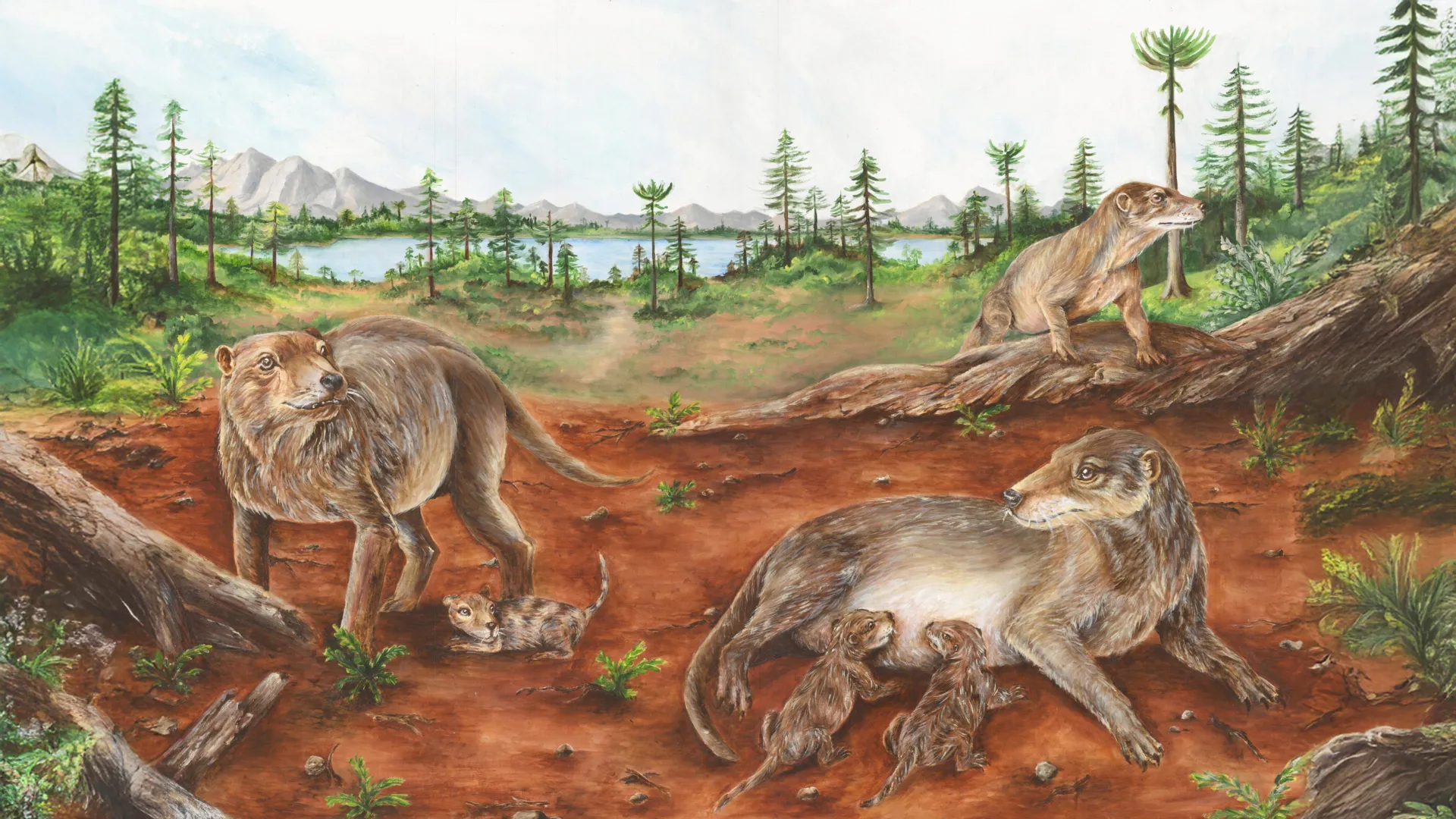
Pioneering research published in the journal Frontiers in Mammal Science has fundamentally shifted our understanding of mammalian evolution, revealing that the origins of live birth may stretch tens of millions of years further back into the prehistoric past than previously acknowledged. For generations, evolutionary biologists and paleontologists operated under the long-standing consensus that viviparity—the biological mechanism of giving birth to live young rather than laying eggs—was a relatively late adaptation within the mammalian lineage. However, a comprehensive microscopic analysis of fossilized skeletal remains has introduced compelling evidence suggesting that at least some ancient cynodonts bypassed the traditional egg-laying habits of their contemporaries and instead carried their developing offspring internally.
The focal point of this breakthrough is Chiniquodon theotonicus, an advanced therapsid cynodont that roamed the Earth approximately 236 million years ago during the Triassic period. According to the study’s lead author, Dr. Leandro Gaetano, a paleontologist affiliated with the National Scientific and Technical Research Council (CONICET) in Argentina, this discovery establishes that live birth was present in at least one key mammalian ancestor far earlier than scientific models had predicted. By identifying distinct physiological markers within the bone structure of C. theotonicus, the research team has calculated that the timeline for the emergence of viviparity among early cynodonts must be pushed back by an estimated 95 to 90 million years. This finding not only illuminates the reproductive strategies of ancient fauna but also challenges foundational assumptions regarding how prehistoric ecosystems functioned and how ancestral species adapted to severe environmental pressures.
The Triassic Landscape: Environmental Pressures and Evolutionary Adaptations
To fully grasp the magnitude of this discovery, researchers emphasize the necessity of examining the harsh ecological backdrop of the Triassic period. This geological epoch followed immediately in the wake of the Permian-Triassic extinction event—colloquially known as the Great Dying—which wiped out over 95 percent of marine species and roughly 70 percent of terrestrial vertebrate species. The recovery and restructuring of terrestrial ecosystems during the early and middle Triassic required surviving lineages to adapt rapidly to newly volatile environments characterized by intense competition for dwindling resources and relentless predatory pressures.
Dr. Adriana Mancuso, a senior author on the study and a CONICET researcher specializing in the evolution of terrestrial ecosystems, points out that the climate during this era was increasingly marked by extreme aridity and strong seasonality. In such unforgiving conditions, the traditional strategy of laying vulnerable, external eggs presented severe survival liabilities. Eggs left in nests were highly susceptible to dehydration, temperature fluctuations, and opportunistic predators. Conversely, embryos of viviparous species enjoyed a sheltered, highly regulated internal environment that provided superior protection during critical stages of early development.
This environmental adversity likely catalyzed evolutionary innovations that favored internal gestation. While previous scientific consensus maintained that the energetic costs of viviparity would have been too prohibitive for animals of that evolutionary grade, the new data suggest that the survival advantages of internal incubation heavily outweighed the physiological burdens, acting as a crucial catalyst for early mammalian evolution.
Unlocking the Fossil Record: A Novel Methodological Approach
For decades, the reproductive habits of prehistoric synapsids remained categorized as an inscrutable mystery. Because soft tissues and embryonic remains rarely fossilize, researchers attempting to reconstruct the reproductive history of extinct lineages faced seemingly insurmountable obstacles. Traditional paleontological techniques offered little insight into whether animals like cynodonts laid eggs or bore live young, leaving a critical gap in the evolutionary narrative connecting non-mammalian amniotes to true mammals.
The breakthrough occurred almost by accident during an advanced postgraduate training course when investigators observed an unusual, highly specific growth mark embedded within the microscopic lamellar structure of a fully grown C. theotonicus fossil excavated from the fossil-rich deposits of northwestern Argentina. Upon closer examination and extensive cross-referencing with the histology of living vertebrate taxa, the research team identified the feature as a definitive neonatal line.
Neonatal lines are microscopic growth rings that manifest within bones and dental tissue in direct response to the massive physiological shock and subsequent acceleration of metabolic and skeletal growth that occurs immediately following birth. When an organism transitions from the protected, stable environment of internal gestation—or hatches from an egg—to the independent challenges of the external world, its biological systems undergo a sharp, measurable shift. By isolating this structural marker, the researchers realized they had secured a direct, physical proxy for neonatal development preserved across more than two centuries of geological time.
Comparative Anatomy: Establishing the Newborn-to-Adult Mass Ratio
To rigorously test their hypothesis and rule out alternative explanations for the neonatal line, the research team devised an ingenious comparative framework. They calculated the estimated body mass of the specific C. theotonicus specimen at two crucial life-history stages: at the time of birth, as indicated by the dimensions of the neonatal ring, and at the time of death, as determined by the external surface dimensions of the fully grown skeletal elements.
The mathematical reconstructions yielded astonishing figures. The researchers calculated that the individual weighed approximately 1.7 kilograms at birth and grew to a mature adult mass of roughly 12 kilograms. This establishes a neonate-to-adult body mass ratio of approximately 14 percent. In practical terms, this means the newborn C. theotonicus constituted nearly one-seventh of its eventual adult size at the moment it entered the world.
To contextualize these proportions, the research team conducted a comprehensive comparative analysis utilizing extensive datasets encompassing thousands of extant mammals, non-avian reptiles, and birds within equivalent adult weight brackets. The results highlighted a stark dichotomy between the reproductive outputs of amniote classes:
- Reptilian Reproductive Patterns: Extant reptiles of comparable adult sizes—such as large snakes, monitor lizards, and crocodilians scaling between 8 kilograms and 14.5 kilograms—produce remarkably diminutive offspring. Hatchlings from these species typically weigh between 9 grams and 53 grams, yielding extremely low neonate-to-adult body mass ratios ranging from 0.1 percent to 0.6 percent.
- Avian Reproductive Patterns: Similarly, birds spanning adult weights between 8 kilograms and 21.5 kilograms—including various species of cranes, pelicans, and vultures—exhibit relatively small hatchling-to-adult proportions. Their young generally range from 110 grams to 357 grams, translating to body mass ratios of approximately 1.3 percent to 4.5 percent.
- Mammalian Reproductive Patterns: In sharp contrast, modern placental mammals sharing the 8-kilogram to 15-kilogram adult weight bracket routinely invest heavily in fewer, significantly larger offspring. Neonates within this group range from 35.5 grams to a robust 1.87 kilograms, with mass ratios soaring as high as 18.77 percent. A prime example is the bay duiker antelope, which routinely gives birth to single calves that match the estimated birth weight of the ancient C. theotonicus specimen.
By systematically excluding non-placental mammals—such as monotremes that lay eggs and marsupials that produce extremely underdeveloped young before transferring them to external pouches—the researchers demonstrated that the fossil cynodont aligned exclusively with the reproductive metrics characteristic of modern placental mammals. Co-author María Miceli Baro, a graduate student at the University of Buenos Aires, emphasized the significance of this alignment: embryonic tissues had never before been observed in cynodonts, making the identification of a mammalian-style neonatal line a watershed moment for paleo-histology.
Broader Scientific Implications and Future Research Directions
The implications of this discovery extend far beyond the taxonomy of a single Triassic species. Live birth has traditionally been viewed as a relatively recent, highly specialized milestone achieved late in the mammalian transition. By demonstrating that a robust, high-investment reproductive strategy was already operational 236 million years ago, the study forces evolutionary biologists to reconsider the chronological appearance of complex physiological traits.
Furthermore, this finding opens up the distinct possibility that C. theotonicus was not an evolutionary anomaly, but rather representative of a broader, systemic shift across the cynodont clade. If viviparity was already established at this early stage, it suggests that other sophisticated biological adaptations commonly associated with true mammals—such as specialized lactation, endothermy (warm-bloodedness), and complex social behaviors—may have also evolved much earlier than current fossil records explicitly demonstrate.
Despite the strength of the histological and comparative data, the research team maintains a measured, scientifically rigorous stance regarding the universality of their findings across all cynodont lineages. Dr. Gaetano noted that while the discovery points toward a widespread transition from egg-laying to live birth early in the mammalian stem lineage, additional fossil discoveries and microscopic analyses will be required to definitively confirm how widespread viviparity was among contemporaneous therapsids.
As paleontologists continue to re-examine existing museum collections with advanced imaging and histological techniques, the prehistoric landscape continues to yield secrets that bridge the gap between ancient reptilian ancestors and the modern mammalian world. The revelation that Chiniquodon theotonicus carried its young through a prolonged internal gestation period fundamentally enriches our comprehension of deep evolutionary history, proving that the fundamental traits defining modern life on Earth took root in a world vastly older and more complex than previously imagined.
