
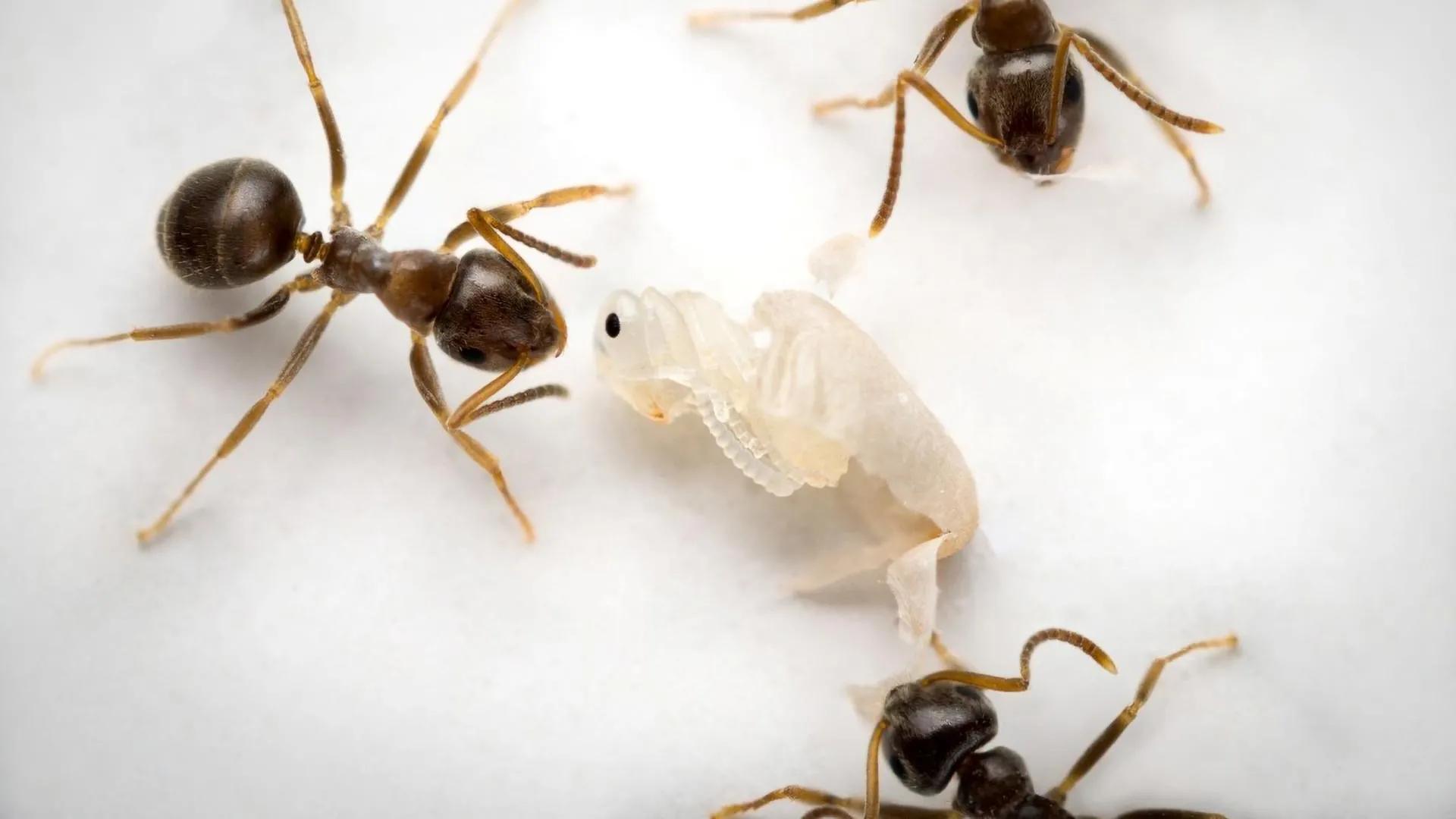
Ant societies behave like tightly integrated "superorganisms," where thousands of individuals work together in a way that profoundly resembles the coordinated activity of cells within a single biological body. This complex organization is now understood to extend to disease management, as researchers at the Institute of Science and Technology Austria (ISTA) have uncovered a remarkable mechanism: terminally ill ant brood release a distinctive odor, akin to the distress signals sent by infected cells in a multicellular organism. This specific scent acts as a crucial early alert, enabling the colony to swiftly detect and eliminate infections before they can spread and devastate the entire population. The groundbreaking findings, which shed new light on the intricate world of social immunity and the evolution of altruism, were recently published in the esteemed scientific journal Nature Communications.
The Unveiling of a Colony’s Self-Preservation Mechanism
While many social animals exhibit behaviors designed to conceal illness to avoid being ostracized or harmed by their group, ant pupae demonstrate a starkly different and highly evolved strategy. When confronting an infection that proves fatal, these developing ants do not hide their plight. Instead, they actively produce a chemical alarm, a potent warning signal that alerts their nestmates to the grave danger they represent to the collective. This remarkable form of communication underscores the extreme cooperative ethos inherent in ant colonies, where individual sacrifice often serves the greater good of the superorganism.
Upon detecting this urgent chemical signal, worker ants initiate a rapid and precise response. They meticulously open the infected pupa’s cocoon, create small, deliberate cuts in its outer surface, and then apply formic acid. This powerful natural antimicrobial compound, which the workers produce themselves, is highly effective at neutralizing the pathogens proliferating within the pupa. While this treatment successfully eradicates the infectious agents, it also, by necessity, results in the pupa’s death. It is a harsh but effective measure, prioritizing colony survival over individual life.
Dr. Erika Dawson, the study’s first author and a former postdoc in the Social Immunity research group led by Professor Sylvia Cremer at ISTA, offers critical insight into this seemingly paradoxical behavior. "What appears to be self-sacrifice at first glance is, in fact, also beneficial to the signaler: it safeguards its nestmates, with whom it shares many genes," Dawson explains. This statement highlights the principle of kin selection, a cornerstone of evolutionary biology. By warning the colony of their deadly infection, terminally ill ants contribute to the colony’s overall health and its ability to produce new daughter colonies. This indirect propagation of the signaler’s genes to the next generation illustrates a profound evolutionary trade-off, where the individual’s demise ensures the perpetuation of its shared genetic material through its relatives.
The research, conducted in collaboration with chemical ecologist Dr. Thomas Schmitt from the University of Würzburg in Germany, marks the first time such an altruistic disease signaling mechanism has been meticulously documented in social insects. Without such a sophisticated early warning system, a dying ant could easily become a highly infectious biohazard, posing an existential threat to the entire colony. By signaling their dire condition early, the incurably ill make it possible for the colony to neutralize the threat before it escalates into a widespread epidemic, thereby protecting the genetic legacy of the group.
The Superorganism Concept: A Deeper Dive into Collective Intelligence
The concept of the "superorganism" is central to understanding the extraordinary social structures of ants, bees, and termites. Coined by the American myrmecologist William Morton Wheeler in 1911 and later popularized by biologists like E.O. Wilson, this term describes a group of individuals that function as a cohesive unit, exhibiting behaviors and characteristics that emerge at the collective level, much like a single organism. In an ant colony, the division of labor is highly specialized: a queen dedicates herself primarily to reproduction, laying eggs to ensure the continuity of the lineage. Worker ants, typically sterile females, manage every other essential task, from foraging for food, maintaining the nest structure, defending against predators, and crucially, providing healthcare for their kin.
This intricate division of labor within an ant colony draws striking parallels to the organization of cells within a multicellular organism. In a human body, for instance, reproductive cells (gametes) are responsible for generating offspring, while somatic cells perform all other daily biological tasks necessary for the individual’s survival and function. Both biological organisms and superorganisms rely on the close and highly coordinated cooperation of their reproductive and non-reproductive components. In ants, this cooperation is so extensive that it encompasses behaviors that directly benefit the colony, even at a severe cost to the individual. The sacrifice of fatally infected brood is a prime example of this extreme form of altruism, demonstrating how deeply ingrained the collective good is within their evolutionary programming.
The evolutionary underpinnings of such altruistic behaviors are largely explained by kin selection theory, first formalized by W.D. Hamilton. Hamilton’s Rule (rB > C) posits that altruistic genes can spread in a population if the benefit (B) to the recipient, weighted by the degree of genetic relatedness (r) between the altruist and recipient, outweighs the cost (C) to the altruist. In highly related ant colonies, where worker sisters share a significant proportion of their genes, sacrificing an infected individual to save thousands of genetically similar nestmates is a highly adaptive strategy for ensuring the propagation of shared genes. This fundamental principle helps explain why such seemingly self-destructive actions have evolved and persist.
The Critical Need for an Early Warning System
A natural and pertinent question arises: why have ants evolved such a sophisticated chemical alarm system if sick individuals can simply remove themselves from the colony? Professor Cremer clarifies that adult ants approaching death often practice "thanatosis" or necrophoresis – they leave the nest to die outside the colony, thus minimizing the risk of contagion. Similarly, workers exposed to fungal spores are known to practice a form of social distancing, moving away from the high-traffic areas of the nest. However, this option of self-removal is simply unavailable to ant brood. Developing pupae are immobile and entirely dependent on the care of worker ants, making them analogous to infected cells within a body that cannot independently eliminate themselves.
Like infected cells in a multicellular organism, ant pupae require external assistance to mitigate the threat they pose. Developing pupae and body cells face remarkably similar challenges regarding infection and have evolved analogous strategies to address them. Both release specific chemical cues that attract external helpers – immune cells in the case of a body, or worker ants in the case of a colony. These helpers then proceed to remove the potential source of infection. Immunologists refer to this crucial cellular communication as the "find-me and eat-me signal," a mechanism by which apoptotic (dying) cells advertise their presence to phagocytes for swift removal, preventing inflammation and further damage. The discovery in ants provides a fascinating macro-level parallel to this fundamental biological process.
"The signal must be both sensitive and specific," Cremer emphasizes, highlighting the delicate balance required for such an alarm system to be effective. "It should help to identify all terminally-sick ant pupae but be precise enough to avoid triggering the unpacking of healthy pupae or those capable of overcoming the infection with their own immune system." This raises a critical question about the mechanisms underlying such precision – how do worker ants differentiate between a pupa needing removal and one that is merely stressed or capable of recovery?
Decoding the Chemical Language of Distress
Dr. Thomas Schmitt, whose extensive work focuses on chemical communication in social insects, provided crucial insights into how this precision is achieved. He observed that worker ants are capable of targeting a single sick pupa amidst a multitude of healthy ones. This precision implies that the alarm scent cannot simply diffuse through the nest chamber as a generalized airborne warning. Instead, the signal must be directly and specifically associated with the diseased pupa. Accordingly, the research revealed that the signal does not consist of highly volatile compounds that easily disperse, but rather of non-volatile compounds present on the pupal body surface. This ensures that the message is localized and provides a clear "address" for the workers to act upon.
The study identified that two specific components of the ants’ natural scent profile become significantly stronger and more pronounced when a pupa is fatally infected. To rigorously test whether this shift in odor alone was sufficient to trigger the disinfection response from worker ants, researchers conducted a series of elegant experiments. They extracted the altered scent profile from signaling pupae and carefully transferred it to the surface of healthy pupae, subsequently monitoring the behavioral responses of the worker ants.
"We extracted the smell from the signaling pupae and applied it to healthy brood," Cremer recounts. The results were conclusive: the presence of this altered scent alone was sufficient to induce workers to unpack the treated pupae and initiate the disinfection process, even though the pupae themselves were perfectly healthy. This compelling evidence unequivocally demonstrated that the altered odor of terminally infected brood functions in precisely the same way as the "find-me and eat-me" signal observed in infected body cells, guiding the collective immune response of the colony.
Strategic Signaling: Who Warns and When?
Further investigations by Dawson revealed another layer of complexity and strategic optimization within this altruistic signaling system: not all brood send this alarm signal. "Queen pupae, which have stronger immune defenses than worker pupae and can limit the infection on their own, were not observed to emit this warning signal to the colony," she explains. This crucial distinction highlights a sophisticated risk assessment at the individual level. Queen pupae, being reproductively vital and possessing robust immune capabilities, are deemed capable of self-recovery and thus do not trigger an alarm that would lead to their premature demise. Worker pupae, however, lacking this inherent ability to control severe infections, consistently signaled for help, indicating their terminal condition.
By signaling only when an infection is genuinely uncontrollable and poses an unavoidable threat, the brood ensure that the colony responds exclusively to bona fide dangers. This precision prevents the unnecessary loss of individuals that might otherwise be capable of recovery, conserving the colony’s resources and genetic investment. Cremer concludes, "This precise coordination between the individual and colony level is what makes this altruistic disease signaling so effective." It is a testament to the evolutionary pressures that have sculpted such refined communication and self-sacrifice for the ultimate benefit of the collective.
Broader Implications and Future Avenues
The discovery of altruistic disease signaling in ant colonies carries profound implications across several scientific disciplines. From an evolutionary perspective, it significantly enriches our understanding of social evolution, reinforcing theories of kin selection and the emergence of complex cooperative behaviors in highly social species. It underscores how sophisticated mechanisms evolve to manage disease in dense populations, a challenge faced by all social organisms, including humans.
The parallels drawn between cellular distress signals in individual organisms and colony-level communication in superorganisms open new avenues for interdisciplinary research. It suggests that fundamental principles of biological organization and communication may manifest across vastly different scales of life, from microscopic cells to sprawling insect colonies. This cross-scale understanding could inspire novel approaches in fields such as biomimicry, where engineers and scientists seek to emulate biological designs and processes to solve human problems. For instance, the ants’ early warning system could potentially inform the development of highly sensitive and specific biosensors for early disease detection in other contexts.
Furthermore, these findings contribute significantly to the field of disease ecology, offering insights into the natural control of pathogen transmission within social insect populations. Understanding these intricate defense mechanisms is crucial for comprehending ecosystem health and could even have implications for pest management strategies, by better understanding the vulnerabilities and strengths of ant colonies.
The research conducted at ISTA, in collaboration with the University of Würzburg, exemplifies the power of rigorous, interdisciplinary scientific inquiry. As the original article notes, to better understand fundamental biological processes, such as those in behavioral biology, immunology, or genetics, research involving animals is essential. No other methods, including in silico approaches, can fully replace these studies. All animals used in these experiments are collected, reared, and handled according to strict legal regulations, ensuring ethical scientific practice. This commitment to both discovery and ethical conduct underscores the high standards applied to unraveling the complex mysteries of the natural world, paving the way for future breakthroughs that deepen our appreciation for life’s intricate dance of cooperation and survival.
