
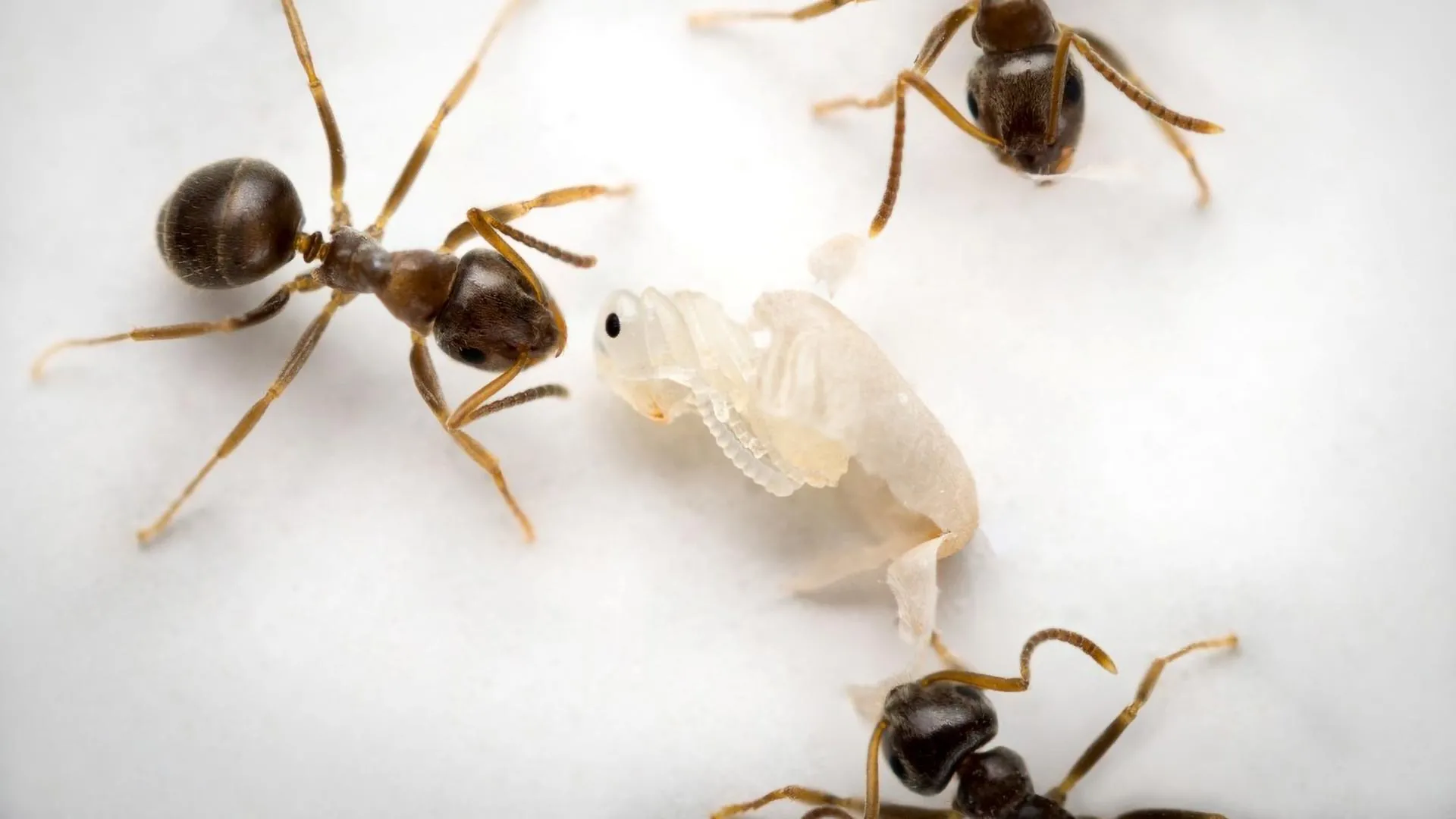
Ant colonies, long recognized for their intricate social structures, are now understood to function with a level of coordination so profound that they resemble integrated "superorganisms." In a groundbreaking discovery published in Nature Communications, researchers at the Institute of Science and Technology Austria (ISTA) have uncovered a remarkable mechanism within these insect societies: terminally ill ant brood release a distinctive chemical odor, akin to distress signals from infected body cells. This specialized scent acts as an early warning system, enabling the colony to swiftly detect and neutralize infections before they can proliferate and jeopardize the entire collective. The findings offer unprecedented insights into the sophisticated strategies of social immunity and the evolutionary drivers behind extreme cooperation in complex biological systems.
The Superorganism Concept: A Biological Masterpiece
The idea of a "superorganism" transcends a mere collection of individuals; it describes a highly integrated society where members cooperate to such an extent that the group functions as a single biological entity. This concept is most vividly exemplified by eusocial insects like ants, bees, and termites. In an ant colony, thousands, sometimes millions, of individuals work in concert, each performing specialized roles crucial for the survival and reproduction of the entire unit. Queens are dedicated to reproduction, laying eggs that perpetuate the lineage. Worker ants, typically sterile females, undertake all other vital tasks: foraging for food, caring for the brood, constructing and maintaining the nest, and crucially, managing the colony’s health and defense. This intricate division of labor mirrors the organization within a multicellular organism, where different cell types specialize in functions like reproduction (germ cells) or maintenance (somatic cells).
The success of a superorganism, much like a single body, hinges on the seamless cooperation between its reproductive and non-reproductive components. For ants, this cooperation extends to extreme behaviors, including self-sacrifice, where an individual’s life is forfeited for the greater good of the colony. Such altruism is often explained through the lens of kin selection, where individuals share a significant proportion of their genes with their relatives in the colony. By ensuring the survival of the colony, the altruistic individual indirectly contributes to the propagation of its shared genetic material. This collective resilience, often referred to as "social immunity," involves a suite of behavioral and physiological defenses employed by the group to combat pathogens and parasites, forming a robust barrier against disease threats that could otherwise devastate an entire population.
Unveiling Altruistic Disease Signaling
While many social animals exhibit behaviors to conceal illness, perhaps to avoid ostracization or predation, ant pupae facing an incurable infection adopt a strikingly different strategy. Instead of hiding their ailment, they actively broadcast a chemical alarm, signaling their compromised state to their nestmates. This discovery challenges conventional understanding of individual-level disease responses and highlights the unique evolutionary pressures acting on superorganisms.
Upon detecting this urgent chemical signal, worker ants initiate a rapid and precise response. They meticulously open the infected pupa’s cocoon, create small, deliberate cuts in its outer surface, and then apply formic acid. Formic acid, a potent natural antimicrobial compound produced by the workers themselves, acts as a powerful disinfectant. This targeted treatment effectively kills the pathogens growing within the pupa, preventing their spread throughout the colony. However, this intervention also inevitably results in the death of the infected pupa.
Erika Dawson, the study’s first author and a former postdoc in Sylvia Cremer’s Social Immunity research group at ISTA, explains the profound significance of this seemingly tragic act. "What appears to be self-sacrifice at first glance is, in fact, also beneficial to the signaler: it safeguards its nestmates, with whom it shares many genes," Dawson notes. "By warning the colony of their deadly infection, terminally ill ants help the colony remain healthy and produce daughter colonies, which indirectly pass on the signaler’s genes to the next generation." This elegant mechanism underscores the deep evolutionary roots of altruism within eusocial systems, where the individual’s fate is inextricably linked to the collective’s success.
The research, conducted in collaboration with chemical ecologist Thomas Schmitt from the University of Würzburg in Germany, marks a pivotal moment in the study of social insects. It provides the first documented evidence of such altruistic disease signaling, a sophisticated warning system that prevents a dying individual from becoming a highly infectious reservoir capable of wiping out an entire colony. Without this early warning, an infected pupa could silently incubate pathogens, releasing them into the nest environment upon death or emergence, triggering a devastating epidemic. By signaling their dire condition early, the incurably ill individuals empower the colony to preemptively neutralize the threat before it escalates into a widespread crisis.
The Imperative for an Early Warning System: Immobility and Vulnerability
A logical question arising from this discovery is why such an elaborate alarm system has evolved when, in other contexts, sick individuals might simply isolate themselves. Sylvia Cremer elaborates on this distinction, explaining that adult ants approaching death often engage in self-removal, leaving the nest to die outside the colony. Similarly, workers exposed to fungal spores are known to practice a form of social distancing, minimizing contact with nestmates. However, this crucial option is unavailable to the ant brood – eggs, larvae, and pupae – which are immobile and entirely dependent on the care of worker ants. Like infected cells within a larger organism, they cannot remove themselves and require external intervention.
This parallel between developing ant pupae and individual body cells is a central tenet of the superorganism concept. Both face similar challenges when infected and employ remarkably similar strategies. Just as infected cells in a multicellular organism release chemical cues that attract immune cells to initiate their removal (a process immunologists term the "find-me and eat-me signal"), ant pupae release specific chemical signals that draw worker ants to them. These worker ants then perform the necessary "immune response" for the colony, eliminating the source of potential infection.
The efficacy of such a signal, Cremer emphasizes, relies on two critical attributes: "The signal must be both sensitive and specific. It should help to identify all terminally-sick ant pupae but be precise enough to avoid triggering the unpacking of healthy pupae or those capable of overcoming the infection with their own immune system." This requirement for high precision is paramount to avoid unnecessary losses of viable brood, which would represent a significant cost to the colony’s overall fitness.
Decoding the Chemical Language of Distress
The precision of this warning system led researchers to investigate the exact nature of the chemical signal. Thomas Schmitt, whose expertise lies in chemical communication among social insects, elucidated how workers can pinpoint a single sick pupa amidst a multitude of healthy ones. He noted, "This means the scent cannot simply diffuse through the nest chamber but must be directly associated with the diseased pupa. Accordingly, the signal does not consist of volatile compounds but instead is made up of non-volatile compounds on the pupal body surface." This detail is crucial; volatile compounds would quickly disperse, making targeted identification impossible. Non-volatile compounds, adhering directly to the pupal cuticle, ensure that the signal is localized and directs workers to the specific infected individual.
The research revealed that two specific components of the ants’ natural scent profile intensify when a pupa becomes fatally infected. To conclusively prove that this altered odor alone triggers the disinfection response, the researchers conducted an elegant experiment: they extracted the scent from signaling pupae and transferred it to healthy pupae, then observed the workers’ behavior. "We extracted the smell from the signaling pupae and applied it to healthy brood," Cremer recounts. The results were unequivocal: the transferred scent alone was sufficient to prompt workers to unpack the treated pupae and initiate the disinfection process. This experiment definitively demonstrated that the altered odor of terminally infected brood functions as a direct chemical command, akin to the "find-me and eat-me" signal observed in infected body cells, compelling the collective immune response.
Specificity and Adaptive Value: Why Only Certain Pupae Signal
Further investigation into the signaling behavior revealed another layer of complexity and adaptive intelligence. Erika Dawson clarified that not all infected brood emit this critical alarm signal. "Queen pupae, which have stronger immune defenses than worker pupae and can limit the infection on their own, were not observed to emit this warning signal to the colony," she explains. This distinction is vital. Queen pupae, destined to become the colony’s future reproductive individuals, represent a far greater investment for the colony than worker pupae. Their superior immune capabilities mean they have a higher chance of fighting off infection independently. Conversely, worker pupae, lacking this robust defense, did reliably signal for help when fatally infected.
This differential signaling strategy highlights the sophisticated cost-benefit analysis inherent in the superorganism’s collective decision-making. By signaling only when an infection is truly uncontrollable and poses an existential threat, the brood ensures that the colony’s resources and efforts are directed only towards genuine, critical dangers. This prevents the unnecessary sacrifice of individuals who might otherwise recover, thereby conserving valuable colony members and optimizing overall fitness. Cremer concludes, "This precise coordination between the individual and colony level is what makes this altruistic disease signaling so effective." It’s a testament to evolutionary fine-tuning, where individual sacrifice is not random but a precisely calibrated response to maximize the survival and reproductive potential of the entire superorganism.
Broader Implications and Future Research Directions
This groundbreaking research from ISTA carries profound implications for our understanding of social evolution, collective intelligence, and disease ecology in social insects. It deepens the "superorganism" analogy, moving beyond mere metaphor to reveal concrete, shared physiological and immunological strategies between multicellular organisms and highly integrated societies. The discovery of altruistic disease signaling provides a powerful example of how natural selection can operate at multiple levels, favoring individual behaviors that enhance the fitness of the group, even at personal cost.
The findings could inform various fields. In social insect research, it opens new avenues for studying the evolution of eusociality and the complex interplay of genetics, behavior, and chemical communication in maintaining colony health. Understanding these mechanisms could provide insights into how ant colonies, as dominant ecological forces, manage to thrive despite constant pathogen pressure. For disease ecology, it offers a novel model for studying host-pathogen interactions within a social context, providing a unique perspective on how collective immunity functions.
Beyond fundamental science, there are potential practical applications. The precise chemical nature of the distress signal could inspire novel strategies for pest control, perhaps by developing synthetic cues that disrupt ant colony communication or trigger inappropriate defense responses. Furthermore, the principles of collective decision-making and early warning systems observed in ant superorganisms could offer bio-inspired solutions for robotics and artificial intelligence, particularly in developing robust, self-organizing systems capable of distributed problem-solving and rapid threat detection.
Finally, this research subtly reminds us of the interconnectedness of all life. While ants operate on a vastly different scale, the fundamental challenges they face – disease, survival, reproduction – are universal. The elegant solutions they have evolved, such as altruistic disease signaling, offer a window into the incredible adaptive capacity of life and the intricate beauty of natural selection.
It is important to note that all animal studies, including those vital for understanding fundamental biological processes in behavioral biology, immunology, or genetics, are conducted under strict legal regulations. The researchers adhere to ethical guidelines, ensuring that animals are collected, reared, and handled responsibly, recognizing that currently, no alternative methods, including in silico approaches, can fully replicate the complexity of these living systems. This research stands as a testament to the continued value of exploring the natural world to unravel its most fascinating mysteries.
