
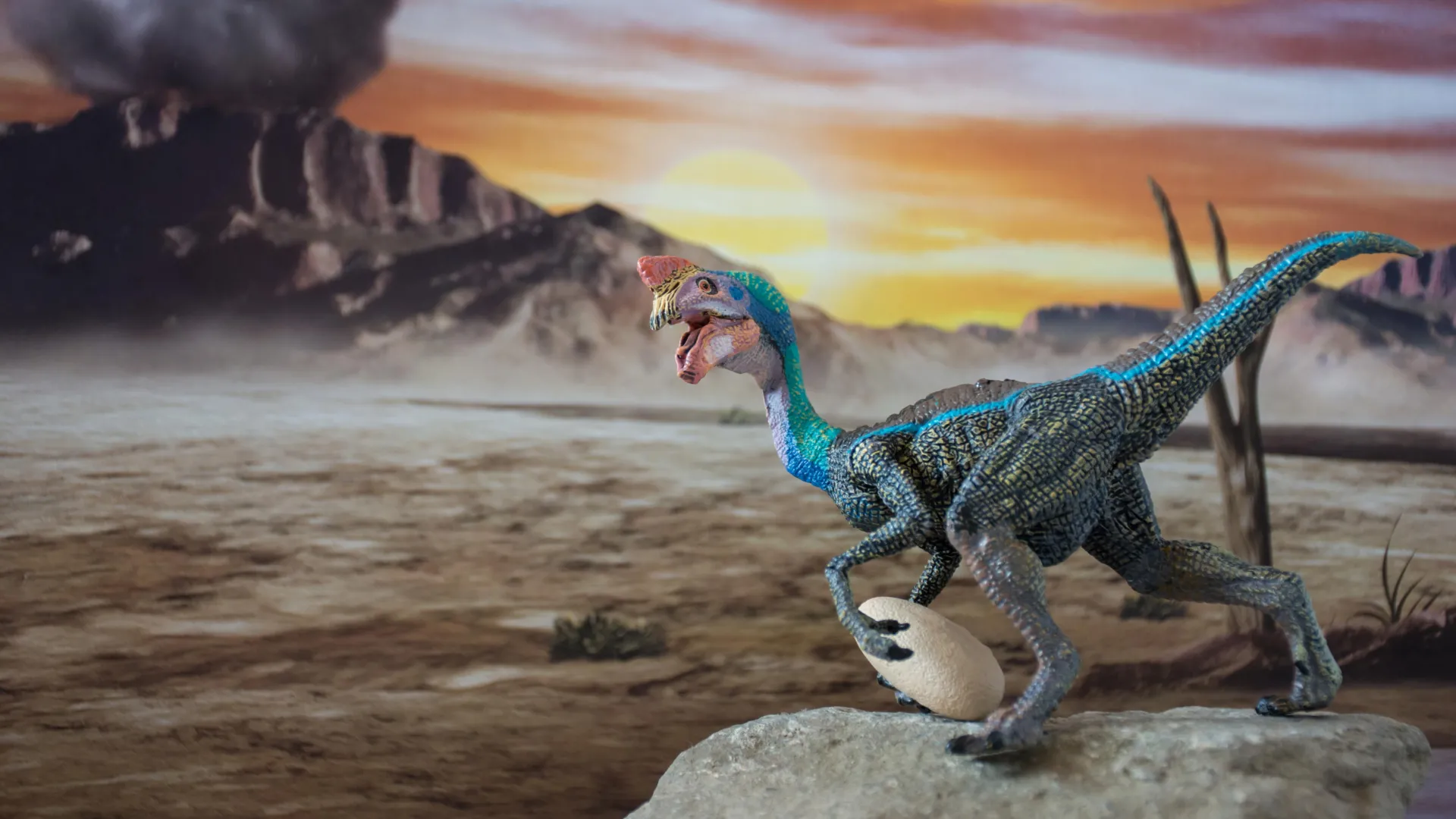
The reproductive strategies of non-avian dinosaurs have long remained one of paleontology’s most captivating enigmas, particularly regarding how feathered, flightless theropods brought their young into the world. For decades, researchers debated whether creatures such as oviraptors incubated their clutches in a manner akin to modern birds, relying on direct body heat, or if they depended more heavily on environmental sources of warmth, following the reproductive patterns of modern reptiles like crocodiles and turtles. A novel study published in the journal Frontiers in Ecology and Evolution sheds unprecedented light on this prehistoric puzzle, utilizing a combination of physical experimentation and advanced computer simulations to reconstruct how oviraptor eggs were warmed and how efficiently they hatched.
The research team, based in Taiwan, constructed a life-sized model of an oviraptor and recreated an entire nesting environment using artificial eggs. Their findings indicate that the relative positioning of the brooding adult to the eggs played a critical role in thermal regulation and subsequent embryonic development. Furthermore, the data reveal that oviraptor incubation was significantly less efficient than that seen in modern avian species, pointing to a unique evolutionary transitional phase where dinosaurs and solar radiation acted as co-incubators.
Reconstructing the Past: The Methodology Behind the Model
To investigate these ancient reproductive behaviors, the researchers focused their efforts on Heyuannia huangi, a specific oviraptor species that inhabited the floodplains and arid environments of what is now China during the Late Cretaceous period, roughly 70 to 66 million years ago. An adult Heyuannia huangi typically measured approximately 1.5 meters in length, weighed an estimated 20 kilograms, and constructed semi-open nests characterized by distinctive, multi-layered rings of elongated eggs.
Recreating this prehistoric nursery required meticulous craftsmanship. The scientific team constructed the model dinosaur’s torso using a sturdy wooden framework coupled with lightweight polystyrene foam. To mimic the soft tissues and muscle mass of the living animal, they layered cotton, cloth, and bubble paper over the structural core. Meanwhile, the clutch of eggs was cast from resin and meticulously arranged in double rings that precisely mirrored the spatial layout observed in exceptionally preserved fossilized oviraptor nests discovered across Asia.
The physical construction was fraught with technical hurdles. According to Chun-Yu Su, the study’s first author who was a student at Washington High School in Taichung when the research was conducted, standard laboratory materials could not easily replicate the unique morphology of dinosaur eggs. Oviraptor eggs possess distinct structural and textural properties unlike those produced by any living vertebrate species, necessitating the custom fabrication of resin replicas to approximate the thermal conductivity and geometry of the original fossils.
Sunlight and Thermal Dynamics in the Nest
By subjecting the physical model and artificial nest to controlled environmental conditions, the research team evaluated how ambient temperatures and the presence of a brooding adult influenced the internal heat distribution of the clutch. The experiments revealed stark contrasts in thermal consistency depending on environmental factors.
Under cooler simulated atmospheric conditions, eggs situated in the outer ring of the nest—even when attended by the brooding adult—exhibited temperature discrepancies of up to 6 degrees Celsius compared to the innermost eggs. In biological terms, such pronounced thermal variation would likely have induced asynchronous hatching, a phenomenon where eggs within the same clutch hatch at significantly different times over a span of days or weeks.
Conversely, under warmer environmental conditions, the temperature gap between the innermost and outermost eggs shrank dramatically to just 0.6 degrees Celsius. This critical discovery strongly implies that oviraptors residing in warmer latitudes or during peak seasonal heat relied heavily on ambient sunlight as an indispensable auxiliary heat source.
Dr. Tzu-Ruei Yang, senior author of the study and an associate curator of vertebrate paleontology at Taiwan’s National Museum of Natural Science, noted that the physical constraints of large dinosaur bodies precluded traditional avian sitting behaviors. While massive sauropods completely abandoned their clutches to solar and soil warmth like modern sea turtles, oviraptors occupied a middle ground. Because oviraptor nests were semi-open to the air rather than buried completely underground, direct sunlight played a vastly superior thermal role compared to subterranean geothermal heat.
Evolutionary Implications: Oviraptors Versus Modern Birds
To contextualize their findings, the research team compared oviraptor reproduction with thermoregulatory contact incubation (TCI), the standard brooding mechanism utilized by modern birds. TCI depends strictly upon three foundational conditions: the parent must maintain direct physical contact with every individual egg, the parent’s body must serve as the primary and nearly exclusive source of thermal energy, and the entire clutch must be maintained within a remarkably narrow, uniform temperature band.
The structural morphology of oviraptors and the geometry of their semi-open nests prevented them from satisfying these rigorous requirements. The adults simply could not achieve simultaneous, direct contact with every egg arrayed across multiple concentric rings.
Consequently, the researchers concluded that oviraptors and the sun functioned as co-incubators. While this dual-source strategy yielded lower overall incubation efficiency when measured against modern avian standards, the authors caution against viewing this as an evolutionary shortcoming. The combination of parental attendance and ambient environmental heat represents a transitional behavioral adaptation bridging the gap between fully buried reptile clutches and modern avian brooding techniques.
Dr. Yang emphasized that evolutionary biology should not be framed as a competition where ancient lineages are evaluated as inherently inferior to modern descendants. Modern birds are not objectively "better" at hatching eggs; rather, modern avian species and Late Cretaceous oviraptors simply evolved distinct reproductive strategies tailored to their respective ecological niches and physiological designs.
Context, Limitations, and Broader Horizons
While the study provides a groundbreaking framework for understanding dinosaur reproductive biology, the authors acknowledge several methodological limitations. The conclusions are inherently tied to the specific architectural parameters of the reconstructed nest model. Furthermore, global climatic conditions during the Late Cretaceous featured atmospheric compositions, humidity levels, and mean temperatures that differ substantially from the modern Earth, variables that would have subtly altered heat transfer dynamics. Paleontological consensus also suggests that oviraptors generally endured significantly longer incubation periods than extant birds, meaning embryos developed under sustained, lower-intensity thermal regimes.
Despite these variables, the research introduces an innovative multidisciplinary methodology to paleontology. By wedding physical resin reconstructions with advanced mathematical heat-transfer computer modeling, the team successfully interrogated complex biological questions that resist resolution through fossil analysis alone.
Beyond its scientific contributions, the project holds symbolic weight within the academic community of Taiwan. Dr. Yang highlighted the achievement as a profound encouragement for students and researchers in regions devoid of indigenous dinosaur fossil deposits. The success of the study demonstrates that geographic absence of physical fossils is no barrier to conducting world-class paleontological research, opening new avenues for global collaboration and computational analysis in the study of deep-time evolution.
