
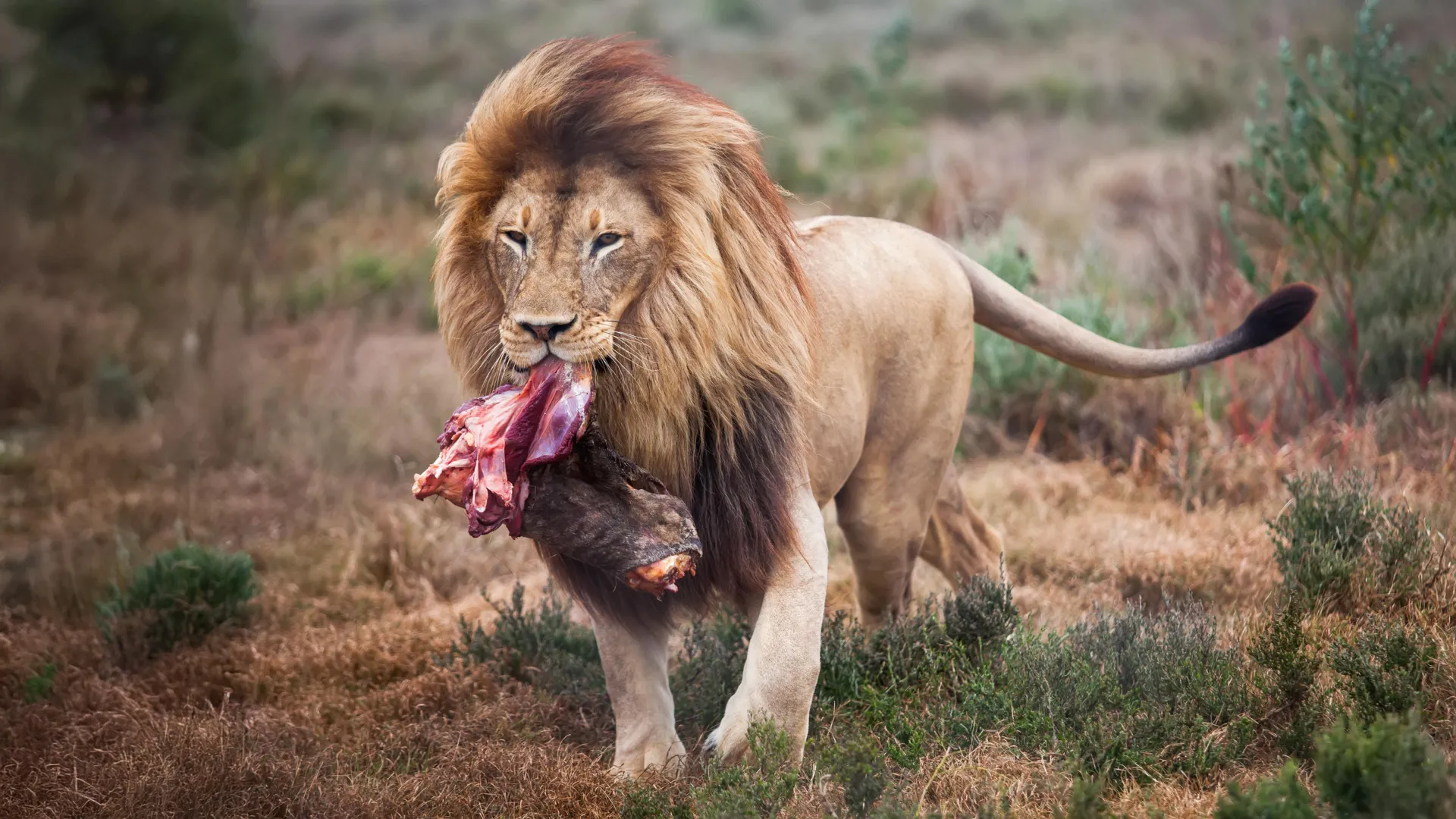
A groundbreaking study conducted by researchers from the University of Adelaide and Monarto Safari Park in South Australia has shed new light on the psychological and behavioral impacts of captive animal management, revealing that zoo-dwelling African lions closely mimic the behavioral patterns of their wild counterparts when subjected to a naturalistic "feast and fast" feeding schedule involving whole animal carcasses. Published in the peer-reviewed journal Applied Animal Behaviour Science, the research offers a critical reassessment of how modern zoological institutions approach the nutritional and psychological enrichment of large carnivores.
The study centered on a coalition of three adult male African lions housed at Monarto Safari Park, one of the largest open-range zoos in the world. By shifting away from predictable, daily fragment-based feeding routines and introducing whole animal carcasses every nine days, the animal care and research teams were able to replicate the irregular foraging cadence experienced by wild apex predators. Over an intensive three-month observation period, continuous high-definition video monitoring documented profound changes in how the lions fed, rested, and moved throughout their sprawling South Australian habitat.
The findings challenge longstanding zoo management traditions that prioritize rigid, daily caloric distribution. By embracing the biological reality of large carnivores—which naturally alternate between periods of hyper-consumption and prolonged fasting—the research team successfully unlocked species-specific behaviors that have historically been difficult to elicit in human-managed environments.
The Chronology and Methodology of the Study
To arrive at these conclusions, the multi-institutional research team designed a rigorous, multi-phased observational protocol. The project was spearheaded by lead author Lesia Hryhorenko, a researcher at the University of Adelaide’s School of Animal and Veterinary Sciences, in collaboration with visiting Belgian Master’s student Florence Demoulin from the University of Liege, and co-author Associate Professor Alexandra Whittaker.
The investigation began with a comprehensive baseline observation phase, during which the three male lions were monitored under their standard, pre-existing feeding regime. This baseline established normal behavioral baselines for the coalition, tracking movement, social dynamics, and localized activity indices.
Following the baseline period, the experimental intervention commenced. Animal care staff at Monarto Safari Park introduced a whole carcass feeding schedule, delivering approximately 200 kilograms of whole animal carcasses to the enclosure every nine days. Crucially, these carcasses were not immediately removed after the lions finished eating; instead, the food remained accessible within the habitat for up to three consecutive days. This allowed the animals to interact with the remains at their leisure before entering a subsequent multi-day fasting and digestion window.
To capture the totality of this cycle, the research team deployed an array of eight advanced infrared cameras positioned strategically around the enclosure. This technological setup facilitated continuous, 24-hour monitoring, generating one of the most comprehensive behavioral datasets ever compiled for captive African lions under an intermittent carcass-feeding regime.
Quantifying the Behavioral Shift
The empirical data collected via continuous video surveillance revealed dramatic shifts in time allocation and physical exertion among the lions. Most notably, the introduction of whole carcasses radically altered the animals’ feeding mechanics.
During carcass-feeding days, the lions spent nearly three times as long engaged in feeding activities compared to their standard diet routines. Rather than consuming bite-sized, pre-portioned meat fragments delivered on a predictable daily schedule, the coalition was forced to work for its sustenance. The lions spent hours tearing, pulling, tugging, and manipulating the heavy carcasses. This prolonged physical engagement mirrored the arduous mechanics of wild hunting and carcass processing, utilizing muscle groups in the neck, shoulders, and jaw that rarely see such intensive activation under traditional zoo feeding models.
Following these intense feeding bouts, a distinct physiological and behavioral shift occurred. The lions entered an extended period of rest, spending significantly more hours lying down, digesting, and conserving energy. As the nine-day cycle progressed and the fasting period deepened, the animals’ activity levels did not plummet into lethargy; rather, their movement patterns gradually increased, culminating in heightened roaming and exploratory behaviors just as the next carcass delivery approached.
This cyclical oscillation—characterized by intense, labor-intensive consumption, followed by prolonged torpor and digestion, and concluding with a steady rise in foraging-associated locomotion—mirrors precisely the ecological rhythm documented among wild lion prides in sub-Saharan Africa. Wild lions rarely secure a meal every twenty-four hours; their access to food is dictated by hunting success, environmental conditions, and prey migration, resulting in a natural feast-and-famine existence.
Addressing Anticipatory Stereotypies and Social Stability
One of the primary historical concerns among zookeepers and animal welfare scientists regarding intermittent feeding schedules has been the potential increase in food-frustration behaviors, such as stereotyped pacing or inter-coalition aggression. Captive carnivores frequently exhibit repetitive locomotor patterns—commonly known as pacing—when anticipating predictable feeding events.
To determine whether a nine-day fasting window exacerbated this issue, the research team meticulously tracked the lions’ movement paths throughout the entire study. Interestingly, while pacing showed minor fluctuations over the course of the three-month project, it did not correlate with the duration of the fast. The lions did not pace more frantically on day eight of a fast than they did on day two.
Instead, spatial-temporal analysis revealed that the most significant spikes in pacing behavior were tightly coupled with predictable, routine-driven events managed by human staff. Specifically, pacing increased markedly around the arrival times of animal keepers and during scheduled operational movements when the lions were shifted between different management areas of their habitat. This finding strongly indicates that pacing in these animals is an anticipatory response to human schedules and operational cues rather than an indicator of genuine nutritional deprivation or unmanaged hunger.
Furthermore, the introduction of massive, highly prized food resources did not compromise social stability within the all-male coalition. Large carnivores are notoriously competitive over high-value food items, raising fears that whole carcasses might trigger severe aggression or injury among coalition members. However, the study recorded no escalation in injurious fighting or social disruption. The lions shared the resources efficiently, demonstrating that established male coalitions can manage whole carcass distributions without detrimental impacts on group harmony.
Official Perspectives and Expert Analysis
The implications of the Adelaide University and Monarto Safari Park study extend far beyond a single enclosure in South Australia, offering valuable insights for the global zoological community.
Lead author Lesia Hryhorenko emphasized that the research fundamentally redefines what constitutes appropriate enrichment for captive carnivores, noting that dietary management must account for physical mechanics as well as nutritional inputs.
"Wild lions don’t eat at the same time every day. They experience natural periods of feasting and fasting depending on hunting success," Hryhorenko stated, highlighting the evolutionary mismatch inherent in standard zoo practices. "Providing whole carcasses changes much more than the nutritional content of the diet. It gives lions the opportunity to engage in behaviors such as tearing, pulling, and manipulating food over extended periods, which are important components of their natural feeding ecology."
Associate Professor Alexandra Whittaker, co-author of the study, pointed out that the research underscores a vital methodological lesson for animal behaviorists and zoo curators: the necessity of longitudinal observation. Many historical assessments of zoo management techniques suffer from short observation windows, capturing only the immediate post-feeding response while missing the broader behavioral ripples that occur days later.
"Many zoo studies focus only on what happens immediately after food is provided," Associate Professor Whittaker noted. "Our results show that feeding schedules can influence behavior for days afterwards, making it essential to look at behavioral patterns across the entire feeding cycle rather than a single feeding event."
Broader Implications for Zoological Welfare and Conservation
As modern zoological parks increasingly transition from traditional exhibition models to centers focused on holistic animal welfare, conservation education, and behavioral expression, the findings of this study provide an actionable framework for continuous improvement.
Traditional feeding regimes—while efficient for staff and effective at meeting baseline nutritional requirements—inadvertently create an artificial environment where a major biological drive (foraging and food processing) is compressed into a few minutes of daily routine. By restructuring feeding schedules to reflect natural ecological variability, zoos can stimulate cognitive engagement, improve physical fitness by exercising neglected muscle groups, and promote natural resting and activity cycles.
Animal welfare scientists suggest that incorporating intermittent whole carcass feeding could be successfully adapted for other captive carnivore species, such as tigers, leopards, cheetahs, and hyenas, provided that facility infrastructure and management protocols can safely accommodate large, multi-day food items.
Looking ahead, the research team recommends that future investigations expand upon these behavioral findings by integrating physiological biomarkers—such as fecal cortisol assays to measure stress hormones or metabolic profiling to track energy expenditure. Combining continuous behavioral monitoring with precise physiological metrics will provide a comprehensive, multi-dimensional assessment of how varying feeding strategies impact the long-term health, welfare, and psychological well-being of animals living under human care.
For institutions like Monarto Safari Park, the successful trial demonstrates that bringing a touch of the wild into a managed environment does not require compromising safety or social stability. Instead, by aligning animal husbandry practices with the evolutionary blueprints of wild species, modern zoos can significantly enhance the quality of life for the magnificent animals in their stewardship.
