
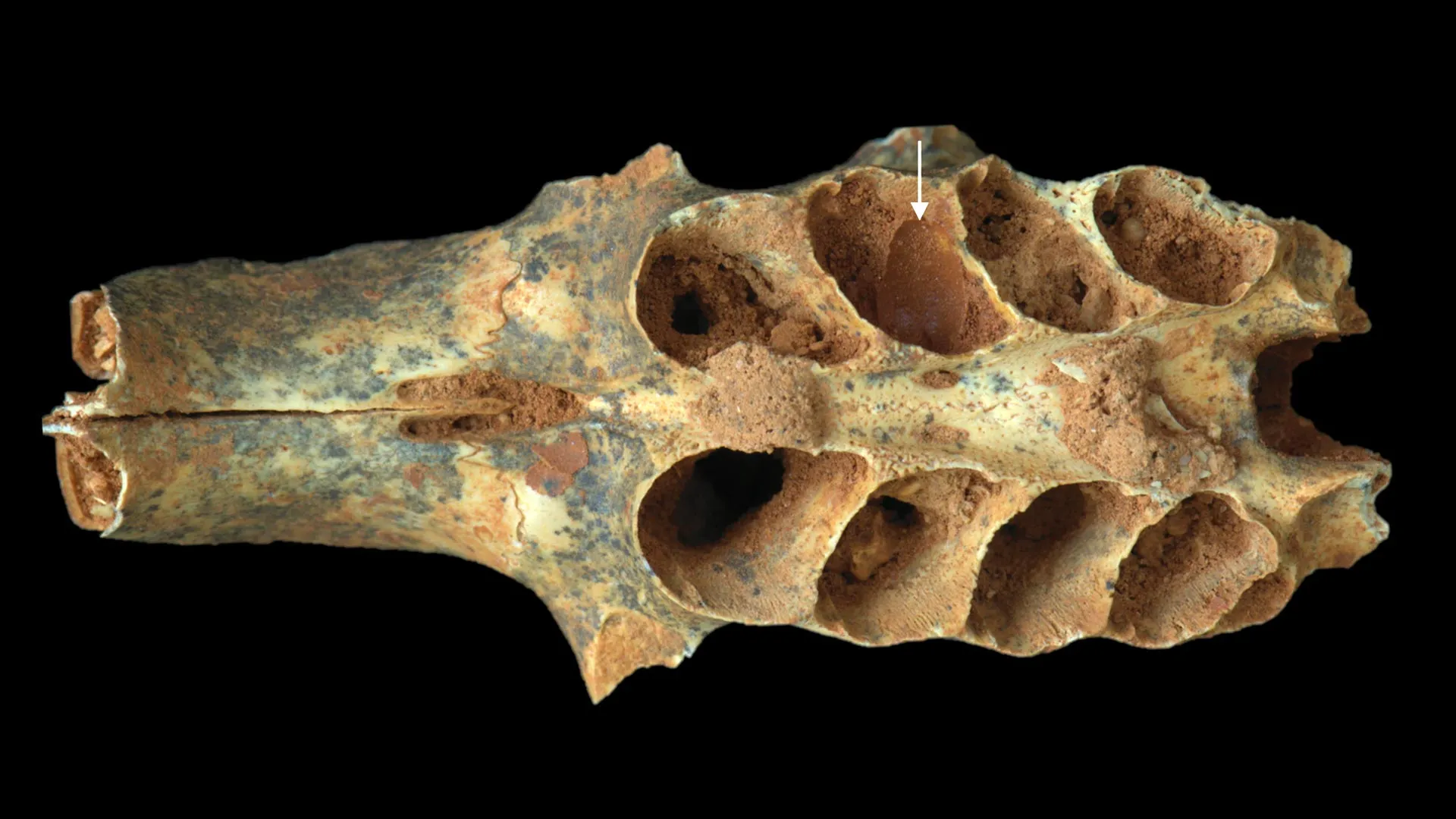
Deep within the cavernous, limestone-rich subterranean networks of the Caribbean island of Hispaniola, a remarkable prehistoric discovery has pushed the boundaries of paleoentomology and evolutionary ecology. According to a landmark study recently published in the scientific journal Royal Society Open Science, researchers have identified the first known evidence of ancient bees utilizing the empty tooth sockets of fossilized animal jawbones as nurseries for their offspring. Dating back approximately 20,000 years, this unprecedented nesting strategy highlights the remarkable adaptability of solitary insect species navigating challenging prehistoric ecosystems.
The findings, spearheaded by a team of international paleontologists and evolutionary biologists, offer an extraordinary glimpse into an Ice Age micro-ecosystem. By analyzing micro-structures preserved within rodent and mammal mandibles accumulated by generations of roosting owls, scientists have uncovered a novel trace fossil—subsequently named Osnidum almontei—that bridges the gap between vertebrate paleontology and invertebrate ecology.
The Discovery: A Serendipitous Finding in a Fossil-Rich Cave
The investigation centered on a remote, vertical-access limestone cave located on Hispaniola, an island shared by the nations of Haiti and the Dominican Republic. The region is famously pockmarked by thousands of sinkholes and caves, a geological phenomenon driven by the dissolution of soluble bedrock over millennia.
"In some areas, you’ll find a different sinkhole every 100 meters," explains Dr. Lazaro Violó López, a postdoctoral researcher at the Field Museum in Chicago and the lead author of the study.
The specific site examined by the research team had previously been identified by Juan Almonte Milan, curator of paleobiology at the Dominican Republic’s Museo Nacional de Historia Natural, as an exceptionally fertile deposit of Quaternary fossils. Dr. Violó López encountered the site while conducting doctoral research split between the University of Florida and the Florida Museum of Natural History.
Accessing the cave required technical fieldwork. Researchers descended into the subterranean chamber via ropes secured to the surface, navigating a dark environment inhabited by tarantulas before traversing a ten-meter-long tunnel to reach the fossiliferous layers. Inside, the cave walls and floor preserved multiple strata of remains separated by mineralized carbonate deposits, which formed during ancient, high-precipitation climatic phases.
While the primary objective of the initial excavation was to study vertebrate remains—predominantly small rodents, alongside sloths, birds, reptiles, and amphibians representing upwards of 50 species—an unexpected anomaly derailed routine fossil preparation. Dr. Violó López noticed that several mammalian jawbones contained smooth, concave deposits lining their empty tooth sockets. Unlike naturally accumulated wind- or water-borne sediment, these formations exhibited a deliberate, manufactured geometry.
Drawing on prior field experience—specifically an undergraduate paleontology project in Montana where he was introduced to fossilized wasp cocoons—Dr. Violó López suspected that the unusual sedimentary infills were biological in origin. Subsequent high-resolution computed tomography (CT) scanning confirmed his hypothesis: the structures were ancient mud nests constructed by solitary insects.
Chronology and Ecosystem Dynamics: Life and Death in a Caribbean Cave
To understand how these tiny nests came to reside inside the jawbones of Ice Age prey, researchers reconstructed the chronology of the cave’s utilization over thousands of years.
Roughly 20,000 years ago, during the Late Pleistocene epoch, the cave served as a long-term roosting site for generations of predatory owls. These birds hunted across the surrounding Hispaniolan landscape, returning to the subterranean shelter to digest their meals and regurgitate indigestible material in the form of pellets. Over centuries, these pellets accumulated vast quantities of small vertebrate bones on the cave floor.
At the same time, the local environment presented significant ecological challenges for nesting insects. The karst topography of Hispaniola features highly porous limestone terrain with very little topsoil, rendering traditional ground-nesting strategies difficult or impossible for subterranean insects. Furthermore, the constant rain of owl pellets provided an abundant, pre-fabricated supply of small, hollow cavities—specifically the tooth sockets of rodent mandibles—scattered across the cave floor.
Sometime after the owls deposited the bones, female solitary bees discovered these miniature natural troughs. Utilizing a mixture of excavated dirt and salivary secretions, the bees constructed tiny, pencil-eraser-sized masonry nests within the tooth sockets. Inside these fortified chambers, the mothers provisioned their eggs with compacted pollen grains—traces of which were successfully identified via CT scans—before sealing the nests to protect their developing larvae.
Taxonomic Classification of Trace Fossils: Introducing Osnidum almontei
Because the warm, highly humid subterranean conditions of Hispaniola are antithetical to the preservation of delicate chitinous insect exoskeletons, no fossilized bodies of the bees themselves were recovered from the cave. Without physical specimens of the insects, researchers were unable to definitively determine whether the nest-builders belonged to a species still extant today or one lost to extinction alongside many of the vertebrate species whose bones fill the cave.
Nevertheless, the architectural distinctiveness of the mud nests warranted formal scientific classification. The research team designated the trace fossils as a new ichnospecies, Osnidum almontei, honoring Juan Almonte Milan for his decades of foundational work documenting the paleontological heritage of the Dominican Republic.
Trace fossils—structures left behind by organisms rather than their physical remains, such as footprints, burrows, and nests—play an invaluable role in evolutionary biology. In this instance, Osnidum almontei provides direct behavioral evidence of insect-vertebrate interactions that would otherwise be entirely lost to the fossil record.
Broader Implications for Paleoentomology and Ecosystem Analysis
The documentation of bees nesting within animal bone matrices marks a significant milestone in evolutionary ecology, expanding our understanding of the resourcefulness of solitary bee species. While certain modern insects utilize unconventional substrates—such as empty snail shells observed in parts of Europe and Africa, or abandoned wood-boring beetle holes—the utilization of vertebrate osteological remains has never before been documented in either the modern or fossil record.
Experts note that this discovery carries profound methodological implications for paleontologists and field researchers. Traditionally, scientists cleaning vertebrate fossil collections might view fine-grained sediment inside tooth sockets as mere matrix to be cleared away and discarded. The findings from Hispaniola serve as a cautionary tale and a call for heightened observational rigor during fossil preparation.
"This discovery shows how weird bees can be—they can surprise you. But it also shows that when you’re looking at fossils, you have to be very careful," Dr. Violó López remarked. He emphasized that vertebrate paleontologists must remain vigilant for trace fossils left by invertebrates, as these small clues offer expansive windows into ancient food webs, climate conditions, and micro-habitats.
As researchers continue to analyze the rich fossil beds of the Caribbean, the identification of Osnidum almontei underscores the interconnectedness of ancient ecosystems. From apex avian predators hunting across Pleistocene landscapes to microscopic bees carefully sculpting mud nurseries inside the jaws of their prey, the fossil record continues to reveal complex ecological narratives hidden in plain sight.
