
When visitors observe a captive animal tracing the exact same perimeter path within an enclosure—step after repetitive step—it is easy to misinterpret the movement as mere restlessness, boredom, or boundless energy. However, animal behaviorists and wildlife sanctuary staff recognize this monotonous movement, known as pacing, as a critical behavioral indicator of psychological stress. For organizations dedicated to wildlife rescue and rehabilitation, such as the Toucan Rescue Ranch, decoding these physical manifestations provides essential insight into the mental wellbeing of animals adjusting to captive environments.
Understanding Pacing in Wildlife Settings
Pacing is formally classified as a stereotypic behavior—a repetitive, unvarying movement pattern that serves no obvious adaptive purpose. In zoological and sanctuary settings, this phenomenon frequently manifests as an animal walking a rigid path along a fence line, spinning in continuous circles, swaying rhythmically from side to side, or tracing a fixed route within its habitat.
These behaviors are disproportionately documented in wild animals housed in captivity, particularly when engineered enclosures fail to replicate the vast spatial complexity and sensory richness of natural ecosystems. Apex predators and wide-ranging species, including jaguars, pumas, bears, wolves, and smaller carnivores, are particularly susceptible. While modern conservation science continually refines enclosure architecture, completely replicating the expansive freedom of a natural territory within a managed care facility remains an inherent challenge in wildlife management. This operational limitation underscores the vital necessity of comprehensive environmental enrichment programs designed to stimulate the cognitive and physical faculties of captive species.
The Etiology of Captive Stress: Why Pacing Develops
Contrary to popular misconception, animals are not born pacing. Instead, this behavioral response develops progressively over time as a direct consequence of chronic stress, frustration, and the inability to execute natural ethological behaviors.
In their native habitats, wild animals navigate expansive territories, engage in complex social hierarchies, forage or hunt for sustenance, and interact with a dynamic environment that constantly challenges their sensory and instinctual faculties. When animals are placed in restricted spaces, these evolutionary drives cannot simply be switched off. Lacking an appropriate outlet for their instincts, animals frequently channel their frustration into repetitive motor patterns.
Neuroscientific research indicates that stereotypic behaviors like pacing share underlying neural pathways with anxiety and obsessive-compulsive disorders in humans. While the repetitive movement may initially serve a self-soothing function—offering a minor degree of psychological relief through predictable physical exertion—it ultimately functions as a distress signal. It is a visible indicator that fundamental biological or psychological needs remain unfulfilled. Furthermore, once established, stereotypic behaviors are notoriously resilient. Even when an individual is transferred to an expansive, highly enriched habitat, established pacing habits can persist for years. Consequently, wildlife professionals emphasize early intervention, sophisticated enclosure design, and proactive enrichment protocols to prevent these pathways from forming in the first place.
Diagnostic Indicators: What Pacing Reveals About Animal Welfare
Observing persistent pacing prompts animal care teams to evaluate several core factors concerning an individual’s welfare and environment:
Spatial and Environmental Deficiencies: Enclosures that lack structural complexity—such as vertical climbing structures, dense foliage, diverse substrates, visual barriers, and water features—frequently fail to stimulate the animal’s cognitive needs, triggering stress-induced behaviors.
Social Isolation and Chronic Stress: The absence of appropriate conspecific social structures, or the premature separation from mature adults, can induce long-term psychological trauma, manifesting in repetitive physical routines.
Unmet Behavioral Drives: A carnivorous mammal genetically wired to spend hours stalking and hunting prey cannot suppress that innate drive simply because a carcass is provided in a bowl. When natural hunting behaviors are thwarted, stereotypic movements frequently fill the void.
Distinguishing Stereotypic Pacing from Healthy Anticipatory Behavior
A critical competency for wildlife rehabilitators and sanctuary keepers is distinguishing between pathological, stress-induced pacing and normal, healthy anticipatory behavior.
Many captive species exhibit heightened, repetitive movement patterns immediately preceding predictable daily events, most notably feeding time. This phenomenon, known as anticipatory behavior, has been documented across a wide taxonomic spectrum, encompassing large felines, raptors, and primates. It is behaviorally equivalent to a domestic dog pacing and vocalizing near its food bowl when dinner is prepared.
This healthy form of pacing is brief, temporally tied to a specific scheduled event, and accompanied by positive arousal markers such as alert posture, bright eyes, and species-specific vocalizations. Crucially, the behavior ceases immediately once the food is delivered, and the animal returns to a relaxed, baseline state for the remainder of the day.
In stark contrast, chronic stereotypic pacing occurs irregularly throughout the day, persists regardless of external stimuli, and tends to intensify over time if environmental conditions remain static. The diagnostic differentiator lies in context and duration: anticipatory pacing is goal-directed and short-lived, whereas stereotypic pacing is a symptom of unresolved environmental monotony.
The Role of Mitigation, Enrichment, and Community Support
Addressing the root causes of pacing requires a multifaceted approach focused on environmental enrichment, structural adaptation, and attentive husbandry. Modern sanctuaries utilize puzzle feeders, novel scent introductions, dynamic habitat changes, and carefully curated social groupings to engage the minds and bodies of rescued wildlife.
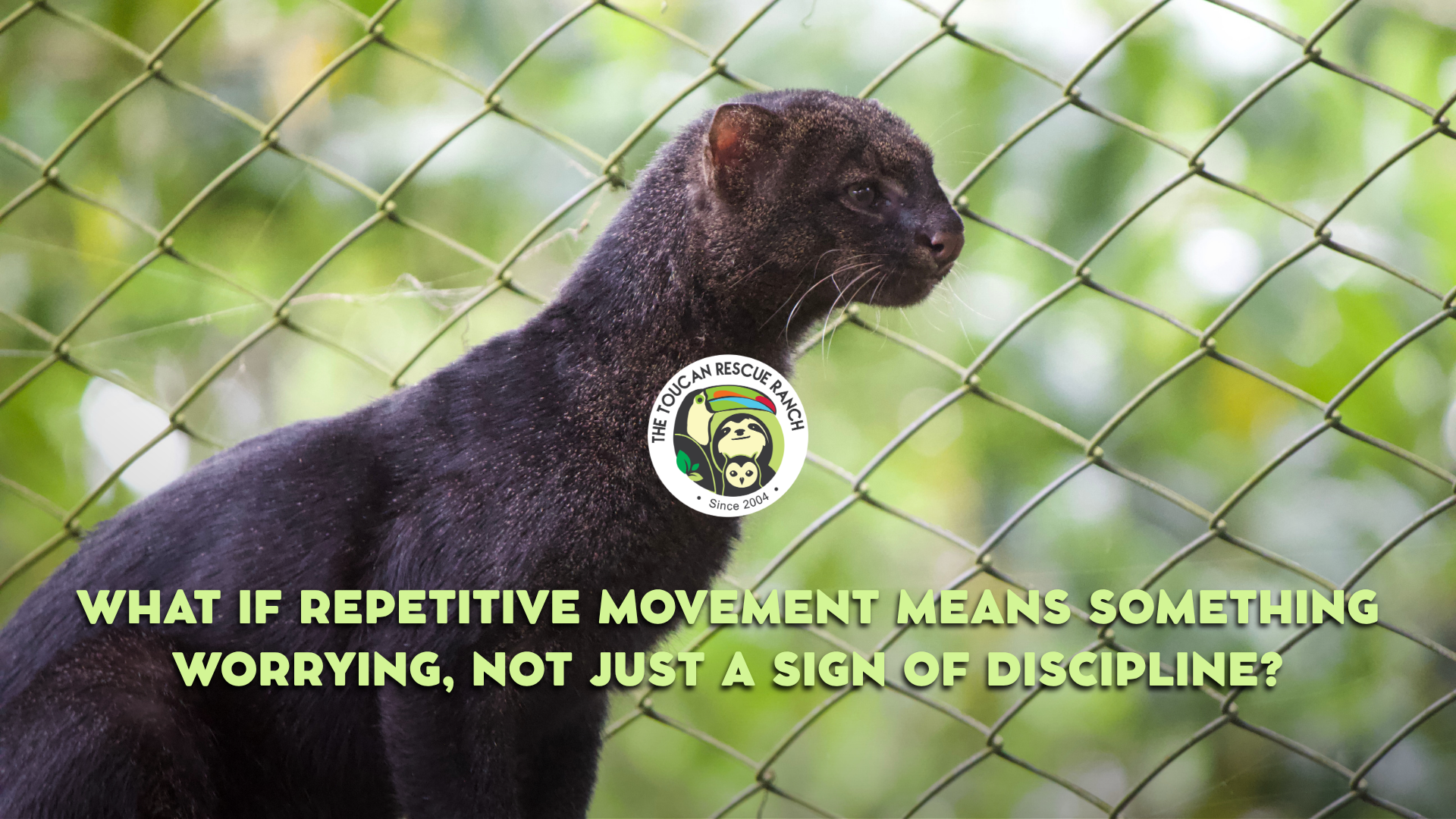
Institutional initiatives, such as private educational enrichment workshops and corporate volunteer partnerships, play a transformative role in habitat construction. Collaborative efforts allow sanctuaries to build modern, science-backed enclosures—such as advanced habitats designed for grisons—that incorporate complex vertical spaces, natural substrates, and interactive foraging stations. These targeted interventions provide the physical foundation necessary to support psychological rehabilitation.
Broader Implications for Conservation and Captive Management
The presence of pacing within zoological collections and wildlife sanctuaries serves as a constant reminder of the profound psychological toll captivity can exact on wild species. While sanctuaries strive to provide optimal care, the ultimate success of rehabilitation and long-term housing relies on an evolving understanding of animal psychology and ethology.
By closely monitoring behavioral indicators, refining enclosure design, and implementing rigorous enrichment protocols, conservationists can bridge the gap between captivity and the complex needs of wild animals. Ensuring that rescued wildlife achieve both physical recovery and mental tranquility remains a defining challenge for modern animal welfare organizations worldwide.
