
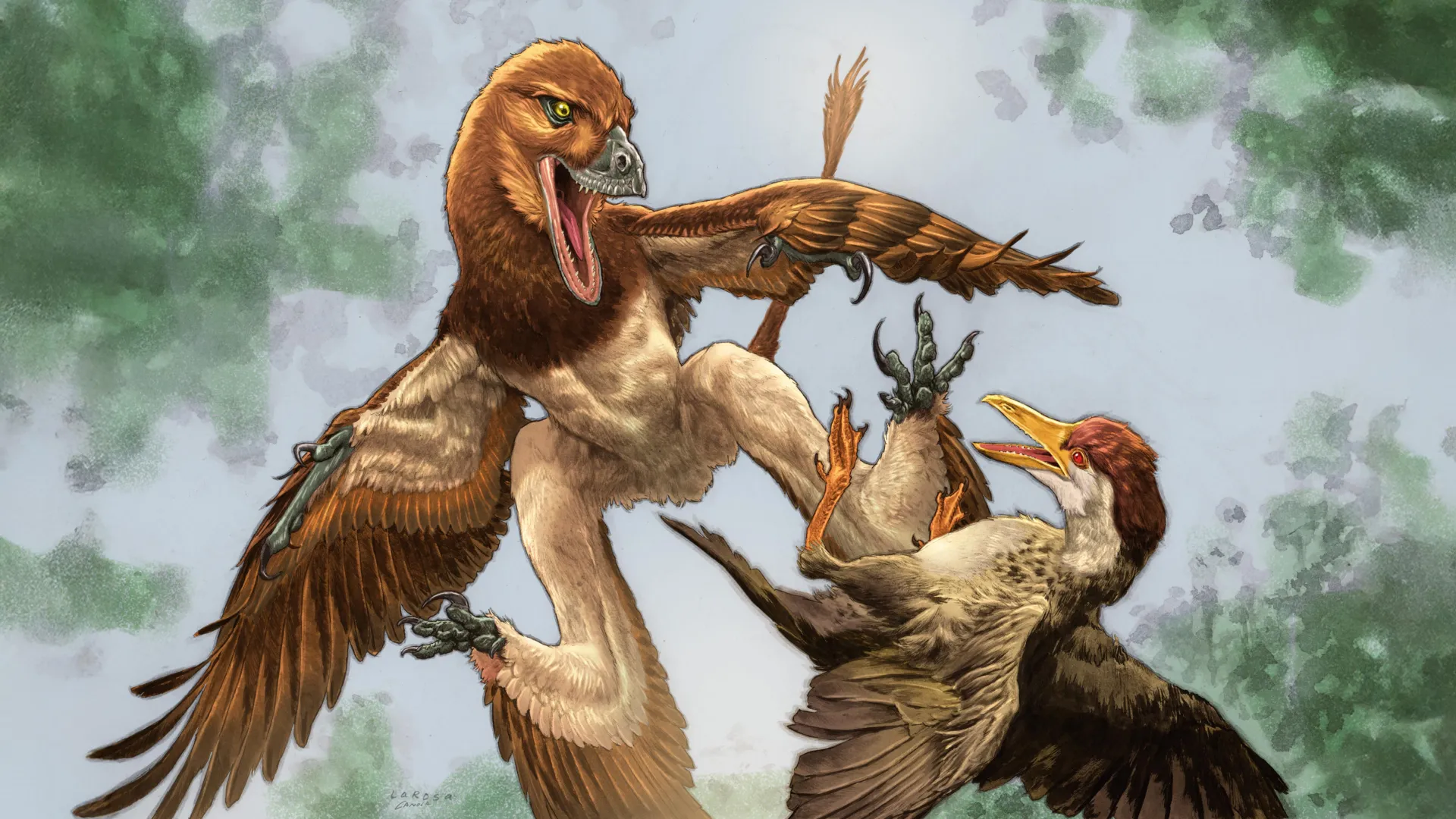
A remarkable fossil site in northwestern China has yielded hundreds of prehistoric bird remains, including enigmatic clusters of shattered bones compressed into pellet-like masses strikingly similar to those produced by modern owls. For years, paleontologists have suspected that a larger predator was responsible for hunting these ancient birds, systematically consuming them and then regurgitating their indigestible remains, yet direct evidence of such an animal had remained elusive. Now, a newly described dinosaur species has emerged from the same fossil bed, providing a compelling answer to this long-standing paleontological puzzle and offering unprecedented insights into the complex food webs of the Cretaceous period.
A New Predator Emerges: Introducing Jian changmaensis
The groundbreaking discovery, detailed in a study published in the Annals of Carnegie Museum, reports the identification of a previously unknown dinosaur species, Jian changmaensis, from the very same Changma Basin site. This fascinating creature was a feathered relative of the infamous Velociraptor, distinguished by long feathers adorning both its forelimbs and hind limbs. Based on unique and distinctive features of its arm and shoulder bones, scientists have put forth the hypothesis that this newly described dinosaur was indeed the primary predator responsible for the mysterious accumulations of bird bones found throughout the site.
Jingmai O’Connor, the associate curator of fossil reptiles at the Field Museum in Chicago and senior author of the paper describing the new species, articulated the significance of the find: "Scientists have found these weird, broken-up clusters of bird bones at this site, and we didn’t know what made them. This new microraptor dinosaur, Jian changmaensis, is our best guess." She further elaborated on the compelling evidence: "It’s the only dinosaur found at this site that wasn’t a bird, it was a carnivore, and it was much bigger than everything else that we’ve found there." This unique combination of characteristics positions Jian changmaensis as the prime candidate for the apex avian predator of its ecosystem.
The Changma Basin: A Window into Early Bird Ecosystems
The Changma Basin in China’s Gansu province has long been celebrated as a treasure trove for paleontologists, particularly renowned for its exquisitely preserved fossil birds. The geological strata of the basin date back to the Early Cretaceous period, approximately 120 million years ago, a crucial epoch in the evolutionary history of birds. During this time, the Earth was a vastly different place, characterized by lush landscapes, diverse flora, and a rich tapestry of animal life. Birds, which are the direct descendants of avian dinosaurs, were undergoing significant diversification, evolving various forms and ecological roles.
The bird fossils recovered from Changma represent some of the earliest known modern-looking birds, providing critical data on the origins of avian flight, plumage, and ecology. However, despite the abundance of bird remains, the ecosystem’s top predators, particularly those preying on birds, had largely remained a mystery. The recurring presence of these bone "pellets" — a taphonomic signature often associated with the digestive processes of predatory birds like owls, which regurgitate indigestible material such as bones, fur, and feathers — strongly hinted at a specialized predator. The discovery of Jian changmaensis finally provides a concrete link, filling a crucial ecological void in the ancient Changma food web.
A Feathered Relative of Velociraptor: The Dromaeosaur Lineage
To understand Jian changmaensis, it’s essential to place it within its broader evolutionary context. Today’s birds are the only surviving dinosaurs, having endured the catastrophic asteroid impact that struck Earth 66 million years ago. But long before that cataclysmic event, birds lived alongside a vast array of other dinosaur groups during the Jurassic and Cretaceous periods. Among their closest relatives were the dromaeosaurs, a group of feathered dinosaurs famously known for being relatively small to medium-sized, agile, and formidable predators.
Velociraptor, a name instantly recognizable thanks to the Jurassic Park films, is one of the most iconic members of this group. However, scientific understanding has significantly advanced beyond popular culture depictions. Real Velociraptors would have been considerably smaller than their cinematic counterparts, roughly the size of a turkey, and critically, they would have been covered in feathers, bearing a striking resemblance to large, predatory birds.
Jian changmaensis belongs to a specific subgroup of dromaeosaurs known as microraptors. Most microraptors were generally quite small, with some species barely reaching the size of a modern crow. This makes the newly identified species a standout. "Jian is one of the biggest microraptor specimens that has ever been found," O’Connor remarked. "The piece of its upper arm bone that we have is about 4 inches long, so the entire dinosaur probably had something like a four-foot wingspan, around the size of a barn owl." This substantial size for a microraptor further solidifies its position as a dominant predator within the Changma ecosystem, capable of tackling early avian prey.
A Four-Winged Gliding Dinosaur: Locomotion and Adaptation
While scientists have only recovered a partial skeleton of Jian changmaensis, primarily comprising elements of its arm and shoulder, compelling evidence from other microraptor fossils strongly suggests that Jian shared a distinctive anatomical feature: long feathers likely covered both its arms and legs, creating the striking appearance of four wings. This "four-winged" morphology is a hallmark of the microraptor group, exemplified by species like Microraptor gui, one of the first dinosaurs found with extensive feather impressions on all four limbs.
Rather than being capable of true, powered flight akin to modern birds, these four-winged dinosaurs were most likely adapted for gliding. O’Connor clarified this aspect of their locomotion: "Jian and the other microraptors probably weren’t capable of true, powered flight, but they could probably glide like a flying squirrel." This suggests that Jian changmaensis navigated its arboreal or semi-arboreal environment by launching from elevated positions, using its four wings to control its descent and potentially hunt prey among the trees or on the forest floor. Such a gliding capability would have provided a significant advantage in pursuing agile early birds.
The dinosaur’s evocative name itself reflects both its unique appearance and its discovery location. In Chinese mythology, "Jian" is a mythical winged creature, a fitting tribute to the dinosaur’s feathered, four-limbed form. The specific epithet "changmaensis" directly refers to the Changma Basin, the geographical region in China’s Gansu province where the fossil was uncovered, anchoring the discovery firmly to its significant paleontological context.
Chronology of Discovery and Research
The narrative of Jian changmaensis is a testament to the methodical and often protracted nature of paleontological research. For years, perhaps even decades, the peculiar bird bone accumulations at the Changma site intrigued researchers. These masses, resembling owl pellets, were first noted during systematic excavations that began in the early 2000s, revealing an abundance of early bird fossils. The consistent presence of these enigmatic bone clusters, fragmented and compacted, signaled a clear pattern of predation, yet the identity of the predator remained a persistent question mark.
The specific fossil specimen of Jian changmaensis that provided the breakthrough was unearthed more recently, as part of ongoing fieldwork in the Changma Basin led by Chinese paleontologists in collaboration with international teams. Once recovered, the partial skeleton underwent meticulous preparation and analysis. This involved detailed anatomical comparisons with known dromaeosaur species, particularly within the microraptor subgroup. The distinct morphology of its arm and shoulder bones, indicative of robust musculature and a predatory lifestyle, began to align with the evidence of avian predation.
The collaborative effort behind the study is noteworthy, bringing together experts from various institutions. Ling-Qi Zhou of the Gansu Geological Museum played a pivotal role in the initial discovery and context. Matthew Lamanna from the Carnegie Museum of Natural History, Ashley Poust from the University of Nebraska State Museum and University of California Museum of Paleontology, Da-Qing Li from Gansu Agricultural University, Hai-Lu You from the Institute of Vertebrate Paleontology and Paleoanthropology, Chinese Academy of Sciences, and Jingmai O’Connor from the Field Museum all contributed their specialized knowledge to the comprehensive analysis. The culmination of this multi-institutional research was the formal description and publication of Jian changmaensis in the prestigious Annals of Carnegie Museum, finally presenting the scientific community with the long-awaited answer to the bird bone mystery.
Broader Impact and Implications for Paleontology
According to the researchers, the discovery of Jian changmaensis fills a significant and long-standing gap in our understanding of the ancient ecosystem represented by the Changma fossil site. Matt Lamanna, corresponding author of the study and Carnegie Museum of Natural History’s Mary R. Dawson Curator of Vertebrate Paleontology and senior dinosaur researcher, emphasized this point: "Jian changmaensis reveals that non-avian dinosaurs lived in what is now the Changma Basin, an area famous for its fossil birds." He added, "Our team has recovered more than a hundred bird fossils at Changma, but only this single non-avian dinosaur specimen. Jian provides critical new insight into the biological history of the Changma region and the ecological context of the ancestors of today’s birds."
This singular non-avian dinosaur specimen, acting as the dominant avian predator, offers crucial insights into the ecological pressures faced by early birds. The presence of a large, agile, feathered dromaeosaur like Jian would have exerted significant selective pressure on the diverse bird populations of the Changma Basin. This pressure could have driven the evolution of various adaptations in birds, such as improved flight capabilities, enhanced maneuverability, cryptic plumage for camouflage, or changes in nesting behaviors to avoid predation. Understanding these ancient predator-prey dynamics is fundamental to comprehending the evolutionary trajectory of avian life.
Furthermore, the find helps scientists better understand how birds evolved and what specific characteristics set their lineage apart from their close dinosaur relatives. O’Connor articulated the profound implications: "You cannot understand life on the planet today without looking at its origins. Birds are arguably the most successful group of land-dwelling vertebrate animals on Earth today. Learning about early birds and their close non-bird dinosaur relatives gives us a better understanding of what made the group of birds that survived so special." The study of Jian changmaensis not only solves a specific paleontological riddle but also contributes to the grander narrative of life’s evolution, highlighting the intricate connections between extinct dinosaur groups and their modern descendants.
The discovery also reinforces the growing body of evidence for the widespread presence of feathers among theropod dinosaurs, blurring the lines between what was traditionally considered a "dinosaur" and a "bird." The four-winged morphology of microraptors, now including Jian changmaensis, provides compelling examples of various evolutionary experiments with flight and gliding that occurred before the emergence of true powered flight in the avian lineage. This mosaic of features underscores the complex and branching evolutionary tree that led to the incredible diversity of life we observe today.
Future research at the Changma Basin and similar Early Cretaceous sites will undoubtedly seek to uncover more complete specimens of Jian changmaensis and other non-avian dinosaurs, further refining our understanding of this crucial period. Analyzing the precise dietary habits of Jian through potential gut contents or trace fossils could provide even more direct evidence of its diet. The ongoing exploration of these ancient ecosystems promises to continue revealing the surprising and intricate stories of life on Earth millions of years ago, offering invaluable context to the planet’s enduring biodiversity.
