
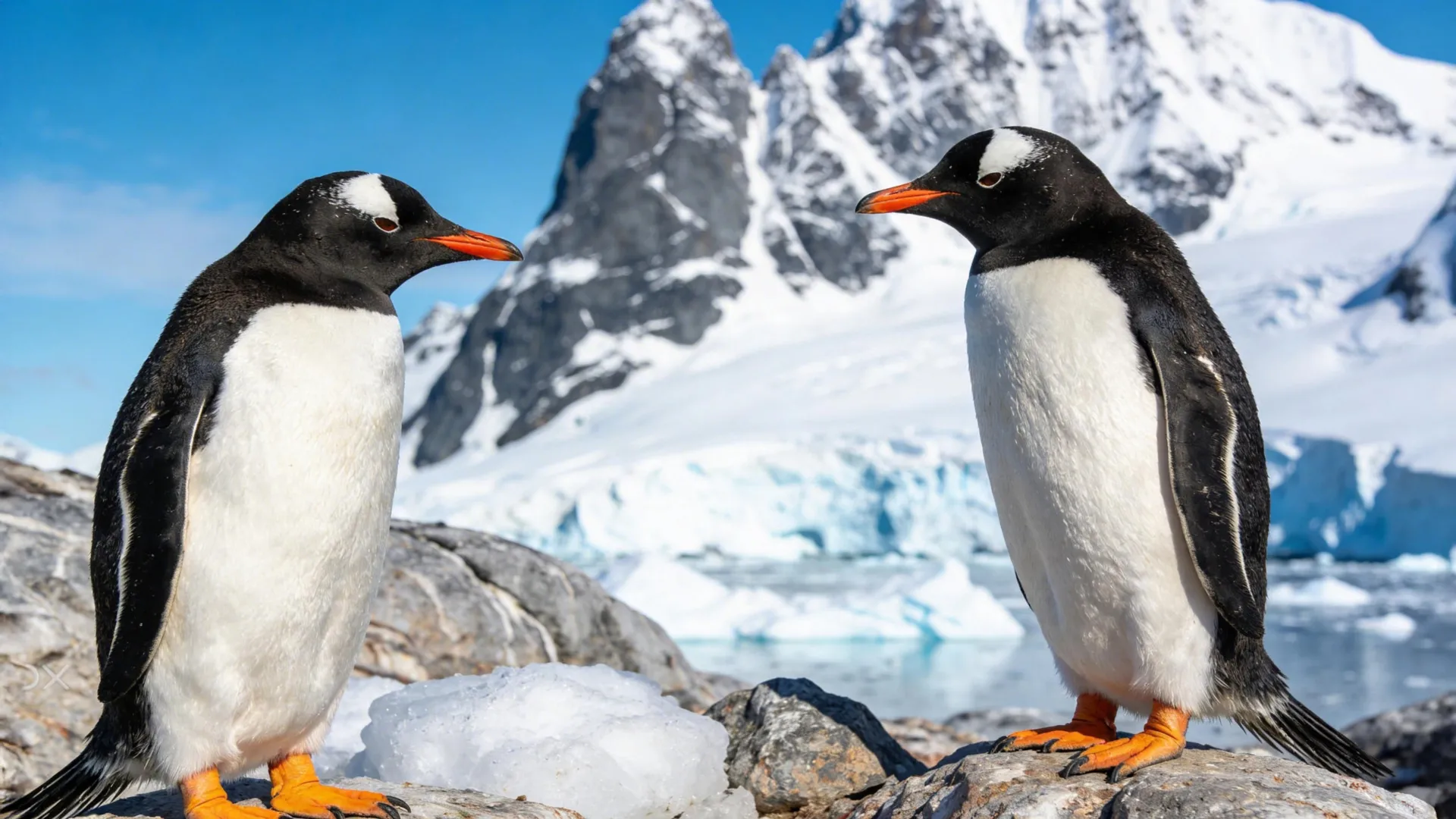
For more than a century, the taxonomy of the gentoo penguin has remained one of the most contentious topics in modern ornithology. Long classified by the scientific community as a single, widely distributed species known formally as Pygoscelis papua, these iconic marine birds with their striking white head-stripes and vibrant orange-red bills have now been definitively partitioned. Following a comprehensive, multi-year genomic study spanning nearly the entire geographic range of the genus, an international coalition of researchers has revealed that gentoo penguins actually comprise four distinct species. Among them is a previously unrecognized cryptic species native to the remote Kerguelen Islands, marking the first time in over a century that a new penguin species has been formally identified and named.
The findings, published in the peer-reviewed journal Communications Biology, carry significant implications for global conservation strategies, wildlife management across multiple jurisdictions, and our understanding of how geographical isolation and climate dynamics drive speciation in the Southern Hemisphere.
The breakthrough was achieved by an unprecedented global collaboration led by senior researchers Dr. Juliana Vianna of Andrés Bello National University in Santiago, Chile; Dr. Rauri Bowie, a professor of integrative biology and curator at the University of California, Berkeley’s Museum of Vertebrate Zoology; and Dr. Elie Poulin of the University of Chile. The research team incorporated geneticists, field biologists, and ecologists from Australia, Spain, Venezuela, South Africa, the United Kingdom, France, Argentina, Monaco, and Brazil. Daly Noll, a graduate student at the University of Chile, served as the study’s first author, spearheading the intricate genomic sequencing that dismantled decades of taxonomic assumptions.
Chronology of a Century-Long Taxonomic Dispute
The debate surrounding gentoo classification dates back generations. As early explorers and naturalists charted the sub-Antarctic islands and the Antarctic Peninsula, they noted physical variations among gentoo populations distributed thousands of miles apart. Over the decades, various taxonomists proposed splitting the genus into as many as six distinct subspecies based on subtle differences in body size, plumage dimensions, and vocalizations. However, without a unifying framework or comprehensive genetic data, the scientific community remained deadlocked, with no universal consensus on whether the birds represented a single polytypic species or a complex of multiple species.
The turning point arrived when modern molecular techniques enabled whole-genome sequencing at an unprecedented scale. Vianna, Bowie, and Poulin assembled a dataset utilizing whole-genome sequences extracted from 64 individual penguins across 10 distinct breeding colonies. By examining thousands of genetic variations known as single nucleotide polymorphisms (SNPs), the research team was able to map the evolutionary lineages of populations that had previously been studied only in localized isolation.
By comparing these comprehensive genetic profiles alongside physical measurements, behavioral traits, breeding schedules, vocalizations, and dietary preferences, the researchers successfully resolved the century-old controversy. The genetic evidence confirmed that three populations previously classified as regional subspecies are genetically distinct enough to be elevated to full species status. Furthermore, the analysis unmasked an entirely cryptic species inhabiting the Kerguelen Islands—a remote archipelago nearly 2,000 miles away from any permanently inhabited landmass, often referred to in French as the Îles de la Désolation (Desolation Islands).
Genetic Architecture and Local Adaptation
The newly delineated taxonomy divides the former Pygoscelis papua complex into four distinct species, each uniquely adapted to its specific ecological niche and geographical boundaries:
- The Northern Gentoo (Pygoscelis papua): Restricted primarily to the Falkland/Malvinas Islands and Martillo Islands in South America, north of the Antarctic Polar Front. Genomic analysis indicates this lineage possesses genetic enrichments linked to digestion, heart contraction, and muscle excitation—traits likely required to sustain prolonged physical activity during underwater foraging in warmer, saltier waters.
- The Eastern Gentoo (Pygoscelis taeniata): Inhabiting sub-Antarctic outposts such as the Crozet, Marion, and Macquarie Islands, this lineage displays genetic adaptations favoring efficient carbohydrate metabolism and enhanced diving performance. These include traits associated with oxygen transport, blood vessel formation, mitochondrial activity, and lung development, enabling the birds to forage effectively in oceans with relatively low biological productivity.
- The Southeastern Gentoo (Pygoscelis kerguelensis): Formally recognized for the first time, this newly described species evolved in isolation on the Kerguelen Islands and likely neighboring Heard Island, positioned near the critical boundary of the Antarctic Polar Front.
- The Southern Gentoo (Pygoscelis ellsworthi): The most numerous of the four lineages, this species inhabits the Antarctic Peninsula, coastal Antarctica, and South Georgia Island. Genetically distinct from its northern relatives, the southern gentoo exhibits adaptations tailored to extreme polar survival, including a higher concentration of genes linked to heat production, lipid and fat storage, and specialized light perception to cope with dramatic seasonal shifts in daylight and intense glare from glacial ice.
Researchers estimate that these four distinct lineages diverged over the past 300,000 to 500,000 years. This evolutionary divergence was propelled not only by vast geographical distances but also by the Antarctic Polar Front—a powerful oceanographic boundary in the Southern Ocean where water temperatures and salinity drop sharply, creating an effective barrier that restricts the movement of marine fauna.
Evolutionary History and Dietary Flexibility
The broader evolutionary context of gentoo penguins is rooted in deep geological history. Previous collaborative research published by Bowie and Vianna in 2019 indicated that the broader penguin family originated near Australia and New Zealand approximately 22 million years ago. Over ensuing epochs, lineages such as Emperor and King penguins diverged, with Emperors anchoring themselves to the extreme cold of the Antarctic continent while Kings claimed sub-Antarctic territory.
Approximately 12 million years ago, the intensification of the Antarctic circumpolar current facilitated the dispersal of other penguin groups across the Southern Hemisphere. These lineages colonized remote islands and archipelagoes, eventually pushing as far north as the coasts of Africa and South America.
Among their taxonomic peers, gentoo penguins possess a distinct ecological advantage: dietary flexibility. While specialized predators like Emperor and Adélie penguins rely heavily on predictable prey bases—most notably Antarctic krill, which are currently threatened by disappearing sea ice—gentoos are opportunistic generalists. They consume a wide variety of marine organisms, including fish, squid, cuttlefish, and various crustaceans.
Ironically, this same dietary flexibility served as a primary driver of speciation. Because gentoos could find adequate sustenance locally without undertaking massive migratory journeys, they consistently returned to the same localized breeding colonies year after year. Over millennia, isolation on remote islands fostered distinct behavioral and physiological adaptations, which were systematically reinforced by natural selection across their genomes.
Conservation Implications and Official Responses
While the discovery of a new penguin species marks a major milestone for evolutionary biology, it also sounds an urgent alarm for conservationists. Climate projections and habitat modeling developed by the research team suggest that under moderate climate change scenarios, island-dwelling sub-Antarctic gentoo species face severe habitat loss by the year 2050. Because these populations are restricted to isolated island chains, they lack geographical escape routes as local marine environments warm.
"In Antarctica, of course, other species, not the gentoo, are threatened by climate change," explained Dr. Juliana Vianna. "But the gentoo is of most concern in the sub-Antarctic region," an ecologically sensitive zone consisting of widely separated islands north of Antarctica governed by a mosaic of international jurisdictions, including Chile, South Africa, France, the Netherlands, Australia, and New Zealand.
"It’s very important that conservation institutions in all the different countries involved recognize and take appropriate action to save these three gentoo penguin species," Vianna emphasized.
Unlike their sub-Antarctic relatives, the southern gentoo (Pygoscelis ellsworthi) residing along the Antarctic Peninsula and mainland coast is currently thriving and may even expand its geographical range as environmental conditions shift. However, conservation experts caution that climate change is only one of multiple existential pressures facing modern penguin populations. Warming ocean temperatures, habitat degradation, invasive mammalian predators such as rats and dogs, industrial commercial fisheries competition, and accidental entanglements in commercial fishing gear pose continuous, compounding threats.
Drawing parallels to other vulnerable endemic populations, Vianna noted the precarious status of island-restricted birds: "Galapagos and other island penguin species, because they’re endemic to these islands, will find no place to go after a change in their environment. Those islands are very isolated, and these penguins cannot adapt easily to colonize any other region."
Broader Applications of Genomic Conservation
Beyond restructuring avian taxonomy, the massive genomic dataset assembled by the international research consortium holds substantial promise for broader wildlife management and disease surveillance. Dr. Rauri Bowie highlighted the immediate practical value of the research methodology, noting that whole-genome sequencing has fundamentally transformed modern conservation biology.
Currently, Dr. Vianna and her colleagues are actively analyzing penguin genomes to identify specific genetic markers associated with natural survival and resistance against avian influenza—a devastating viral pathogen currently ravaging wild bird, marine mammal, and penguin colonies across the globe. By pinpointing genetic traits linked to disease resistance or vulnerability, conservationists can better assess which specific populations require immediate, targeted intervention.
As international bodies review the newly published taxonomy, researchers hope that formal recognition of Pygoscelis kerguelensis, Pygoscelis taeniata, Pygoscelis papua, and Pygoscelis ellsworthi will prompt a corresponding update in global conservation policies. Ensuring the survival of these newly defined species will require coordinated, cross-border management to safeguard the remote sub-Antarctic ecosystems they call home.
